
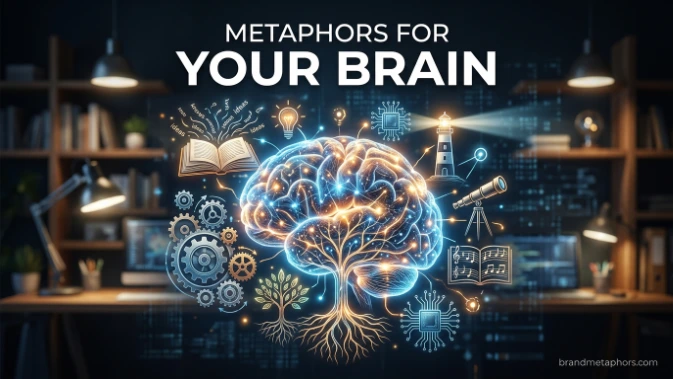
A Mind Like a Flickering City at Night
At 2 a.m., when the world quiets down, your brain doesn’t sleep the way you think it does.the hums. It flickers. It lights up like a distant city seen from a hilltop—roads glowing, intersections buzzing, shadows shifting behind illuminated windows.
Thoughts move like cars, sometimes smoothly, sometimes stuck in traffic. Memories blink like neon signs, drawing your attention whether you want them to or not.
This is your brain: alive, layered, endlessly active.
We often talk about the brain in clinical or scientific terms, but metaphors give us something richer. They help us feel what the brain does, not just understand it. Whether you’re a writer, a student, or simply someone trying to make sense of your thoughts, metaphors can turn the abstract into something vivid and usable.
In this article, you’ll explore powerful metaphors for your brain—each one offering a new way to understand how you think, feel, and create. Along the way, you’ll find examples, storytelling, and exercises to help you use these ideas in your own life and writing.
Why Use Metaphors for Your Brain?
Metaphors aren’t just decorative language—they’re tools.
When you say, “My brain is overloaded,” you’re already using a metaphor. You’re comparing your mind to a machine pushed beyond its limits. That simple comparison shapes how you respond: maybe you rest, maybe you slow down.
Using metaphors for your brain helps you:
- Understand complex mental processes
- Express emotions more vividly
- Improve writing and storytelling
- Gain control over stress and overthinking
A well-chosen metaphor can change your perspective in seconds. It’s like turning a kaleidoscope—same pieces, entirely different pattern.
Metaphor 1: Your Brain as a Busy Highway

Meaning & Explanation
Imagine your brain as a sprawling highway system. Thoughts are cars. Some move fast, some crawl, and some crash into each other. During calm moments, traffic flows smoothly. During stress, it becomes a jam—horns blaring, engines idling, frustration rising.
This metaphor captures how your mind handles multiple thoughts at once, especially under pressure.
Example Scenario
You’re trying to fall asleep, but your brain won’t stop:
“My brain is like a highway at rush hour—too many thoughts speeding past, none of them willing to exit.”
Alternative Expressions
- “My thoughts are stuck in a mental traffic jam.”
- “Ideas are racing through my mind like cars with no brakes.”
- “There’s too much noise on my mental road.”
Sensory & Emotional Details
You can almost hear it: engines revving, tires screeching, a distant siren. That tension mirrors anxiety or overwhelm.
Mini Story
A student sits at their desk before an exam. Every fact they studied is trying to surface at once. Instead of clarity, there’s chaos—like ten lanes merging into one. The more they panic, the worse the jam becomes.
Practice Exercise
- Write down 5 “cars” currently on your mental highway (thoughts, worries, ideas).
- Now imagine directing traffic: which ones slow down? Which ones exit?
Bonus Tip
Use this metaphor in social media captions:
“Today my brain feels like a highway at peak hour—so I’m pulling over to breathe.”
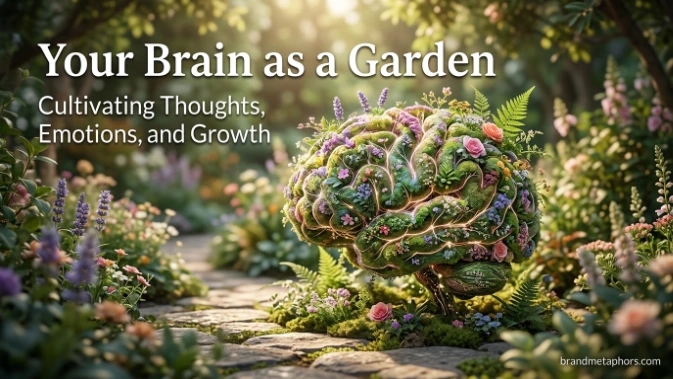
Metaphor 2: Your Brain as a Garden
Meaning & Explanation
Think of your brain as a garden. Thoughts are plants. Some grow into beautiful flowers, others into stubborn weeds. What you water grows.
This metaphor emphasizes control, patience, and intentional thinking.
Example Scenario
You’re trying to stay positive but keep spiraling:
“I need to stop watering the weeds in my mind.”
Alternative Expressions
- “My thoughts need pruning.”
- “I’m planting better ideas in my head.”
- “Negativity is taking root.”
Sensory & Emotional Details
Picture damp soil under your fingers, the smell of earth after rain, sunlight warming leaves. It feels calm, slow, nurturing.
Mini Story
An artist struggles with self-doubt. Every time they start a new piece, a voice says, “You’re not good enough.” Over time, they realize they’ve been watering that thought daily. So they start replacing it: “I’m learning.” Slowly, a new plant grows.
Practice Exercise
- List 3 “weeds” (negative thoughts).
- List 3 “flowers” (positive or helpful thoughts).
- Ask yourself: which ones are you watering more?
Bonus Tip
In writing, use seasonal imagery:
“Winter settled in my mind, but I knew spring would come.”
Metaphor 3: Your Brain as a Library

Meaning & Explanation
Your brain is a vast library. Memories are books. Some are neatly organized, others misplaced. Sometimes you can’t find what you need—not because it’s gone, but because it’s buried.
This metaphor highlights memory, learning, and retrieval.
Example Scenario
You forget something important:
“It’s like the memory is in my library—I just can’t find the right shelf.”
Alternative Expressions
- “My mind is flipping through dusty pages.”
- “That memory is archived somewhere deep.”
- “I need to reorganize my mental shelves.”
Sensory & Emotional Details
Think of quiet aisles, the smell of old paper, soft footsteps echoing. There’s a sense of depth and history.
Mini Story
An elderly man tries to recall his childhood home. At first, nothing comes. Then slowly—like opening an old book—the details return: the creaky door, the smell of tea, the sound of laughter.
Practice Exercise
- Close your eyes and “walk” through your mental library.
- What section are you in? Childhood? Work? Dreams?
- Pick one “book” and describe it.
Bonus Tip
Great for storytelling:
“She kept that memory locked in a corner of her mind’s library, untouched for years.”
How Metaphors Shape Your Thinking
The metaphors you choose aren’t random—they influence your mindset.
as ling as your brain is a “battlefield,” you may feel conflict. If it’s a “garden,” you may feel control. If it’s a “storm,” you may expect chaos.
Changing your metaphor can change your emotional response. That’s powerful.
Using Brain Metaphors in Writing
Writers use metaphors to:
- Make abstract ideas concrete
- Create emotional impact
- Build imagery and tone
Instead of saying:
“I felt overwhelmed.”
You could say:
“My brain became a crowded highway, every thought honking for attention.”
It’s more vivid, more memorable.
Using Brain Metaphors in Daily Life

You don’t need to be a writer to use these.
Try saying:
- “I need to clear some mental traffic.”
- “I’m planting better thoughts today.”
- “Let me check my mental files.”
These phrases help you understand and communicate your inner state.
Interactive Prompts to Spark Creativity
Try these exercises:
Prompt 1
“If my brain were a place, it would be…”
Describe it in detail.
Prompt 2
“What kind of weather is in my mind today?”
Stormy? Sunny? Foggy?
Prompt 3
“What is one metaphor that describes my thoughts right now?”
Write a sentence using it.
Bonus Tips for Social Media & Content Creation
- Use relatable metaphors for engagement
- Keep them short and visual
- Pair them with emotion
Example:
“My brain feels like a browser with 100 tabs open—and I can’t find the one playing music.”
Expanding Your Metaphor Toolkit
Don’t stop at three. Your brain can also be:
- A computer (processing, crashing, rebooting)
- A stage (thoughts performing)
- An ocean (deep, unpredictable)
- A machine (efficient or overloaded)
The more metaphors you explore, the more ways you have to understand yourself.
Frequently Asked Questions (FAQs)
1. Why are metaphors important for understanding the brain?
Metaphors simplify complex ideas and make them easier to relate to emotionally and mentally.
2. Can metaphors actually change how I think?
Yes. The way you describe your thoughts influences how you experience and manage them.
3. Which metaphor is best for reducing stress?
The “garden” metaphor is often helpful because it promotes calm, control, and growth.
4. How can I create my own brain metaphors?
Think about how your mind feels, then compare it to something familiar—nature, places, or objects.
5. Are metaphors useful in professional writing?
Absolutely. They make content more engaging, memorable, and easier to understand.
Conclusion
Your brain is not just an organ—it’s an experience. A shifting, glowing, growing world inside you. at time it’s a highway, loud and overwhelming. Sometimes it’s a garden, quiet and full of potential. Sometimes it’s a library, holding stories you haven’t yet opened.
Metaphors give you a way to navigate that world.
They help you pause, reflect, and reshape your thoughts. They turn confusion into clarity, chaos into imagery, and feeling into language.
So the next time your mind feels too full, too loud, or too distant—ask yourself:
What is my brain like right now?
The answer might just help you understand it better.