
A Morning That Smells Like Possibility
The sun hasn’t fully risen yet, but the air already hums with quiet energy. A bicycle leans against a wall, its tires still dusty from yesterday’s adventures. Somewhere, laughter bursts open like a window. Youth feels like this moment—unfinished, glowing, full of motion before direction.
That’s the magic of being young: it resists definition, yet begs to be described. And this is where metaphors come alive.
In this article, we’ll explore metaphors for “young”—not just as poetic tools, but as ways to capture energy, innocence, growth, and potential. Whether you’re a writer, student, or someone who simply loves language, these metaphors will help you express youth with clarity, beauty, and originality.
What Does “Young” Really Mean?
“Young” isn’t just about age. It’s about newness, curiosity, vulnerability, and boundless energy. A person can be young in spirit even in old age, or feel ancient despite being a teenager.
Metaphors allow us to stretch this meaning. They help us paint youth not as a number, but as an experience.
Think of phrases like:
- “Young as spring”
- “A blank canvas”
- “A spark waiting to catch fire”
Each one tells a deeper story.
Why Use Metaphors for Youth in Writing and Life?
Metaphors make your language:
- More vivid (readers can see and feel your words)
- More emotional (they connect ideas to human experience)
- More memorable (imagery sticks longer than plain facts)
When describing youth, metaphors are especially powerful because youth itself is full of change, energy, and imagination.
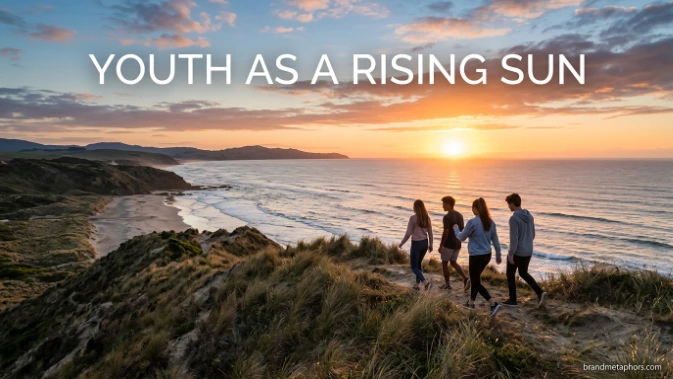
Metaphor #1: Youth as a Rising Sun
Meaning & Explanation
Comparing youth to a rising sun highlights fresh beginnings, warmth, and growing strength. Just like the sun climbs slowly but surely, young people are in the process of becoming.
Example Scenario
“She walked into the room like a rising sun, her presence quiet but impossible to ignore.”
Alternative Ways to Express It
- “A dawn breaking over the horizon”
- “Morning light spilling into the world”
- “The first glow of day”
Sensory & Emotional Details
Think golden light, cool morning air, and the promise of something new. It feels hopeful, calm, and quietly powerful.
Mini Storytelling
A teacher watches a shy student slowly gain confidence over months. By the end of the year, that student shines—just like the sun finally reaching full brightness.
Metaphor #2: Youth as an Unwritten Book
Meaning & Explanation
This metaphor emphasizes potential and possibility. A young person hasn’t yet written their story—they hold endless chapters within them.
Example Sentence
“He was an unwritten book, every page waiting for ink.”
Alternative Expressions
- “A blank canvas”
- “An empty stage before the play begins”
- “A story still finding its voice”
Sensory & Emotional Details
Imagine crisp white pages, the smell of fresh paper, the anticipation of the first word.
Cultural Touch
Writers often describe youth this way because storytelling itself mirrors life. Each decision becomes a sentence; each year, a chapter.
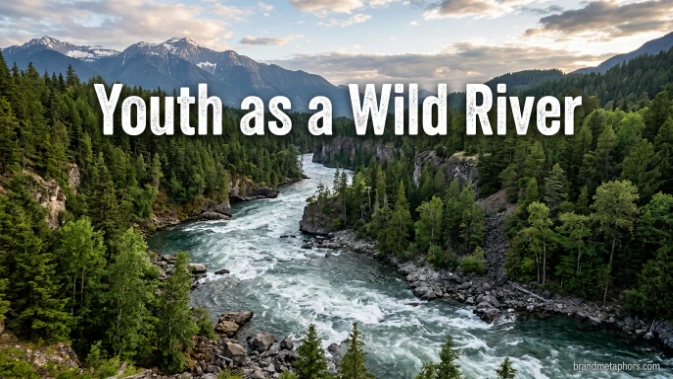
Metaphor #3: Youth as a Wild River
Meaning & Explanation
Youth can be unpredictable, energetic, and difficult to control—just like a rushing river.
Example Scenario
“The boy’s thoughts flowed like a wild river, impossible to contain.”
Alternative Ways to Express It
- “A storm of energy”
- “A whirlwind in motion”
- “A restless tide”
Sensory & Emotional Details
Hear the roar of water, feel the spray on your skin, sense the unstoppable momentum.
Real-Life Reflection
Teenagers often feel like this—full of emotion, speed, and intensity, not yet shaped by calm banks or direction.
Creative Ways to Build Your Own Metaphors for Young
Want to go beyond common phrases? Try these strategies:
1. Connect Youth to Nature
Nature is full of “young” imagery:
- Budding flowers
- Spring mornings
- Baby animals
2. Use Movement and Energy
Youth is rarely still:
- “A bouncing ball”
- “A flickering flame”
3. Focus on Growth and Change
Think transformation:
- “A seed becoming a tree”
- “Clay waiting to be shaped”
Mini Storytelling: A Classroom Full of Metaphors
Imagine a classroom where each student represents a different metaphor:
- One is a rising sun—quiet but glowing
- One is a wild river—loud and unstoppable
- One is an unwritten book—thoughtful and observant
The teacher doesn’t just see children. She sees stories, forces, beginnings.
That’s the power of metaphor—it transforms how we see people.
Interactive Exercises to Practice Metaphors for Young

Exercise 1: Finish the Sentence
Complete this in three different ways: “Youth is like ______ because ______.”
Exercise 2: Sensory Expansion
Pick a metaphor and add:
- A sound
- A color
- A feeling
Example: “Youth is a spark—bright orange, crackling, and warm with excitement.”
Exercise 3: Personal Reflection
Describe yourself (or your younger self) using a metaphor. Were you a storm? A seed? A sunrise?
Using Youth Metaphors in Writing and Social Media
For Writing
- Use metaphors in introductions to hook readers
- Add them to character descriptions
- Build themes around them
For Social Media
- “Feeling like a rising sun today 🌅”
- “Still an unwritten story—watch this space”
Bonus Tip
Don’t overuse metaphors. One strong image is more powerful than five weak ones.
Common Mistakes to Avoid
- Clichés without freshness: Add your own twist
- Overcomplication: Keep it clear and relatable
- Mixed metaphors: Don’t combine too many conflicting images
Example of a mixed metaphor: “He was a rising sun drowning in a storm of pages.” (confusing!)
Expanding Beyond Age: Youth as a Mindset

Youth isn’t limited to years. Some people carry youth in their:
- Curiosity
- Creativity
- Willingness to try
You can say:
- “Her ideas were young, full of wild color.”
- “His spirit stayed a rising sun, even in old age.”
More Fresh Metaphor Ideas for Young
Here are quick inspirations:
- A newly lit candle
- A kite catching its first wind
- A song just beginning
- A green leaf in spring
- A spark in dry wood
Each one captures a different shade of youth.
5 Frequently Asked Questions (FAQs)
1. What is a metaphor for young?
A metaphor for young compares youth to something else, like “a rising sun” or “a blank canvas,” to highlight qualities like growth or potential.
2. Why are metaphors important in describing youth?
They make descriptions more vivid, emotional, and memorable, helping readers connect deeply with the idea.
3. Can metaphors for young be used in everyday conversation?
Yes! Simple metaphors like “full of energy like a spark” work well in daily speech.
4. How can I create my own metaphors?
Think about qualities of youth (energy, growth, curiosity) and match them with similar images in nature or life.
5. Are metaphors only for creative writing?
No—they can be used in speeches, social media, teaching, and even casual conversations.
Conclusion
Youth is more than a stage—it’s a feeling, a force, a beginning. Through metaphors, we can capture its glow, its chaos, and its quiet promise.
Whether you describe it as a rising sun, an unwritten book, or a wild river, each metaphor reveals a different truth about what it means to be young.
So next time you write or speak, pause and ask: What does youth feel like to me?
Then turn that feeling into an image—and let your words come alive.