
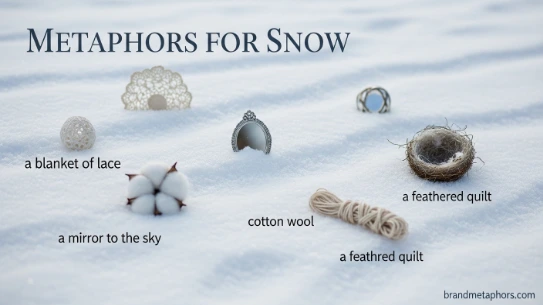
The first snow rarely arrives quietly. It slips into the world like a secret, soft and hushed, transforming the ordinary into something luminous. Rooftops wear white caps, trees hold delicate lace on their branches, and the air itself feels lighter, as if the sky has exhaled its dreams.
You step outside, and suddenly the crunch beneath your feet sounds like walking through a poem. Snow doesn’t just fall—it tells a story.
Metaphors for snow help us capture that story. They turn a simple weather event into something emotional, visual, and unforgettable.
Whether you’re writing creatively, crafting social media captions, or simply trying to express how winter feels, metaphors give your language texture and life. In this article, we’ll explore powerful metaphors for snow, understand their meanings, and learn how to use them effectively.
Why Metaphors for Snow Matter in Writing
Snow is more than frozen water—it’s a symbol. It can represent purity, silence, isolation, renewal, or even mystery. Without metaphors, describing snow often becomes repetitive: “cold,” “white,” “falling.” But with metaphors, snow becomes a blanket, a whisper, a canvas.
Using metaphors for snow allows you to:
- Evoke emotion and mood
- Create vivid imagery
- Add depth and symbolism to your writing
- Make your words more memorable
Think about it: “The snow fell softly” is fine. But “The snow fell like a lullaby over the sleeping town” stays with you.
1. Snow as a Blanket: Comfort and Silence
Meaning and Explanation
One of the most common and powerful metaphors is describing snow as a blanket. This comparison emphasizes warmth, stillness, and protection. Snow covers everything gently, muting noise and softening harsh edges.
Example Sentence
“By morning, the village was tucked beneath a thick blanket of snow, as if the world had been gently put to sleep.”
Alternative Expressions
- A quilt of snow
- A soft white covering
- A winter’s embrace
- A silent shroud
Sensory & Emotional Details
Imagine the muffled quiet after snowfall. Cars move slower, voices seem softer, and even the wind feels restrained. The “blanket” metaphor captures not just the visual but the emotional calm that follows.
Mini Storytelling Touch
Think of a child waking up, rushing to the window, and gasping at the sight—everything hidden under a smooth, white layer. The world feels paused, safe, almost magical.
2. Snow as Stardust: Magic and Wonder
Meaning and Explanation
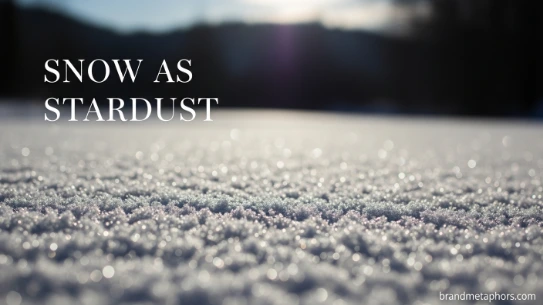
Comparing snow to stardust evokes magic, fantasy, and beauty. Each snowflake becomes something celestial, fragile, and rare.
Example Sentence
“Snow drifted down like stardust, turning the night into a quiet galaxy.”
Alternative Expressions
- Sky glitter
- Frozen stars
- Heavenly dust
- Silver sparkles
Sensory & Emotional Details
Picture snow falling at night under streetlights, each flake catching the glow. It feels surreal—like standing inside a dream. This metaphor is especially effective in poetic or romantic writing.
Cultural Reference
In many cultures, snow is linked to wonder and storytelling—like winter tales where magic feels closer. The stardust metaphor taps into that shared imagination.
3. Snow as a Canvas: Possibility and Transformation
Meaning and Explanation
Snow can be seen as a blank canvas, representing new beginnings, creativity, and untouched potential. It invites footprints, drawings, and stories.
Example Sentence
“The fresh snow stretched across the field like a blank canvas, waiting for the first mark of life.”
Alternative Expressions
- A white page
- Nature’s sketchbook
- A pristine surface
- A clean slate
Sensory & Emotional Details
There’s something deeply satisfying about being the first to step on untouched snow. The crunch, the imprint—it feels like making your mark on something pure.
Real-Life Example
Artists and photographers often use snowy landscapes to highlight contrast and simplicity. The “canvas” metaphor reflects this visual clarity and creative opportunity.
How to Create Your Own Snow Metaphors
Step 1: Observe the Feeling
Ask yourself: What does snow feel like? Peaceful? Lonely? Magical?
Step 2: Find a Comparison
Match that feeling to something familiar:
- Peaceful → blanket, lullaby
- Magical → stardust, fairy dust
- Isolated → desert, silence
Step 3: Add Detail
Instead of just saying “snow is like a blanket,” expand it: “Snow wrapped the city in a thick, quiet blanket that hushed even the busiest streets.”
Interactive Exercises: Practice Snow Metaphors
Exercise 1: Fill in the Blank
Complete this sentence with your own metaphor: “The snow fell like ________.”
Try to avoid common answers. Think creatively—maybe something unexpected like “forgotten letters from the sky.”
Exercise 2: Mood Matching
Write one metaphor for snow based on each mood:
- Happiness
- Sadness
- Mystery
Example:
- Happiness → “Snow danced like laughter in the air.”
- Sadness → “Snow fell like quiet tears from the sky.”
Exercise 3: Sensory Writing Prompt
Describe a snowy scene using all five senses:
- Sight: What does it look like?
- Sound: Is it quiet or crunchy?
- Touch: How does it feel?
- Smell: Is the air crisp?
- Taste: Can you imagine catching snowflakes?
Add at least one metaphor to your description.
Bonus Tips for Using Snow Metaphors Effectively
Keep It Fresh
Avoid overused phrases unless you add a twist. Instead of “white as snow,” try “white as a forgotten winter morning.”
Match the Tone
If your writing is dark or emotional, choose metaphors like “snow as ash” or “a silent graveyard.” For lighthearted writing, go with “marshmallow fluff” or “powdered sugar.”
Use in Social Media
Short and striking metaphors work best:
- “Snowfall feels like the sky whispering secrets.”
- “A world dipped in powdered sugar.”
Blend with Storytelling
Metaphors become stronger when tied to a moment: “As she waited by the window, the snow fell like unanswered questions, piling up in silence.”
Expanding Your Metaphor Toolbox
Here are a few more creative metaphors for snow to inspire you:
- Snow as feathers drifting from the sky
- Snow as sugar sprinkled over the earth
- Snow as silence made visible
- Snow as a dream settling on reality
- Snow as time slowing down
Each of these can be expanded into vivid descriptions depending on your purpose.
FAQs About Metaphors for Snow
What is a metaphor for snow?
A metaphor for snow is a figure of speech that describes snow by comparing it to something else, such as a blanket, stardust, or canvas, to create vivid imagery.
Why use metaphors for snow in writing?
Metaphors make descriptions more engaging, emotional, and memorable. They help readers visualize and feel the scene more deeply.
What are some simple metaphors for snow?
Common examples include:
- Snow as a blanket
- Snow as sugar
- Snow as feathers
How can I make my snow metaphors unique?
Focus on personal experiences, emotions, and unexpected comparisons. Avoid clichés or add creative twists to them.
Can snow metaphors be used in everyday writing?
Yes! They work well in stories, poems, captions, journals, and even casual conversations to make language more expressive.
Conclusion
Snow is never just snow. It’s a hush, a shimmer, a story waiting to be told. Through metaphors, you can turn a simple snowfall into something magical, emotional, or deeply symbolic. Whether you see it as a blanket of comfort, a sprinkle of stardust, or a blank canvas of possibility, the key is to let your imagination guide you.
So next time snow falls—whether outside your window or in your writing—pause for a moment. Watch how it moves, how it feels, how it transforms the world. Then, find the words that do it justice.
Because sometimes, the right metaphor doesn’t just describe snow—it makes us feel it.