
Introduction (150–200 words)
Fear rarely arrives with clear instructions. It does not knock politely or explain its purpose. Instead, it slips in quietly—like a sudden shadow stretching across a familiar room, or a cold breath brushing the back of your neck when nothing is there. Everyone has felt it in some form: before an exam, during a difficult conversation, while standing on the edge of a risky decision, or in the silence of the night when thoughts become louder than reality.
But fear is not just a feeling; it is also something we try to understand through language. That is where metaphors come in. We often describe fear as a monster, a storm, a shadow, or a locked door. These comparisons are not random—they help us make sense of something invisible and powerful.
Metaphors for fear matter because they shape how we experience it. If fear is a prison, we feel trapped. If it is a warning light, we feel guided. In this article, we will explore powerful metaphors for fear, what they reveal about human emotion, and how they can help us better understand and manage fear in everyday life.
Fear as a Language of Metaphors
Fear is difficult to define in simple terms because it is both physical and emotional. It shows up in the body—racing heart, tense muscles, shallow breath—and in the mind as worry, imagination, or anticipation of danger. Because it is so complex, humans naturally turn to metaphors to describe it.
When someone says “fear took over me,” they are not speaking literally. Instead, they are describing how fear feels like an outside force controlling their thoughts and actions. This use of metaphor helps us communicate something deeply internal in a shared and understandable way.
Metaphors also shape how we respond to fear. If fear is seen as a “signal,” we may listen to it. If it is seen as a “trap,” we may try to escape it. In this way, metaphors are not just words—they are mental tools that influence behavior.
Understanding fear through metaphor gives us clarity. It helps us separate what is real danger and what is emotional interpretation. Most importantly, it allows us to see fear not just as an enemy, but as a message that can be interpreted and managed.
Fear as a Shadow in a Dark Room
One of the most common metaphors for fear is the shadow in a dark room. Imagine walking through a quiet house at night. You notice shapes that seem unfamiliar. A coat on a chair becomes a figure. A curtain becomes movement. The fear is not in the objects themselves, but in how the mind interprets them.
Why This Metaphor Works
A shadow has no substance. It only exists because of light and positioning. Similarly, fear often grows in uncertainty, not reality. When information is missing, the mind fills in the gaps—often with worst-case scenarios.
Real-Life Meaning
This metaphor shows how fear can distort perception. Many everyday worries—like fear of failure or rejection—are “shadows” created by the mind. They feel real, but they are often exaggerated or incomplete.
Lesson
Turning on the “light” means gaining clarity: asking questions, seeking facts, or grounding ourselves in reality. The shadow disappears not by fighting it, but by understanding it.
Fear as an Internal Storm
Fear is often described as a storm raging inside the mind. In this image, thoughts are winds, emotions are thunder, and the body becomes a landscape shaken by emotional weather.
When fear hits strongly, it rarely feels calm. Thoughts speed up, imagination becomes dramatic, and physical sensations intensify. Like a storm, fear feels uncontrollable in the moment.
Emotional Impact
This metaphor highlights the chaotic nature of fear. Just as storms temporarily disrupt the environment, fear disrupts mental clarity. Decisions become harder, and focus weakens.
Human Experience
Before public speaking or major life decisions, people often describe “storm-like” feelings—sweaty palms, racing thoughts, and inner noise. These are not signs of weakness, but natural responses to perceived pressure.
Lesson
Storms pass. This metaphor reminds us that fear is temporary. It rises, peaks, and eventually settles. Recognizing this can prevent panic and encourage patience during emotional intensity.
Fear as a Locked Door
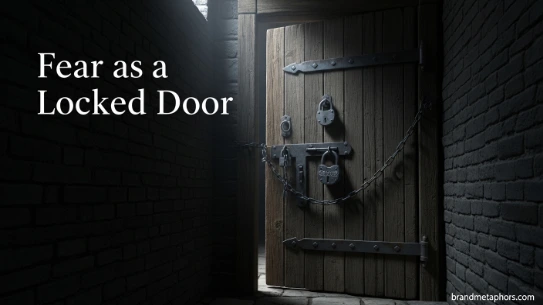
Fear is often imagined as a locked door standing between a person and what they want. Behind that door might be opportunity, growth, or change—but the lock represents uncertainty.
Meaning of the Locked Door
This metaphor reflects hesitation. We want to move forward, but something inside us says, “What if something goes wrong?” The door is not always physically closed; it is mentally restricted.
Real-Life Situations
Starting a new job, speaking up in a group, or trying something unfamiliar can feel like standing in front of a locked door. We may have the key, but fear makes us doubt using it.
Psychological Insight
Often, the “lock” is not external—it is internal doubt, fear of judgment, or fear of failure.
Lesson
Most locked doors are not truly sealed. They open when we take small steps, test possibilities, and realize the danger imagined is often smaller than expected.
Fear as a Heavy Chain
Fear is also described as chains or weight that holds a person back. In this metaphor, movement becomes difficult, and freedom feels reduced.
When people experience fear of failure or rejection, they often avoid action. This avoidance feels like being tied down by invisible chains.
Emotional Meaning
Chains represent restriction. Fear limits choices by convincing the mind that safety lies in staying still. Over time, this can reduce confidence.
Everyday Example
Someone who fears speaking in public may avoid opportunities, even when they are capable. The “chain” is not physical—it is psychological conditioning.
Insight
The chains are often made of thoughts: “I can’t,” “What if I fail?” or “People will judge me.”
Lesson
Breaking fear-chains requires action, even small ones. Movement weakens fear. Stillness strengthens it.
Fear as a Protective Alarm System
Not all metaphors for fear are negative. Fear can also be seen as an alarm system—like a fire alarm in a building. It alerts us to possible danger and demands attention.
Positive Side of Fear
This metaphor reframes fear as protection rather than punishment. It exists to keep us safe from harm or poor decisions.
Real-Life Function
Fear before crossing a busy road or entering a risky situation is helpful. It makes us cautious and aware.
Psychological Balance
The problem is not fear itself, but overactive fear. Like a broken alarm, it sometimes rings when there is no real danger.
Lesson
Instead of silencing fear completely, we should learn to interpret it. Ask: “Is this real danger or just uncertainty?”
Fear as a Monster or Illusion
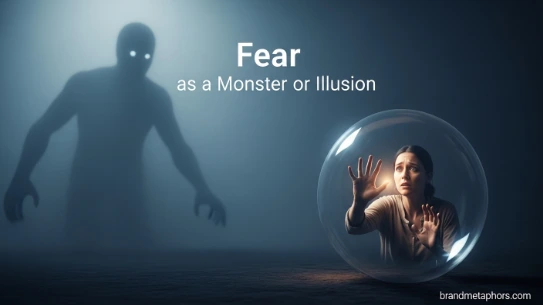
Fear is often imagined as a monster hiding in the dark. It feels large, threatening, and powerful—until we face it directly.
Why We See Monsters
The unknown is often exaggerated by imagination. The mind creates “monsters” to explain what it cannot understand.
Real-Life Example
A difficult conversation may feel terrifying in imagination, but once it happens, the fear often shrinks or disappears.
Deeper Insight
Fear grows in avoidance. The longer we avoid something, the bigger it appears.
Lesson
Facing fear often reveals that the “monster” was smaller than expected—or not real at all.
Fear as Frozen Water or Paralysis
Another powerful metaphor is fear as ice or frozen water. In this state, movement stops. Thoughts slow down, and action becomes difficult.
Emotional Meaning
Fear can freeze decision-making. Instead of reacting, people become stuck, unable to choose or act.
Everyday Experience
In stressful situations like exams or confrontations, some people experience “blank minds.” This is mental freezing.
Psychological Insight
Freezing is a survival response. The body is preparing for safety, but in modern life, it often becomes unhelpful.
Lesson
Warming up the mind requires small actions—breathing, speaking, or breaking tasks into steps.
Fear as a Whispering Voice
Fear is not always loud. Sometimes it is a whisper inside the mind saying, “You are not ready,” or “Something might go wrong.”
Nature of the Whisper
Unlike storms or monsters, this metaphor shows fear as subtle and persistent.
Real-Life Impact
This inner voice often influences decisions without us realizing it. It can stop us from trying new opportunities.
Psychological Insight
This voice is often shaped by past experiences, criticism, or learned doubt.
Lesson
Recognizing the voice of fear helps separate it from truth. Not every whisper is wisdom.
Fear in Daily Life Situations
Fear appears in many everyday experiences—exams, relationships, interviews, or social interactions. Each situation shapes fear differently.
Academic Fear
Students may fear failure, leading to stress and overthinking.
Social Fear
Fear of judgment can prevent people from expressing themselves.
Career Fear
Uncertainty about future decisions creates hesitation.
Insight
Fear is universal, but its form changes depending on context.
Lesson
Understanding the source of fear helps reduce its power. Naming fear makes it more manageable.
How Metaphors Help Us Overcome Fear
Metaphors are not just descriptions—they are tools for healing. They help us reinterpret fear in ways that reduce its power.
Changing Perspective
If fear is a “monster,” we feel threatened. If it is a “signal,” we feel informed.
Creating Distance
Metaphors allow emotional distance. Instead of becoming fear, we observe it.
Building Control
Understanding fear as something temporary or symbolic helps us respond rather than react.
Lesson
The right metaphor can transform fear from an enemy into a guide.
Conclusion
Fear is one of the most powerful human emotions, but it is also one of the most misunderstood. Through metaphors—shadows, storms, locked doors, chains, alarms, and whispers—we give shape to something invisible. These images help us explain what fear feels like, but more importantly, they shape how we respond to it.
Thay fear is seen as a monster, we run. When it is seen as a signal, we listen. When it is seen as a storm, we wait for it to pass. Each metaphor carries a lesson about control, awareness, and emotional balance.
Understanding fear through metaphors does not eliminate it, but it makes it clearer and less overwhelming. In that clarity, fear becomes less of a barrier and more of a message—one that can guide us rather than stop us.
FAQs
What are metaphors for fear?
Metaphors for fear are symbolic ways of describing fear, such as calling it a shadow, storm, or monster to explain how it feels.
Why do we use metaphors to describe fear?
Because fear is abstract and emotional, metaphors help make it easier to understand and communicate.
Is fear always negative?
No, fear can be helpful. It can act as a warning system that protects us from danger.
What does fear as a shadow mean?
It means fear often comes from uncertainty and disappears when we gain clarity or understanding.
How does fear affect daily life?
Fear can influence decisions, behavior, confidence, and emotional well-being in everyday situations.
Can metaphors help reduce fear?
Yes, changing how we describe fear can change how we experience and respond to it.
What is the healthiest way to deal with fear?
Acknowledging it, understanding its source, and taking small actions despite it.