
Introduction: When a Child’s Mind Becomes a Sky Full of Fireflies
A little girl once looked up during a summer evening and whispered, “The stars are tiny lanterns hanging in the sky.” No one had taught her that phrase. It simply bloomed from her imagination. In that moment, language became more than words—it became magic.
Children naturally think in pictures, feelings, and stories. They compare clouds to cotton candy, laughter to music, and fear to shadows under the bed. These comparisons are called metaphors, and they help children understand the world in playful, memorable ways.
Metaphors for children are more than pretty expressions. They strengthen creativity, emotional intelligence, communication skills, and storytelling ability. A child who says, “My anger is a volcano,” is learning how to describe feelings with clarity and imagination. Metaphors also make reading and writing richer, helping young minds connect emotions with images.
In this guide, you’ll explore vivid metaphors for children, creative examples, storytelling ideas, practical exercises, and writing tips. Whether you are a parent, teacher, student, or writer, these imaginative comparisons can open doors to wonder, understanding, and expression.
What Are Metaphors for Children?
A metaphor is a comparison that says one thing is another thing to create meaning or imagery. Instead of saying “He is very brave,” a metaphor might say, “He is a lion.”
Children love metaphors because they turn ordinary ideas into adventures. Suddenly, homework becomes a mountain to climb. Friendship becomes a warm blanket on a cold day. Imagination becomes a rocket ship.
Unlike complicated grammar lessons, metaphors feel natural to kids. They already speak in imaginative ways:
- “My backpack weighs a thousand pounds.”
- “The classroom was a zoo.”
- “Her smile was sunshine.”
These phrases create pictures in the mind. They help emotions and ideas feel alive.
Why Metaphors Matter for Kids
Metaphors help children:
- Improve creative thinking
- Express emotions clearly
- Develop storytelling skills
- Understand difficult concepts
- Build stronger vocabulary
- Enjoy reading and writing more
A child who learns metaphors also learns empathy. They begin seeing the world from different angles, which strengthens emotional understanding.
Metaphors for Children’s Imagination
Children’s imaginations are naturally limitless. Metaphors help shape that imaginative energy into vivid expression.
Example 1: “A Child’s Mind Is a Garden”
Meaning
This metaphor suggests that children’s thoughts grow when nurtured with care, curiosity, and learning.
Example Scenario
A teacher tells parents: “Every story you read plants another flower in your child’s garden.”
Alternative Expressions
- A child’s imagination is a forest full of secrets
- The mind is a treasure chest
- Creativity is a growing tree
Sensory Detail
Imagine bright flowers opening under sunlight after rain. That is how encouragement feels to a young learner.
Mini Storytelling Moment
Think about classic tales like Alice in Wonderland. Alice’s curiosity acts like a key opening hidden doors. Her imagination transforms ordinary moments into magical adventures.
Interactive Exercise
Ask a child: “If your imagination were a place, what would it look like?”
Encourage answers like:
- A candy kingdom
- A dragon cave
- A floating castle
This exercise builds metaphorical thinking naturally.
Animal Metaphors Kids Easily Understand
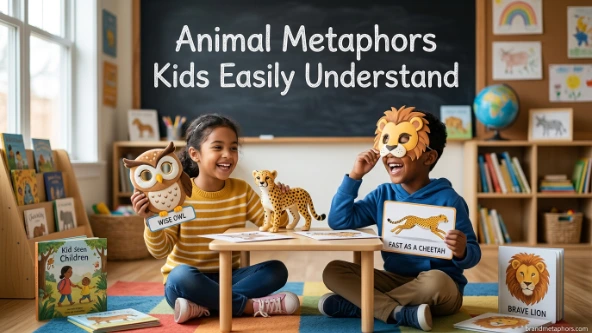
Animals are familiar, exciting, and emotionally expressive. That makes them perfect for metaphors.
Example 2: “He Is a Busy Bee”
Meaning
Someone who works hard or stays active.
Example Sentence
“Jacob cleaned his room, helped cook dinner, and finished homework. He was a busy bee all afternoon.”
Alternative Ways to Say It
- She’s a racing rabbit
- He’s an energetic puppy
- They’re ants building together
Emotional Detail
This metaphor feels cheerful and playful instead of demanding.
Example 3: “She Is a Wise Owl”
Meaning
Someone thoughtful or intelligent.
Scenario
A grandmother solving puzzles quickly might be called a wise owl.
Literary Connection
Owls often symbolize wisdom in stories and folklore, from ancient myths to fantasy novels.
Bonus Tip
Animal metaphors work wonderfully in classroom activities because children instantly connect images with emotions.
Nature Metaphors That Spark Wonder
Nature gives children endless inspiration. Trees, rivers, stars, and storms become emotional symbols.
Example 4: “Her Smile Was Sunshine”
Meaning
Her smile brought warmth and happiness.
Example Scenario
“When Maya entered the room, her smile was sunshine after a rainy day.”
Alternative Expressions
- His laugh was music
- Their kindness was a gentle breeze
- Friendship is a campfire in winter
Sensory Details
Warm golden sunlight on your skin. That comforting feeling becomes emotional imagery.
Example 5: “Fear Is a Thunderstorm”
Meaning
Fear can feel loud, overwhelming, and dark.
Example Sentence
“Before the spelling test, nervous thoughts rolled through his mind like thunder.”
Real-Life Reflection
Children often struggle to describe emotions directly. Nature metaphors give them safe, relatable language for difficult feelings.
School Metaphors Children Relate To
School is a major part of childhood, making it perfect territory for meaningful metaphors.
Example 6: “The Classroom Was a Zoo”
Meaning
The room felt noisy, wild, or chaotic.
Example Scenario
“After indoor recess, the classroom became a zoo.”
Alternative Expressions
- The hallway was a racetrack
- Homework is a mountain
- The library is an ocean of stories
Example 7: “Books Are Windows”
Meaning
Books let readers explore new worlds and perspectives.
Literary Reference
Many educators describe literature this way because stories allow children to “see” beyond their own experiences.
Interactive Prompt
Ask students: “If school were a place in nature, what would it be?”
Possible answers:
- A jungle full of discoveries
- A river carrying ideas
- A mountain trail of challenges
Emotional Metaphors for Children
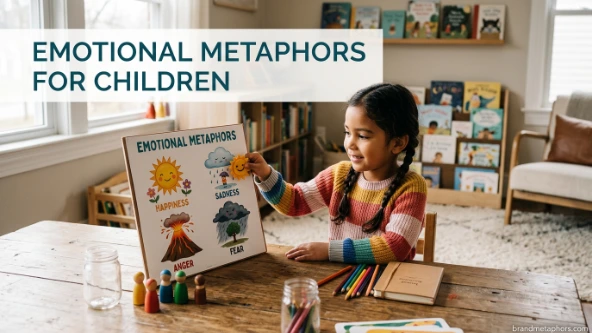
Emotions can feel confusing to children. Metaphors make feelings easier to identify and communicate.
Example 8: “My Anger Is a Volcano”
Meaning
Anger builds pressure and can suddenly explode.
Example Scenario
“After losing the game, his anger felt like a volcano ready to erupt.”
Alternative Expressions
- Sadness is a rainy cloud
- Happiness is fireworks
- Anxiety is buzzing bees
Example 9: “Loneliness Is an Empty Room”
Meaning
Loneliness feels quiet and isolated.
Sensory Description
Imagine footsteps echoing in a silent hallway. That emptiness mirrors emotional distance.
Why Emotional Metaphors Help
Children often act out emotions because they cannot explain them. Metaphors provide language for inner experiences.
A child saying “My worry is a backpack full of rocks” communicates emotional weight clearly and creatively.
Funny Metaphors Kids Love
Humor keeps children engaged. Silly metaphors make language memorable.
Example 10: “My Brother Is a Tornado”
Meaning
The brother creates chaos wherever he goes.
Example Sentence
“He ran through the living room like a tornado made of sneakers and noise.”
Alternative Expressions
- Dad snores like a tractor
- The baby is a tiny alarm clock
- My room is a dinosaur disaster zone
Mini Storytelling Idea
Picture a child trying to clean a room while a younger sibling “tornado” spins through tossing socks into the air. Suddenly, a simple metaphor becomes a vivid comedy scene.
Bonus Writing Tip
Funny metaphors are excellent for:
- Children’s stories
- Social media captions
- Classroom writing prompts
- Family journals
Metaphors for Friendship and Kindness
Friendship is one of the deepest experiences in childhood. Metaphors help children express connection and trust.
Example 11: “A Friend Is a Lighthouse”
Meaning
A good friend guides and supports you during difficult times.
Example Scenario
“When I felt nervous at my new school, Emma became my lighthouse.”
Alternative Ways to Express It
- Friendship is glue
- Friends are stars in the dark
- Kindness is a bridge
Example 12: “Kind Words Are Seeds”
Meaning
Encouragement grows over time.
Sensory Detail
Imagine planting tiny seeds that later bloom into flowers. Kindness works the same way in human hearts.
Cultural Reflection
Many cultures teach kindness through metaphor-rich proverbs and stories. These comparisons make lessons memorable across generations.
Creative Activities for Teaching Metaphors to Children
Children learn best through play and imagination. Interactive activities make metaphor practice exciting.
Activity 1: Finish the Metaphor
Ask children to complete sentences like:
- My happiness is ________
- School feels like ________
- My dog is a ________
Encourage unusual answers. Creativity matters more than perfection.
Activity 2: Metaphor Drawing Game
Have children draw:
- What anger looks like
- What courage looks like
- What friendship looks like
This connects visual thinking with emotional language.
Activity 3: Story Starter Challenge
Give children metaphor prompts such as:
- “The moon was a silver balloon…”
- “The playground roared like…”
- “Her ideas were butterflies…”
Then let them continue the story.
Bonus Tip for Teachers
Create a “Metaphor Wall” where students post imaginative comparisons throughout the year.
How Parents and Teachers Can Encourage Metaphorical Thinking
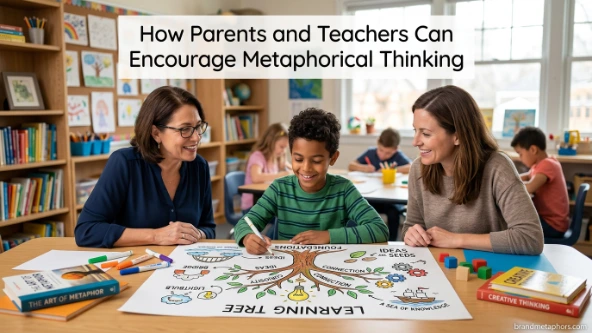
Metaphors should feel playful, not forced. The goal is curiosity, not perfection.
Encourage Observation
Ask questions like:
- “What does this cloud look like?”
- “What animal matches your mood today?”
- “If your homework were weather, what would it be?”
These prompts train imaginative thinking.
Read Rich Literature Together
Books filled with imagery naturally expose children to metaphorical language.
Poetry, fairy tales, and fantasy stories are especially powerful because they overflow with symbolic comparisons.
Celebrate Creative Answers
Never rush to correct imaginative phrasing. A child saying “The moon is a sleepy eye” is practicing poetic thinking.
Real-Life Example
Some of the world’s greatest writers began by noticing imaginative comparisons as children. Creative thinking grows stronger when adults nurture it instead of limiting it.
Using Metaphors in Writing, Social Media, and Daily Life
Metaphors are not only for literature. They enrich everyday communication.
In Creative Writing
Metaphors make stories more emotional and vivid.
Instead of: “The night was dark.”
Try: “The night wrapped around the town like a black velvet blanket.”
In Social Media Captions
Fun metaphors grab attention quickly.
Examples:
- “My coffee is morning magic.”
- “This weekend was a roller coaster.”
- “Dreams are little sparks waiting for fire.”
In Everyday Conversations
Metaphors help children communicate feelings naturally:
- “My brain is tired spaghetti.”
- “Today felt like a race.”
Bonus Tip
Encourage children to keep a “Metaphor Notebook” filled with imaginative comparisons they hear or invent.
Common Mistakes to Avoid When Teaching Metaphors
Even creative language can become confusing if overused.
Avoid Overcomplicated Comparisons
Young children understand concrete images better than abstract ones.
Good: “Her laugh was music.”
Too complicated: “His thoughts were quantum echoes in the fabric of existence.”
Don’t Force Creativity
Some children need time before feeling confident with imaginative language.
Balance Humor and Meaning
Silly metaphors are fun, but they should still make sense emotionally or visually.
Keep Age in Mind
A preschooler and a teenager understand imagery differently. Choose comparisons appropriate for developmental stages.
FAQs About Metaphors for Children
1. What is a simple definition of a metaphor for kids?
A metaphor is a comparison that says one thing is another thing to make language more vivid and imaginative. For example, “Time is a thief.”
2. Why are metaphors important for children?
Metaphors help children improve creativity, emotional expression, communication skills, and storytelling ability. They also make reading and writing more engaging.
3. What are easy metaphor examples for children?
Simple examples include:
- “The classroom was a zoo.”
- “Her smile was sunshine.”
- “My brother is a tornado.”
4. How can teachers teach metaphors creatively?
Teachers can use drawing games, storytelling prompts, nature walks, poetry activities, and metaphor journals to encourage imaginative thinking.
5. At what age can children understand metaphors?
Many children begin understanding simple metaphors around ages 5–7, though deeper metaphorical thinking develops gradually with reading and life experience.
Conclusion
Metaphors are tiny bridges between imagination and understanding. They help children transform ordinary moments into colorful stories and emotions into vivid pictures. A playground becomes a jungle. Hope becomes a candle. Fear becomes thunder. Through metaphor, language begins to breathe.
More importantly, metaphors teach children to look beyond surfaces. They learn that words can carry feelings, images, and entire worlds inside them. This skill strengthens creativity not only in writing, but also in empathy, communication, and problem-solving.
Whether you are guiding a classroom, reading bedtime stories, or encouraging a young writer, metaphors can turn everyday conversations into sparks of wonder. A single imaginative phrase may stay with a child for years, glowing quietly in memory like a lantern in the dark.
So encourage children to compare, imagine, and describe boldly. Their minds are not just learning language. They are building worlds from it.