
Introduction: When Life Quietly Changes Its Shape
There are moments when life feels like a familiar room suddenly rearranged overnight. The chair is still there, the window still opens to the same street—but something is different. The air feels unfamiliar. You stand in the middle of it, unsure whether to step forward or step back.
Change in life rarely arrives with announcements. It slips in quietly, like shifting seasons, like tides that reshape the shore while we sleep. Sometimes it is gentle—a new job, a new friendship, a new mindset. Other times it is sharp and disruptive—a loss, a relocation, a turning point that forces you to become someone slightly new.
This is where metaphors become powerful. They give shape to what feels shapeless. They turn emotional fog into something we can see, hold, and understand. Metaphors for change in life help us make sense of transformation—not by simplifying it, but by making it more human.
In this article, we’ll explore vivid metaphors that capture the essence of life’s changes, along with stories, exercises, and creative prompts to help you use them in writing, reflection, and daily life.
Metaphors for Change in Life: The River That Never Stops Flowing
One of the most enduring metaphors for change is the river. Life is a river—always moving, never still, reshaping everything it touches.
A river does not ask permission to flow. It moves around rocks, breaks through soil, widens, deepens, and sometimes dries into quiet stretches before roaring again. In the same way, life keeps moving forward even when we resist it.
Meaning and Explanation
This metaphor reminds us that change is natural and unavoidable. It encourages acceptance rather than resistance.
Example Sentence
“I used to fear change, but now I see life as a river—I can’t stop it, I can only learn how to swim in it.”
Alternative Expressions
- Life is a flowing stream
- Change is the current of existence
- We are carried by the waters of time
Emotional/Sensory Layer
Imagine standing beside a river at dusk. The water reflects fading light, constantly shifting, never repeating the same pattern. That’s your life—never still, always becoming.
Mini Story
A woman who lost her job once described her experience as “falling into the river without warning.” At first, she panicked, trying to cling to the bank. But eventually, she learned to float, then swim, and finally steer. Years later, she said, “That river didn’t drown me. It carried me somewhere better.”
Interactive Exercise
Write your own “river moment.” Answer:
- What change in your life felt like being pushed into water?
- Did you resist or float?
- What did the river eventually carry you toward?
Metaphors for Personal Transformation: The Butterfly Emerging From the Cocoon
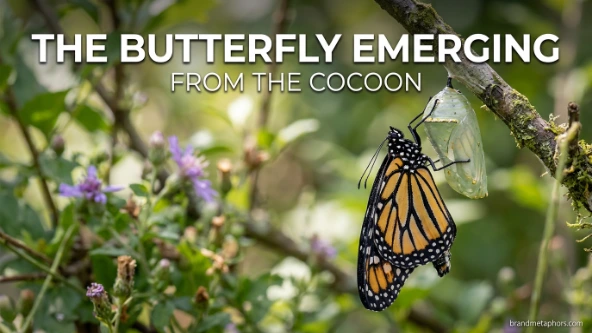
Another powerful metaphor for change in life is the butterfly emerging from its cocoon. It represents transformation that is slow, hidden, and often uncomfortable.
Inside the cocoon, nothing looks alive from the outside. Yet inside, everything is changing.
Meaning and Explanation
This metaphor symbolizes deep personal transformation that requires isolation, patience, and discomfort before growth becomes visible.
Example Sentence
“Her quiet year of healing was not wasted time—it was her cocoon phase before becoming something entirely new.”
Alternative Expressions
- Becoming a butterfly after silence
- Life reshaping itself in the dark
- Transformation through stillness
Emotional/Sensory Layer
There is tightness in the cocoon. Pressure. Waiting. Then suddenly, release—the fragile wings unfold into air for the first time.
Cultural Reference
Many spiritual traditions compare human growth to metamorphosis. The idea that struggle is not failure but preparation appears across philosophies worldwide.
Mini Story
A young artist stopped painting for two years after criticism crushed her confidence. From the outside, it looked like she had given up. But she was inside her cocoon. When she returned, her art carried depth she never had before. She said, “I didn’t stop becoming. I was just changing shape.”
Interactive Exercise
Think of a “cocoon phase” in your life:
- When did you feel invisible or stuck?
- What quietly changed inside you during that time?
- What “wings” did you develop?
Metaphors for Life Transitions: The Seasons That Never Stay the Same
Life, like nature, moves through seasons—spring, summer, autumn, and winter. Each season represents a phase of change.
Spring is beginnings. Summer is growth. Autumn is letting go. Winter is rest and reflection.
Meaning and Explanation
This metaphor shows that life changes are cyclical, not linear. Every ending leads to a beginning.
Example Sentence
“She stopped fearing endings when she realized she was just entering her winter season—not her final chapter.”
Alternative Expressions
- Life moves in seasons
- Change is seasonal, not permanent
- Every winter holds a hidden spring
Emotional/Sensory Layer
Think of autumn leaves falling—quiet, golden, inevitable. There is sadness, but also beauty in letting go.
Mini Story
A man who retired early felt lost at first. He thought his “summer” was over. But over time, he discovered winter’s purpose: reflection, storytelling, teaching younger people. He realized, “Winter is not death. It is rest before life begins again.”
Interactive Exercise
Map your life into seasons:
- What phase are you in right now?
- What season did you just leave?
- What season might be approaching?
Metaphors for Unexpected Change: The Earthquake Beneath Familiar Ground
Some changes don’t flow gently or grow slowly—they shake everything at once. An earthquake metaphor captures sudden, disruptive transformation.
Meaning and Explanation
This metaphor represents life changes that are unexpected, destabilizing, and force immediate adaptation.
Example Sentence
“Her breakup felt like an earthquake—everything familiar cracked, even the parts she thought were unbreakable.”
Alternative Expressions
- Life shifts like tectonic plates
- Sudden emotional tremors
- Ground-level changes in existence
Emotional/Sensory Layer
The sensation of instability. Walls trembling. Foundations breaking. Nothing feels safe—but afterward, a new landscape appears.
Mini Story
After a company collapse, an employee lost his career overnight. At first, it felt like disaster. But that earthquake forced him to rebuild in a direction he never considered—starting his own business.
Interactive Exercise
Reflect on your “earthquake moment”:
- What belief or structure collapsed?
- What did you rebuild afterward?
- What strength did you discover?
Metaphors for Growth in Change: The Tree That Learns to Bend
A tree doesn’t resist storms—it bends with the wind.
Meaning and Explanation
This metaphor teaches adaptability. Strength is not rigidity; it is flexibility.
Example Sentence
“He learned that being strong didn’t mean standing still—it meant bending like a tree in the storm.”
Alternative Expressions
- Flexibility over resistance
- Rooted but not rigid
- Strength through movement
Emotional/Sensory Layer
Wind howling through branches. Leaves shaking. But roots holding steady beneath the soil.
Mini Story
A student struggling with academic pressure learned to adjust her expectations instead of breaking under them. She became like a tree—flexible in storms, grounded in purpose.
Interactive Exercise
Ask yourself:
- Where in your life are you too rigid?
- What would it look like to “bend” instead of break?
Metaphors for Emotional Change: The House Being Renovated
Life changes can feel like living inside a house under construction.
Meaning and Explanation
This metaphor represents internal transformation—messy, noisy, but purposeful.
Example Sentence
“Her healing felt like living in a house being rebuilt while she was still inside it.”
Alternative Expressions
- Emotional renovation
- Rebuilding inner foundations
- Mental remodeling
Emotional/Sensory Layer
Dust in the air. Walls half-painted. Furniture moved. Discomfort—but also anticipation.
Mini Story
After therapy, a man said, “I didn’t realize my thoughts were being redesigned until I started feeling differently inside my own mind.”
Interactive Exercise
Write:
- What “rooms” inside you need renovation?
- What old structures no longer serve you?
Metaphors for Life Direction: The Road That Splits Without Warning

Life often presents crossroads—moments when paths divide.
Meaning and Explanation
This metaphor shows decision-making during change and uncertainty.
Example Sentence
“I stood at the road split, realizing both directions would change me.”
Alternative Expressions
- Life at a crossroads
- Diverging paths of destiny
- Branching journeys
Emotional/Sensory Layer
Dusty roads, silence before choice, the weight of uncertainty.
Interactive Exercise
Think of a past or upcoming decision:
- What are your “two roads”?
- What does each path represent emotionally?
Metaphors for Inner Change: The Sky That Shifts Color Without Warning
The sky changes constantly—sunrise, noon, dusk, night. Yet it remains the sky.
Meaning and Explanation
This metaphor reflects identity during change: we change, but we remain ourselves.
Example Sentence
“Even in her transformation, she realized she was still the same sky—just different colors.”
Alternative Expressions
- Changing skies of selfhood
- Emotional weather patterns
- Identity in motion
Mini Story
A writer who reinvented her career said, “I thought I had become someone new, but I was just another shade of the same sky.”
Interactive Exercise
- What parts of you stay constant?
- What parts shift like colors?
Using Metaphors for Change in Writing, Social Media, and Life
Metaphors are not just literary tools—they are emotional shortcuts that help others feel what you feel.
Writing Tips
- Use one strong metaphor per idea (avoid mixing too many)
- Connect metaphors to sensory detail (sound, sight, touch)
- Anchor abstract emotions in physical imagery
Social Media Use
- “This season feels like winter, but I know spring is coming.”
- “I’m learning to bend like a tree in storms.”
- “Life is a river—I’m still learning how to float.”
Daily Life Application
When facing change, ask:
- What metaphor best describes this moment?
- Am I in a storm, a cocoon, or a river?
This reframes emotional confusion into something understandable.
Conclusion
Life never stays still long enough to be fully understood in one moment. It moves, shifts, breaks, rebuilds, and surprises us again and again.
But metaphors give us language for what otherwise feels wordless. A river teaches flow. A butterfly teaches patience. Seasons teach cycles. Earthquakes teach resilience. Trees teach flexibility. Houses teach rebuilding. Roads teach choice. Skies teach identity.
When we begin to see life through metaphors for change, we stop asking, “Why is this happening to me?” and start asking, “What is this becoming?”
And that shift alone is a form of growth.
FAQs: Metaphors for Change in Life
1. Why are metaphors useful for understanding life changes?
Metaphors simplify complex emotions, making them easier to understand, express, and process.
2. What is the most common metaphor for change?
The river is one of the most common metaphors because it represents continuous movement and flow.
3. Can metaphors help with emotional healing?
Yes. They help people reframe painful experiences into meaningful narratives.
4. How can I create my own metaphors for life change?
Think of natural elements (water, sky, trees) and connect them to your emotional experience.
5. Where can I use metaphors in daily life?
You can use them in journaling, storytelling, conversations, or even social media posts.