
Metaphors for Cats: A Quiet Knock at the Door of Imagination
There is a moment many cat owners know well: the room is still, the world feels ordinary, and then—without warning—a shape slips across the edge of vision. A cat moves like spilled ink across paper, silent but impossible to ignore. One second it is nothing, and the next it is presence itself.
A cat doesn’t simply enter a space; it rewrites it.
This is why metaphors for cats have fascinated writers, poets, and everyday storytellers for centuries. Cats are not just animals in language—they become symbols of mystery, independence, elegance, unpredictability, and quiet intelligence. When we compare something to a cat, we are not just describing it; we are giving it personality, mood, and emotional depth.
In this article, we’ll explore powerful cat metaphors, their meanings, creative uses, storytelling potential, and how you can apply them in writing, social media captions, or even daily conversation. Think of it as learning a new way to “see” language—through soft paws and sharp eyes.
Understanding Metaphors for Cats in Language and Writing
At its core, a metaphor is a comparison that doesn’t use “like” or “as.” Instead of saying something is similar to a cat, we say it is a cat in spirit.
So when we say:
- “Her thoughts were a cat in the dark room,”
we are not being literal. We are suggesting her thoughts are:
- silent
- unpredictable
- hard to grasp
- moving with instinct rather than logic
Metaphors for cats are especially powerful because cats themselves are layered creatures. They can be soft and affectionate one moment, distant and untouchable the next. That emotional contrast makes them perfect symbols for human feelings, personalities, and abstract ideas.
Writers use cat metaphors to express:
- mystery
- independence
- emotional distance
- elegance
- curiosity
- quiet power
Even ancient cultures treated cats as symbols of divine presence, protection, and secrecy. This cultural weight makes cat metaphors feel naturally rich and meaningful.
Cats as Shadows in Moonlight: A Metaphor for Mystery and Silence
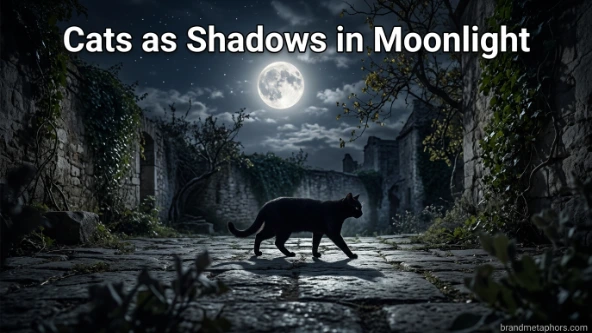
One of the most poetic metaphors for cats is:
“A cat is a shadow in moonlight.”
Meaning & Explanation
This metaphor highlights a cat’s silent movement, subtle presence, and almost supernatural ability to blend into darkness while still being visible. It represents mystery, elegance, and quiet awareness.
Cats don’t announce themselves—they arrive like thoughts you didn’t know you had.
Example Sentence
“Her presence in the room was a shadow in moonlight—soft, quiet, and impossible to ignore.”
Alternative Expressions
- A whisper with whiskers
- A moving silhouette of silence
- A night thought with eyes
Sensory & Emotional Detail
Imagine silver moonlight sliding across wooden floors. A cat passes through it, not breaking it, only shaping it for a moment. There is no sound, only awareness. It feels peaceful but slightly eerie—like something ancient watching from just beyond understanding.
Mini Storytelling Moment
In old Japanese folklore, cats were believed to be spiritual beings capable of slipping between worlds. A shadow in moonlight captures that belief perfectly: half here, half elsewhere, always observing.
Cats as Velvet Philosophers: A Metaphor for Calm Intelligence
“A cat is a velvet philosopher sitting on the edge of silence.”
Meaning & Explanation
This metaphor emphasizes a cat’s calm, thoughtful stillness. It suggests wisdom without noise, intelligence without urgency. Cats often seem like they are observing life with deep understanding but refusing to explain it.
Example Sentence
“He sat by the window like a velvet philosopher, watching the world without rushing to judge it.”
Alternative Expressions
- A soft thinker of still rooms
- A silent scholar of windowsills
- A furred observer of truth
Sensory & Emotional Detail
Picture a cat resting on a sunlit chair. Its fur looks like polished velvet. It does not move unless necessary. Its eyes track everything but reveal nothing. The emotional tone is calm, reflective, almost meditative.
Mini Storytelling Moment
In literature, cats often appear beside writers and poets. Think of Ernest Hemingway’s cats, famously roaming his home. They become symbols of quiet creativity—ideas that don’t shout, but wait patiently to be noticed.
Cats as Silent Hunters of Thought: A Metaphor for Focus and Precision
“A cat is a silent hunter of thought, stalking ideas before they escape.”
Meaning & Explanation
This metaphor focuses on a cat’s hunting instinct—its patience, precision, and sudden action. When applied to thinking or creativity, it represents focus, strategy, and mental sharpness.
Example Sentence
“During exams, his mind became a silent hunter of thought, catching answers before doubt could interfere.”
Alternative Expressions
- A focus-built predator of ideas
- A quiet tracker of insight
- A patient catcher of meaning
Sensory & Emotional Detail
Imagine a cat crouched low, eyes fixed, body still. Time feels suspended. Then—sudden motion. This emotional rhythm mirrors how inspiration sometimes works: long stillness followed by instant clarity.
Mini Storytelling Moment
Many writers describe creativity this way. Ideas don’t always arrive in storms—they arrive like cats hunting, waiting for the exact right moment to strike.
Literary and Cultural Meanings of Cat Metaphors
Across cultures, cats have always carried symbolic weight.
Amid ancient Egypt, cats were sacred guardians. In medieval Europe, they were both feared and admired. In modern literature, they often symbolize independence and emotional complexity.
Metaphors for cats appear in:
- poetry (as symbols of loneliness or grace)
- novels (as companions of introspective characters)
- folklore (as magical or supernatural beings)
For example, in poetry, a cat might represent:
- emotional distance in relationships
- hidden emotions behind calm behavior
- the dual nature of softness and danger
Writers often choose cats when they want to express something that cannot be fully explained—only felt.
Interactive Exercise: Create Your Own Cat Metaphors
Now it’s your turn to think like a writer.
Try these prompts:
- Describe your mood today as a cat metaphor.
- Example: “My mood is a cat stretched in sunlight—half asleep, half dreaming.”
- Turn an object into a cat-like image.
- Example: “The old clock was a cat waiting to leap into midnight.”
- Rewrite a memory using cat imagery.
- What would your childhood feel like if it were a cat?
Challenge Task
Write 3 original metaphors for cats describing:
- fear
- comfort
- curiosity
Don’t worry about perfection. Focus on feeling.
Using Cat Metaphors in Writing, Social Media, and Daily Life
Cat metaphors are not just for poetry—they are powerful communication tools.
In Writing
- Add emotional depth to characters
- Create atmosphere in scenes
- Replace plain descriptions with imagery
Instead of: “She was quiet.”
Try: “She moved through the room like a cat stitched from silence.”
In Social Media
Cat metaphors make captions more engaging:
- “Feeling like a midnight cat tonight—quiet but wide awake.”
- “Today I am a velvet philosopher, watching life unfold.”
In Daily Conversation
You can subtly enrich speech:
- “He’s in his cat mode today—observing everything, saying nothing.”
- “That idea just pounced on me like a cat.”
Bonus Tips for Crafting Strong Cat Metaphors
To make your metaphors more powerful:
- Focus on movement (cats never feel static)
- Use contrast (soft vs. sharp, quiet vs. sudden)
- Include sensory detail (fur, silence, eyes, shadow)
- Avoid over-explaining—let the image breathe
- Think emotionally, not logically
A good cat metaphor doesn’t just describe—it lingers.
Common Mistakes When Using Cat Metaphors
Even creative writing has pitfalls:
- Overusing clichés like “curious as a cat”
- Mixing too many images in one sentence
- Making metaphors too literal
- Forgetting emotional context
A strong metaphor should feel natural, not forced. If it sounds like a riddle, simplify it. If it feels flat, add sensory detail.
Conclusion
Cats are not just animals in language—they are mirrors for human complexity. They embody contradiction: softness and wildness, affection and independence, silence and intensity.
That’s why metaphors for cats remain timeless in writing and speech. They allow us to say things that ordinary words cannot hold. A cat becomes a way to describe not just the world, but the way we feel the world.
So the next time you see a cat slip through a doorway or curl into a patch of sunlight, pause for a moment. You are not just watching an animal—you are watching a metaphor waiting to be written.
FAQs About Metaphors for Cats
1. What are metaphors for cats used for?
They are used to describe emotions, behavior, and ideas using cat-like qualities such as mystery, independence, and elegance.
2. Why are cats popular in metaphors?
Because cats have complex personalities—calm yet wild, affectionate yet independent—which makes them perfect symbolic tools.
3. Can I use cat metaphors in academic writing?
Yes, especially in creative analysis or literary essays, but they should match the tone of the work.
4. What makes a good cat metaphor?
A good one includes strong imagery, emotional depth, and a clear connection between the cat behavior and the idea being described.
5. How can I improve my metaphor writing?
Practice observing real cats, focusing on their movement, silence, and personality, then translate those traits into abstract ideas.
If you’d like, I can also create poems, captions, or 100 short cat metaphors for social media or creative writing practice.