
Introduction (The Invisible Threads That Shape Us)
Walk through any busy street—whether it’s a small village bazaar or a glowing modern city—and you’ll feel something beyond noise, movement, and faces. There is an invisible rhythm shaping how people greet each other, how they dress, how they eat, and even how they think. Culture is not just something we live in; it is something that lives inside us, quietly guiding our choices like an unseen hand.
But how do we truly understand something so vast, layered, and invisible? This is where metaphors for culture become powerful. They turn abstract ideas into relatable images—helping us see culture as a mirror, a river, a garden, or even a machine. These metaphors don’t just decorate language; they shape understanding.
In real life, culture influences everything—from family traditions and education to communication styles and values. Yet many people struggle to define it clearly. By exploring metaphors, we can better grasp how culture grows, changes, and connects people across time and place. This article dives deep into those metaphors, revealing how they help us interpret human behavior, social systems, and shared identity in a more meaningful way.
Culture as a Mirror of Society
One of the most common metaphors for culture is the idea that it is a mirror of society. This suggests that culture reflects who we are—our values, beliefs, fears, and aspirations. Just like a mirror shows our physical appearance, culture reveals our collective identity.
When we look at art, language, or traditions, we are essentially seeing reflections of social reality. For example, festivals often mirror a society’s relationship with nature, religion, or history. In the same way, movies and music reflect social struggles, dreams, and changes in attitudes.
A Living Reflection
Unlike a static mirror, culture is dynamic. As society changes, the reflection also shifts. A culture that once valued strict traditions may gradually reflect modern ideas of individuality and freedom. This metaphor helps us understand that culture is not separate from us—it is created by us and constantly reshaped by human behavior.
Culture as a River That Flows Through Time
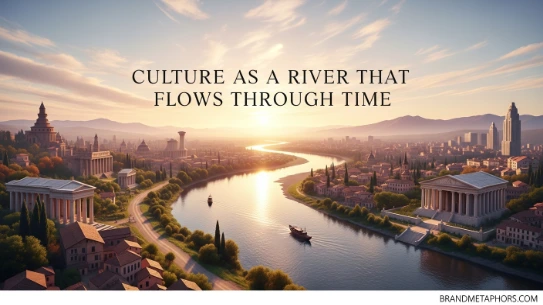
Another powerful metaphor is culture as a river. A river flows continuously, shaped by its environment, yet always moving forward. Similarly, culture flows from one generation to the next, carrying traditions, knowledge, and values.
The Current of Tradition
In this metaphor, traditions are like strong currents. They guide behavior and create stability. Even when society changes, these currents continue to influence how people think and act.
New Streams of Change
New ideas are like tributaries joining the river. They may come from technology, migration, or global communication. Over time, they reshape the flow without completely stopping it. This helps explain how cultures evolve while still maintaining continuity.
The river metaphor highlights both stability and change—two forces that define every culture.
Culture as a Garden of Diversity
Culture can also be seen as a garden, filled with different plants, colors, and growth patterns. Each plant represents a tradition, belief, or practice.
Growth and Care
Just like a garden needs care, culture needs nurturing through education, storytelling, and shared experiences. Without attention, some elements may fade, while others grow uncontrollably.
Diversity in Harmony
A healthy cultural garden is diverse. Different ideas and traditions coexist, sometimes blending and sometimes standing apart. This metaphor reminds us that cultural diversity is not disorder—it is a form of structured beauty.
Culture as a Web of Connections
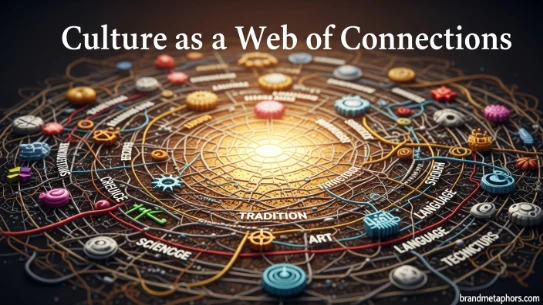
Culture is often described as a web, where every strand is connected to others. Language, religion, food, and customs are all interlinked.
If one strand moves, the entire web vibrates. For example, a change in education can influence family structures, which can affect communication styles.
Interdependence in Society
This metaphor highlights how no cultural element exists in isolation. Everything is connected—making culture both strong and delicate at the same time.
Culture as a Software Running Society
In the modern world, culture is sometimes compared to software that runs the “hardware” of society.
Programming Human Behavior
Just like software programs control how computers function, cultural norms guide human behavior. They influence how people greet each other, resolve conflicts, or define success.
Updating the System
Cultures can be “updated” through innovation, education, and global interaction. However, outdated cultural “code” can also cause conflict or resistance to change.
This metaphor helps explain how deeply embedded cultural systems are in daily life.
Culture as a Story Passed Through Generations
Culture can also be understood as a story—a long narrative written collectively by generations.
Chapters of History
Every generation adds a new chapter to this story. Wars, discoveries, traditions, and migrations all become part of the narrative.
Personal Roles in the Story
Each individual is both a reader and a writer of culture. The way we live contributes to the ongoing story, even if in small ways.
This metaphor emphasizes meaning, continuity, and identity.
Culture as a Lens That Shapes Perception
Culture is often described as a lens through which we see the world. It shapes how we interpret reality.
Different Lenses, Different Views
Two people may witness the same event but interpret it differently based on cultural background. What is respectful in one culture may be unusual in another.
Awareness of Perspective
Understanding this metaphor encourages empathy. It reminds us that our view is shaped—not absolute.
Culture as a Machine with Interlocking Parts
Culture can also be seen as a machine, where different components work together to keep society functioning.
Social Systems in Motion
Family systems, education, religion, and economy are like gears. When one gear slows down or breaks, the entire machine is affected.
Efficiency and Balance
A well-functioning culture maintains balance between its parts. This metaphor helps explain how societies stay organized.
Culture as a Fabric Woven Together
Imagine culture as a fabric, woven from countless threads of experience, tradition, and belief.
Threads of Identity
Each thread represents a group, community, or tradition. Together, they form a strong and complex fabric.
Strength in Unity
Even if one thread weakens, the fabric can still hold, showing resilience. This metaphor highlights unity within diversity.
Culture as a Stage of Human Behavior
Culture can be viewed as a stage, where people perform roles shaped by social expectations.
Roles and Expectations
On this stage, individuals act as students, parents, leaders, or workers. Each role follows cultural “scripts.”
Behind the Curtain
However, behind these roles are personal identities that may not always match societal expectations. This metaphor reveals the tension between individuality and social structure.
Culture as a Living Organism
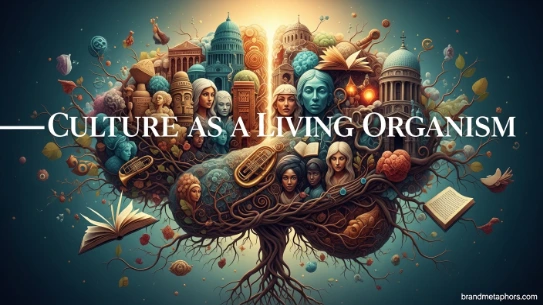
One of the most powerful metaphors is culture as a living organism that grows, adapts, and evolves.
Adaptation and Survival
Cultures that adapt to change survive, while those that resist may struggle. This mirrors biological evolution.
Internal Systems
Like an organism, culture has systems—communication, traditions, and values—that work together to sustain life.
Culture as a Journey Through Time
Culture can also be seen as a journey, where humanity moves through time, carrying memories and experiences.
Paths Taken and Not Taken
Different societies take different paths, shaping unique cultural identities.
Continuous Movement
This metaphor emphasizes that culture is never static—it is always moving forward, shaped by choices and circumstances.
Culture as a Flame Passed Forward
Finally, culture can be imagined as a flame passed from one generation to the next.
Keeping the Flame Alive
Parents, teachers, and elders pass cultural knowledge like a torch. It must be carefully preserved and shared.
Risk of Extinction
If not maintained, the flame can fade. This metaphor highlights responsibility in preserving cultural heritage.
Conclusion
Culture is not a single definition but a collection of meanings that shape how we live and understand the world. Through metaphors like mirrors, rivers, gardens, and living organisms, we gain deeper insight into its complexity. These images help transform an abstract concept into something tangible and relatable. They show us that culture is both stable and changing, personal and collective, visible and invisible.
Understanding metaphors for culture allows us to see beyond surface differences and recognize shared human patterns. It encourages empathy, awareness, and appreciation of diversity. Ultimately, culture is not just something we inherit—it is something we continuously create together, moment by moment, generation by generation.
FAQs
What are metaphors for culture?
Metaphors for culture are simple comparisons used to explain complex cultural ideas, like culture as a river, mirror, or garden.
Why are metaphors used to explain culture?
They make abstract ideas easier to understand by linking them to familiar images and experiences.
Is culture always changing?
Yes, culture evolves over time as people, technology, and societies change.
Can different cultures exist in one society?
Yes, many societies are multicultural, meaning multiple cultures coexist and interact.
Why is culture important in daily life?
Culture shapes behavior, communication, values, and how people interact with the world.
How does culture influence identity?
Culture helps form personal and group identity by shaping beliefs, traditions, and lifestyles.
Can individuals change culture?
Yes, individuals can influence culture through actions, creativity, and social change.
What is the easiest way to understand culture?
Using metaphors like stories, rivers, or gardens helps simplify and visualize cultural ideas.