
Introduction
Imagine a dimly lit stage where silence hangs in the air like a held breath. Then, slowly, music begins—not loud, but steady, like a heartbeat waking up. A dancer steps forward. One movement follows another, not as random gestures, but as if the body is telling a story words could never fully capture. All spin feels like a sentence. Every pause feels like punctuation. Every leap feels like a question thrown into the air.
This is where metaphors for dance begin to matter. Dance is not just movement; it is language without words, emotion without speech, and storytelling without ink. People often struggle to describe what dance truly represents, so they turn to metaphors—bridges between feeling and understanding. We say dance is like flying, like painting in the air, like a conversation between body and rhythm. These metaphors help us interpret something deeply human yet difficult to define.
Understanding metaphors for dance matters because it changes how we see expression itself. It helps us connect with art, emotion, culture, and even our own bodies in a more meaningful way. Dance becomes more than performance—it becomes a reflection of life itself.
Dance as a Conversation Without Words
One of the most powerful metaphors for dance is that it is a conversation without words. When dancers move, they are not speaking in sentences, but they are still communicating. Their bodies respond to rhythm, space, and sometimes even to each other, like people exchanging thoughts in silence.
In partner dances, this becomes especially clear. One dancer leads, the other follows, yet both contribute equally to the dialogue. A shift in weight is like a reply. A pause is like listening. A sudden turn can feel like disagreement or surprise.
Even in solo dance, this metaphor still applies. The dancer is in conversation with the music, the floor, and even their own emotions. It becomes an inner dialogue expressed outwardly.
Real-Life Reflection
Think about moments when you move instinctively to music while no one is watching. That small sway or tap is your body responding to rhythm, almost like answering a question only you can hear. Dance, in this sense, is not performance—it is participation in a silent exchange.
Dance as Fire: Energy That Cannot Stay Still
Another vivid metaphor for dance is fire. Fire is alive, unpredictable, and constantly transforming—just like dance. It grows, softens, or explodes depending on energy, emotion, and rhythm.
A slow dance can feel like a glowing ember, steady and warm. A fast, intense routine can feel like flames rising high, wild and uncontrollable. Dancers often channel emotional intensity through movement, making fire an accurate reflection of their inner state.
Fire also consumes and releases, just as dancers give energy and receive it back from music and audience reaction. The stage becomes a space where emotion is burned into motion.
Emotional Insight
When someone dances with passion, it is often described as “burning with energy.” This is not just poetic—it reflects how movement can transform feeling into visible intensity. Jig, like fire, cannot remain contained for long; it demands expression.
Dance as Flight: Defying Gravity Through Expression
Dance is often compared to flying. Even though dancers never leave the ground for long, their movements create the illusion of weightlessness. Leaps, turns, and lifts all contribute to the feeling of escaping gravity.
Why This Metaphor Works
- Jumps feel like breaking free from physical limits
- Spins create a sense of floating
- Flowing movements resemble air currents
In ballet, this metaphor is especially strong. A dancer rising on pointe shoes appears to hover, defying logic and physics. Even grounded dance styles can feel airborne when movement is fluid and controlled.
Human Connection
We all understand the desire to rise above limitations—emotionally, mentally, or physically. That is why dance as flight resonates so deeply. It symbolizes freedom, escape, and possibility.
Dance as a Story Written in Motion
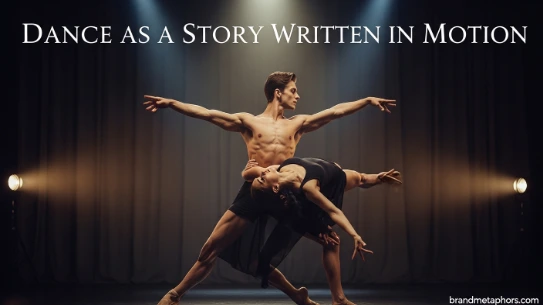
Dance is often described as storytelling without words. Each movement acts like a sentence, each sequence like a paragraph, and the entire performance like a narrative arc.
Elements of the Story
- Beginning: Introduction of emotion or theme
- Middle: Conflict, intensity, or development
- End: Resolution or transformation
A dancer might start with restrained movement, build into chaotic energy, and end in stillness. Without a single spoken word, an entire emotional journey unfolds.
Mini Story Example
A solo dancer begins curled on the floor, slowly rising as if waking from a memory. Their movements become sharper, more urgent, as if chasing something lost. Finally, they stop, hands open, accepting what cannot be changed. The audience understands the story without needing explanation.
Dance as Wind: Invisible but Always Felt
Wind is unseen, yet its presence is undeniable. Dance shares this quality. Even when movements are subtle, they create emotional impact that is felt rather than seen.
Soft hand gestures, slow turns, and gentle footwork can feel like a breeze passing through a room. Powerful movements, on the other hand, resemble strong gusts that shift emotional atmosphere.
Deeper Meaning
Wind also represents change. Dance, too, is constantly changing—never static, always evolving. Each performance is different, even when choreography remains the same, because emotion alters its direction.
Dance as a River Flowing Through Time
Dance can be seen as a river—continuous, flowing, and shaped by its surroundings. Movements do not exist in isolation; they connect seamlessly like water currents.
Characteristics of This Metaphor
- Smooth transitions between steps
- Continuous energy without interruption
- Adaptability to rhythm and space
Like a river, dance can be calm or powerful. It can twist, rush, or settle into quiet pools of stillness.
Life Connection
Just as rivers carve landscapes over time, dance shapes emotional experience. It teaches us that movement and change are natural parts of existence, not interruptions.
Dance as Painting in the Air
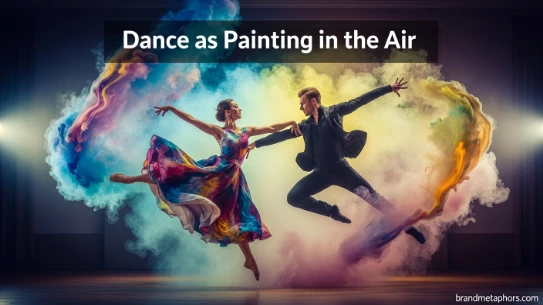
One of the most visual metaphors for dance is painting in the air. Instead of brushes and canvas, dancers use their arms, legs, and entire bodies to create shapes in space.
Every gesture leaves an invisible mark, like strokes of color that only exist for a moment before dissolving.
Artistic Perspective
- Arm movements = brushstrokes
- Body turns = sweeping lines
- Footwork = detailed texture
Jig becomes a living artwork, constantly being created and erased at the same time.
Dance as Emotion Made Visible
Dance is often described as emotion made visible. Feelings like joy, sorrow, anger, or love become physical expressions rather than internal experiences.
Emotional Translation
- Happiness becomes light, bouncing steps
- Sadness becomes slow, heavy movement
- Anger becomes sharp, forceful motion
Instead of hiding emotions, dance releases them into space where they can be seen and felt by others.
Human Insight
This metaphor explains why people often feel emotionally moved by dance even without understanding the technique. They are not just watching movement—they are witnessing emotion in motion.
Dance as a Game of Balance and Control
Dance can also be seen as a delicate balance between control and surrender. Dancers must maintain precision while also letting go enough to feel natural.
Key Balance Elements
- Strength vs softness
- Structure vs freedom
- Discipline vs expression
Too much control makes dance mechanical. Too much freedom makes it chaotic. The beauty lies in harmony between the two.
Dance as Memory in Motion
Every dance can be a reflection of memory. Movements often carry traces of personal or cultural history. A gesture might echo childhood play, tradition, or emotional experience.
How Memory Appears in Dance
- Repeated patterns resemble familiar habits
- Emotional movement reflects past experiences
- Cultural steps preserve collective identity
Dance becomes a way of remembering without words, turning memory into physical expression.
Dance as Silence That Speaks Loudly
Silence is not empty in dance—it is powerful. Pauses between movements can be just as expressive as motion itself.
The Power of Stillness
- Builds anticipation
- Emphasizes emotion
- Creates contrast with movement
A dancer standing completely still can hold an audience just as strongly as a fast sequence of steps. Silence becomes part of the choreography.
Dance as Transformation of the Self
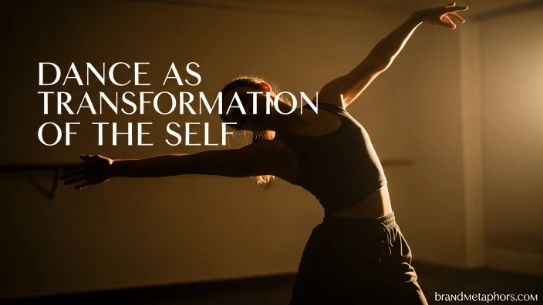
Perhaps the deepest metaphor for dance is transformation. Dancers do not remain the same throughout a performance—they shift emotionally, physically, and mentally.
Stages of Transformation
- Preparation: grounding and focus
- Expression: full emotional release
- Release: letting go of control
Dance becomes a journey where the self is temporarily reshaped by movement.
Conclusion
Metaphors for dance help us understand something that is inherently difficult to define. Dance is not just movement—it is conversation, fire, flight, storytelling, emotion, and transformation all at once. Each metaphor reveals a different layer of meaning, showing how deeply dance is connected to human experience.
Whether seen as flowing water, painted air, or silent speech, dance reflects the complexity of life itself. It teaches us that expression does not always require words and that meaning can exist in motion. In understanding these metaphors, we begin to see dance not just as performance, but as a living language of the body—one that speaks directly to emotion, memory, and imagination.
FAQs
What are metaphors for dance?
Metaphors for dance are symbolic comparisons used to describe dance in imaginative ways, such as calling it “flying,” “painting in the air,” or “a conversation without words.”
Why are metaphors used to describe dance?
They help explain emotional and abstract qualities of dance that are difficult to express through literal language.
Is dance really like a language?
Yes, dance communicates emotion and meaning through movement, similar to how language uses words and grammar.
Why is dance compared to fire?
Because both represent energy, transformation, and emotional intensity that cannot stay contained.
How does dance express emotion?
Through movement speed, body posture, rhythm, and intensity, which reflect different emotional states.
Can dance tell a story?
Yes, choreography often follows narrative patterns with a beginning, development, and resolution.
What does dance as a river mean?
It means dance flows continuously, adapts to rhythm, and evolves naturally like moving water.