
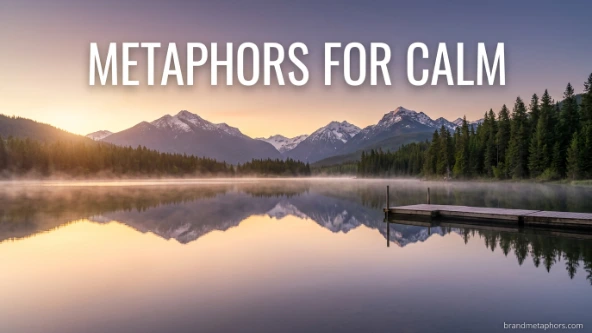
A Quiet Beginning: When the World Slows Down
There are moments when life feels like a storm that refuses to settle. Notifications blink like flashing lights in a busy street, thoughts overlap like crowded voices in a station, and even silence feels distant. Then, unexpectedly, something shifts. It might be the soft rhythm of rain against a window, or the way morning light rests on a wall without asking for attention. In that moment, the mind remembers a different pace—slower, softer, steadier.
That feeling we struggle to name is often what we call calm. But language has a beautiful way of helping us not just name it, but feel it. This is where metaphors for calm become powerful. They don’t just describe peace; they recreate it in the imagination. A good metaphor can slow your breathing without ever touching your body.
In this article, we’ll explore calming metaphors that writers, thinkers, and everyday people can use to bring emotional ease into language and life. You’ll also learn how to use them creatively in writing, storytelling, and even daily reflection.
Understanding Metaphors for Calm: Why They Matter in Language and Emotion
Metaphors for calm are comparisons that translate emotional peace into sensory or familiar experiences. Instead of saying “I feel calm,” we might say “I feel like a lake before sunrise.”
This matters because the human brain responds strongly to imagery. Calm isn’t just an idea—it’s a state we sense. Metaphors help us:
- Slow down overwhelming thoughts
- Make emotions easier to express
- Create grounding mental imagery
- Improve creative writing and storytelling
- Encourage mindfulness in everyday life
Writers, poets, therapists, and even speakers often rely on these images to gently guide people toward emotional balance.
Now let’s explore powerful metaphors that capture calm in vivid, living ways.
Metaphor 1: Calm as a Still Lake at Dawn
A lake at dawn is one of the most universal images of peace. No waves. No rush. Just a surface that reflects the sky without distortion.
Meaning and Explanation
This metaphor represents emotional stillness. The mind becomes like water that has stopped reacting, allowing clarity and reflection.
Example Sentence or Scenario
“After the long argument, her thoughts finally became a still lake at dawn—quiet, open, and undisturbed.”
Alternative Expressions
- A mirror-like lake of silence
- A glassy morning water
- A motionless pool of thought
Sensory & Emotional Detail
Imagine standing near water before sunrise. The air is cool. Birds are just beginning to speak. The surface of the lake holds the world gently, without resistance.
Mini Storytelling Moment
A traveler once sat beside a remote lake after days of chaotic city noise. At first, his mind kept replaying conversations, deadlines, and regrets. But as the sky softened from black to pale gold, something in him softened too. The water didn’t change—it simply showed him how stillness looks when nothing interrupts it. And slowly, he learned to match it.
Interactive Exercise
Close your eyes and imagine your thoughts as water. Are they rippling or still? Rewrite a stressful thought as a “lake image.”
Metaphor 2: Calm as a Soft Blanket of Silence
Silence doesn’t always feel empty. Sometimes it feels like warmth.
Meaning and Explanation
This metaphor frames calm as something comforting and protective rather than cold or isolating.
Example Sentence or Scenario
“The room felt wrapped in a soft blanket of silence after the storm passed.”
Alternative Expressions
- A quilt of quiet
- A warm hush
- A cocoon of stillness
Sensory & Emotional Detail
Think of being wrapped in a heavy, soft blanket during winter. The world outside continues, but you are held gently, separated from noise and pressure.
Mini Storytelling Moment
In a small village after heavy rainfall, electricity often went out. One evening, a child sat with her grandmother in complete darkness. No television. No radio. Just the faint sound of dripping water outside. The child expected fear—but instead, she felt safety. The silence wasn’t empty. It was like being held.
Interactive Exercise
Describe your favorite quiet moment using fabric-related words: weave, wrap, fold, cocoon.
Metaphor 3: Calm as a Forest That Has Stopped Whispering
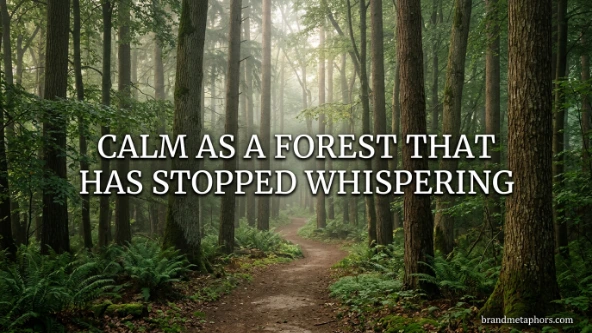
Forests are usually alive with sound, but there are rare moments when even nature seems to pause.
Meaning and Explanation
This metaphor captures a deep, natural calm—where even movement feels respectful and minimal.
Example Sentence or Scenario
“Her thoughts became like a forest that had stopped whispering, waiting for something gentle to arrive.”
Alternative Expressions
- A paused woodland
- A breathless grove
- A resting canopy
Sensory & Emotional Detail
Imagine walking through trees after snowfall. Branches are still. Sound is absorbed by snow. Even footsteps feel like they are asking permission.
Mini Storytelling Moment
A hiker once got lost in a forest trail and panicked. But as evening approached, the wind died down. The trees stopped swaying. Even insects seemed quieter. In that strange stillness, fear faded—not because danger disappeared, but because the forest itself felt like it was listening.
Interactive Exercise
Write a 3-line description of your thoughts as a forest:
- What sounds exist?
- What becomes silent?
- What replaces noise?
Metaphors for Calm in Everyday Life: Turning Language into Feeling
Metaphors aren’t just literary tools—they shape perception. When you describe stress as “storm clouds,” you begin to expect clearing. When you describe calm as “open sky,” you begin to look upward mentally.
Using calming metaphors daily can:
- Reduce emotional intensity
- Help regulate anxiety
- Improve communication in relationships
- Support journaling and reflection practices
Even saying “I need to return to my lake state” can become a personal grounding phrase.
Creative Writing Tips: Using Calm Metaphors Effectively
To use calm metaphors well, avoid overloading your writing. One strong image is more powerful than many weak ones.
Practical Tips
- Pair calm metaphors with sensory details (light, sound, texture)
- Use nature-based imagery for emotional grounding
- Keep language simple to preserve impact
- Let metaphors evolve across a story (storm → lake → sky)
Example Transformation
Instead of: “I felt calm after the meeting.”
Try: “I felt like a forest after the wind finally stopped moving through it.”
This transforms plain emotion into experience.
Metaphors for Calm in Mindfulness and Daily Reflection
Calm metaphors are widely used in mindfulness practices because they help anchor attention.
You can try this simple reflection:
- Sit quietly for one minute
- Choose a metaphor: lake, sky, blanket, forest
- Imagine your breath matching that image
For example, breathing like waves gently settling in a lake.
Over time, your brain begins associating these images with relaxation, making it easier to return to calm states.
Cultural and Literary Inspirations of Calm Imagery
Across cultures, calm is often linked to nature.
- In Eastern poetry, still water symbolizes enlightenment and clarity
- In Western literature, open skies often represent freedom from mental burden
- In Persian poetry, gardens reflect peaceful emotional balance
- In Japanese aesthetics, silence and emptiness often express depth and beauty
Writers like Matsuo Bashō often used minimal natural imagery to suggest profound stillness, showing that calm does not need to be described loudly to be felt deeply.
Exercises: Creating Your Own Metaphors for Calm
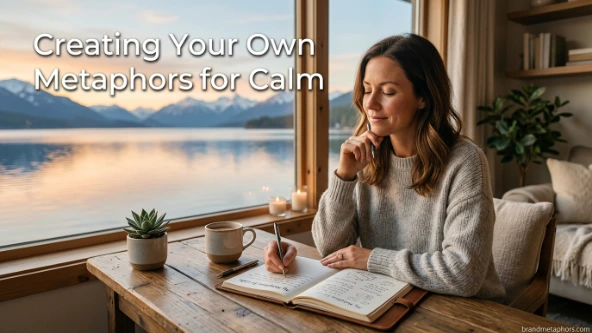
Now it’s your turn to build calming ima1gery.
Exercise 1: Object Transformation
Choose an object (cup, window, stone). Turn it into a calm metaphor.
Example: “A cup becomes a small lake holding morning light.”
Exercise 2: Emotion Mapping
Take a stressful emotion and transform it into nature.
Example: Anxiety → “a wind slowly leaving a field”
Exercise 3: Personal Calm Phrase
Create your own calming sentence and repeat it daily.
Example: “I return to still water within me.”
Bonus Tips: Using Calm Metaphors in Writing, Social Media, and Life
Calm metaphors can enhance more than poetry—they can shape communication.
In Writing
Use them to soften transitions or emotional scenes.
In Social Media
Captions like “Today I am a quiet sky” create emotional resonance.
In Daily Life
Use metaphors as self-talk tools:
- “I am not a storm; I am settling water.”
- “My mind is a resting forest.”
These phrases gently reframe emotional states.
Conclusion
Calm is not absence—it is presence without pressure. Through metaphors, we learn to recognize it not as something rare, but something already available beneath noise.
A still lake, a soft blanket of silence, a forest that has stopped whispering—these are not just poetic images. They are ways the mind learns to return home to itself.
When language slows down, so does thought. And sometimes, all we need is a better image to remember how to breathe again.
FAQs: Metaphors for Calm
1. What are metaphors for calm?
They are figurative expressions that describe peaceful emotional states using imagery like nature, silence, or softness.
2. Why are calm metaphors useful?
They help people understand and feel calm more deeply by engaging imagination and emotion.
3. Can I create my own calm metaphors?
Yes. Any image that feels peaceful to you—like water, sky, or light—can become a personal metaphor.
4. Are calm metaphors used in therapy or mindfulness?
Yes, they are often used to help people regulate emotions and visualize relaxation.
5. How can I use calm metaphors in daily life?
You can use them in journaling, self-talk, writing, or even as mental reminders during stress.
If you’d like, I can also turn this into poetry, social media captions, or a shorter blog version.