

Introduction: When Words Redraw What We See
There are moments when language quietly changes the way we look at the world. Imagine walking through an old village at dusk—the walls are cracked, the paint is faded, vines crawl like slow-moving thoughts across broken brick. Someone might call it “ugly.” But another person pauses, tilts their head, and whispers: “It looks like time itself carved poetry into stone.”
This is where metaphors begin their work.
Metaphors for “ugly” are not about judgment—they are about transformation. They help us describe what feels rough, unconventional, worn, or visually challenging in ways that are vivid, human, and meaningful. Instead of reducing something to a harsh label, metaphors expand it into imagination.
In writing, storytelling, art, and even everyday speech, metaphors allow us to soften perception and deepen understanding. What we call “ugly” often hides complexity, history, and emotion. With the right language, even the most visually difficult things can become symbols of resilience, truth, or character.
H2: Understanding Metaphors for Ugly in Language and Expression
Metaphors for “ugly” are figurative comparisons that describe something visually unappealing or unconventional without using direct judgmental language. Instead of saying something is unattractive, metaphors translate appearance into imagery.
For example:
- “Weathered like an abandoned ship”
- “A face carved by storms”
- “Like a painting left unfinished in the rain”
These expressions do more than describe—they interpret. They help readers feel the subject rather than simply evaluate it.
In literature, this technique is powerful because it shifts focus from criticism to imagination. It invites empathy, curiosity, and reflection.
H2: Why Metaphors for Ugly Matter in Writing and Life
Language shapes perception. When we repeatedly label something as “ugly,” we close the door to deeper understanding. But metaphors reopen it.
In real life, this matters because:
- It encourages more compassionate communication
- It improves creative writing and storytelling depth
- It reduces harsh judgment in describing people, places, or objects
- It helps artists and writers find beauty in imperfection
Even in social media captions, metaphors can transform a simple image into a story: Instead of “old building, ugly,” one might write:
“A building where time forgot to knock twice.”
The difference is emotional tone—and emotional tone shapes how people respond.
H2: Metaphor Example 1 — “Weathered Stone in the Rain”
Meaning / Explanation: This metaphor describes something rough, aged, or visually uneven, but suggests endurance and history rather than pure negativity.
Example Sentence: Her face was like weathered stone in the rain—marked, textured, but strong enough to outlast every storm.
Alternative Expressions:
- “Carved by time and silence”
- “Like stone softened by centuries of wind”
- “A surface shaped by survival”
Sensory / Emotional Detail: You can almost feel the damp chill of rain, the roughness of stone, the quiet dignity of something that has endured too much to be fragile.
Mini Storytelling Moment: An old man sits outside a tea stall every evening. Children once called his face “strange.” But the writer sees him differently—like a monument no museum could afford, built not for beauty contests, but for survival.
H2: Metaphor Example 2 — “A Storm-Tossed Sea”
Meaning / Explanation: This metaphor represents chaotic, uneven, or visually “disrupted” appearance—something that feels unsettled or harsh to the eye.
Example Sentence: The abandoned yard looked like a storm-tossed sea of broken metal and tangled wires.
Alternative Expressions:
- “Like waves frozen mid-chaos”
- “A surface in eternal unrest”
- “A landscape shaken loose by wind and fury”
Sensory / Emotional Detail: Imagine wind howling, metal creaking, debris shifting like waves that forgot how to settle. There is discomfort, but also energy and motion.
Mini Cultural Reference: In Romantic poetry, storms were often used to represent emotional chaos. What appears “ugly” at first glance often symbolizes internal turbulence—grief, change, or forgotten stories.
H2: Metaphor Example 3 — “An Unfinished Painting in Rainlight”
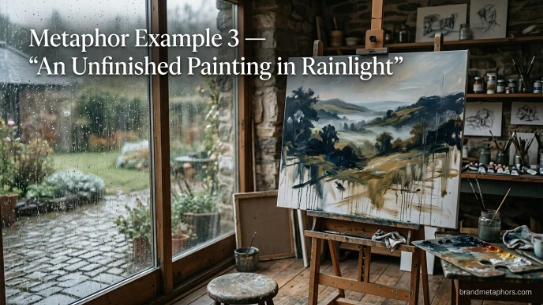
Meaning / Explanation: This metaphor frames imperfection or unconventional appearance as something incomplete rather than inherently negative.
Example Sentence: The old mural looked like an unfinished painting left in rainlight, colors bleeding into each other without apology.
Alternative Expressions:
- “A sketch the world never finished drawing”
- “A canvas still waiting for meaning”
- “Brushstrokes interrupted by time”
Sensory / Emotional Detail: Faded colors, dripping edges, softened lines—all suggest vulnerability rather than failure.
Mini Storytelling Moment: A traveler once photographed a crumbling wall and called it ugly. Years later, that same photo inspired an artist to recreate it as a gallery piece titled “The Beauty of Incompletion.”
H2: Cultural and Literary Views on “Ugly” Imagery
Across cultures, what is considered visually unpleasant often carries deeper symbolic meaning.
- In Japanese aesthetics, imperfection is embraced through wabi-sabi, where aging and decay are seen as beautiful in their transience.
- In Gothic literature, decaying castles and distorted landscapes reflect emotional depth rather than literal ugliness.
- In modern art, distortion is used to challenge traditional beauty standards.
Writers like Franz Kafka and Emily Dickinson often used unsettling imagery not to reject beauty, but to expand it.
What we call “ugly” is often just unfamiliar meaning waiting to be understood.
H2: Emotional Sensitivity and Reframing Appearance Through Metaphors
Using metaphors for “ugly” requires care. Language can either harm or heal perception.
Instead of reinforcing negativity, reframing helps:
- “Harsh-looking” becomes “weather-worn”
- “Distorted” becomes “abstracted”
- “Ugly” becomes “unconventional”
This shift is not denial—it is interpretation.
A cracked wall is not just broken; it may be “a map of forgotten weather patterns.” A scar is not just damage; it may be “a river that learned to stay on the skin.”
Metaphors allow dignity to remain intact even in imperfect descriptions.
H2: Creative Writing Techniques for Metaphors for Ugly
To write powerful metaphors, try these techniques:
- Compare appearance with nature (storms, rocks, deserts)
- Use time-based imagery (faded, aged, eroded, forgotten)
- Focus on texture instead of judgment (rough, cracked, layered)
- Add motion or stillness for emotional effect
Example transformation:
- Plain: “The house looked ugly.”
- Metaphoric: “The house slouched like an old memory refusing to leave.”
The second version creates emotion instead of judgment.
H2: Interactive Exercises to Practice Metaphors

Try these simple creative prompts:
- Look around your environment and choose one object you find “unattractive.” Rewrite it using a metaphor instead of a judgment.
- Complete this sentence:
- “It looked like ___ caught in ___.”
- Turn a negative adjective into imagery:
- Ugly → “like something forgotten by light”
- Broken → “like a story interrupted mid-sentence”
- Write a 3-line micro-poem describing something imperfect without using direct criticism.
These exercises train your imagination to see beyond labels.
H2: Using Metaphors for Ugly in Writing, Social Media, and Daily Life
Metaphors are not just for literature—they are tools for everyday expression.
In Writing:
- Adds emotional depth to descriptions
- Makes scenes more memorable
On Social Media:
- Turns captions into storytelling moments
- Makes posts more engaging and poetic
In Daily Life:
- Encourages kinder observation of surroundings
- Helps reduce harsh judgments about appearance
Instead of saying, “That place is ugly,” you might say:
“It feels like a forgotten corner of the world learning to breathe again.”
H2: Final Reflection — Seeing Beyond the Surface
Metaphors for “ugly” teach us something quietly powerful: appearance is never just appearance. It is history, emotion, time, and transformation folded into form.
When language changes, perception follows. What once felt harsh or unappealing can become layered with meaning. A broken wall becomes a story. A rough face becomes a map. A chaotic scene becomes movement frozen in time.
In the end, metaphors don’t just describe the world—they gently reshape how we choose to see it.
FAQs About Metaphors for Ugly
1. What are metaphors for ugly used for?
They are used to describe visually unappealing or unconventional things in a more creative, emotional, and less judgmental way.
2. Are metaphors for ugly negative?
Not necessarily. They can soften negativity and add meaning instead of criticism.
3. Can I use these metaphors in essays or storytelling?
Yes, they are widely used in creative writing, poetry, and descriptive essays.
4. How do metaphors improve writing?
They make descriptions more vivid, emotional, and memorable.
5. What is the best way to learn metaphors?
Practice daily observation and rewrite simple descriptions into imagery-based language.
Conclusion
Metaphors for “ugly” are not about masking reality—they are about expanding it. They allow us to move beyond surface judgment and enter a space where even imperfection carries meaning. Through imagery, storytelling, and emotional awareness, language becomes a tool for transformation.
What once felt visually harsh can become poetically rich. And in that shift, we don’t just change words—we change the way we see the world.