
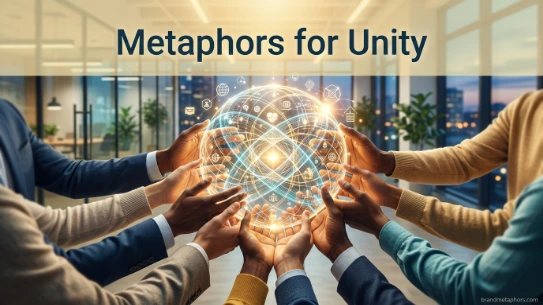
In a quiet village square at dusk, lanterns begin to glow one by one. At first, each light seems small and separate, flickering in its own space of darkness. But as more lanterns are lit, something subtle happens—the darkness no longer feels dominant. Instead, the scattered lights begin to feel like one shared presence, as if the village itself is breathing in warmth together. This is what unity often feels like: not the loss of individuality, but the creation of something larger, steadier, and more luminous than any single part.
Metaphors for unity help us understand this invisible bond between people, ideas, and communities. They turn abstract connection into something we can see, feel, and remember. Whether in writing, leadership, relationships, or social life, these metaphors offer powerful ways to express togetherness and harmony. They remind us that unity is not sameness—it is connection, coordination, and shared purpose woven into different threads of life.
1. Metaphors for Unity as “A Single Fabric Woven from Many Threads”
One of the most enduring metaphors for unity is fabric woven from threads. Each thread represents an individual—unique in color, strength, and texture. Alone, a thread is fragile. But together, they form cloth that can warm, protect, and endure.
This metaphor highlights how unity does not erase identity. Instead, it strengthens it through interdependence. A tapestry is only beautiful because its threads are different.
Example in writing or speech: “Our community is a woven fabric, where every culture adds a thread of meaning and strength.”
Alternative expressions:
- A tapestry of lives
- A woven community
- Interlaced destinies
Sensory detail: Imagine running your fingers over a richly woven carpet—each ridge tells a story of many hands working together.
Mini-story: In an old market, a tailor once stitched cloth from scraps donated by families of different backgrounds. At first, the pieces seemed mismatched. But when sewn together, they became a vibrant quilt displayed in the town hall—symbolizing unity born from diversity.
2. Metaphors for Unity as “A River with Many Streams Joining Together”
Water metaphors often capture unity beautifully. When small streams merge into a river, they do not lose their essence; instead, they gain force and direction.
This metaphor reflects how unity amplifies strength. Separate efforts may flow gently, but together they create unstoppable momentum.
Example scenario: “Different voices in the movement merged like streams forming a powerful river of change.”
Alternative expressions:
- Converging currents
- Merging waters
- Flowing together
Emotional tone: There is a sense of inevitability in this metaphor, as if unity is nature’s way of guiding separate paths toward a shared destination.
Cultural reference: Many ancient civilizations built cities near rivers, symbolizing how unity and flow sustain life itself.
Interactive prompt: Think of your own life. What “small streams” of effort—family, friends, goals—are flowing toward one larger direction? Write a short paragraph describing that river.
3. Metaphors for Unity as “A Choir Singing in Harmony”
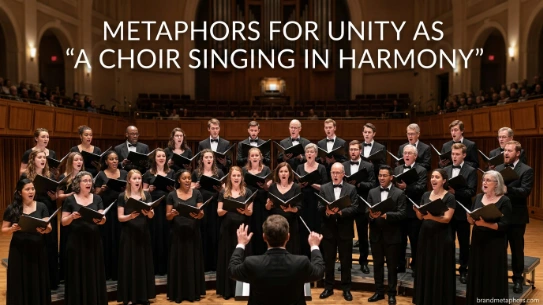
A choir is one of the most powerful artistic representations of unity. Each voice is distinct, yet the beauty emerges when all voices align in rhythm, pitch, and emotion.
This metaphor shows that unity is not silence of individuality but coordination of difference. A single voice may be strong, but harmony creates depth and resonance.
Example sentence: “Our team worked like a choir, where every member’s voice added richness to the shared performance.”
Alternative expressions:
- Harmonized voices
- Collective melody
- Symphonic voices
Sensory detail: Imagine sitting in a concert hall as voices rise and fall around you—some soft as breath, others powerful as thunder, yet perfectly balanced.
Mini storytelling: During a school performance, a group of nervous students struggled during rehearsals. But on stage, something changed. They began listening to each other instead of competing. The result was not perfection—but harmony that moved the audience to tears.
Interactive exercise: Write a short paragraph describing your family or team as a choir. What role does each person’s “voice” play?
4. Metaphors for Unity as “Bricks Building One Strong Wall”
Unity is often compared to construction. Bricks alone are lifeless, but when carefully arranged and bound together, they form structures that withstand storms.
This metaphor emphasizes stability and shared responsibility. Every individual contributes to something bigger and more lasting.
Example: “Each act of kindness was a brick in the wall of community trust.”
Alternative expressions:
- Building blocks of society
- A unified structure
- Collective foundation
Emotional insight: There is satisfaction in knowing that your small contribution is part of something enduring.
Real-life reflection: Great cities, schools, and movements are built brick by brick—quiet contributions that eventually become monuments of shared effort.
Prompt: What “brick” are you currently laying in your personal or professional life? Describe it in 5–6 sentences.
5. Metaphors for Unity as “A Tree with Many Branches and One Root”
A tree is a living symbol of unity. Its branches spread widely, but all life flows from a single root system.
This metaphor reflects shared origin and interconnected growth. Diversity exists above the surface, while unity lies beneath.
Example sentence: “Though we grew in different directions, we were branches of the same tree.”
Alternative expressions:
- Rooted together
- One trunk, many paths
- Shared roots of identity
Sensory detail: Imagine the cool shade of a large tree on a summer day—its branches moving differently in the wind, yet belonging to one living system.
Mini-story: In a family reunion after many years, cousins realized they had taken different paths—teachers, engineers, artists. Yet sitting under their ancestral tree, they felt a quiet recognition: different branches, same roots.
Exercise: Draw or describe your “unity tree.” What are its roots, trunk, and branches in your life?
6. Metaphors for Unity in Society and Culture
Unity often extends beyond personal relationships into culture and society. It can be seen as a mosaic—small pieces forming a larger image.
Each piece is unique in color and shape, yet together they form meaning that no single piece could express alone.
Example: “Our nation is a mosaic of languages, traditions, and stories.”
Alternative expressions:
- Cultural mosaic
- Patchwork society
- Collective identity
Cultural insight: Many modern societies use the mosaic metaphor to emphasize diversity within unity.
Interactive prompt: List three cultural elements in your community. How do they form a larger shared identity?
7. How to Use Metaphors for Unity in Writing and Speech

Metaphors for unity are powerful tools for communication. They make speeches more emotional and writing more memorable.
To use them effectively:
- Choose metaphors that match your audience
- Avoid overcomplicating imagery
- Connect metaphor to real-life meaning
- Keep tone consistent and clear
Bonus tip: Use one strong metaphor per paragraph rather than mixing many, to maintain clarity.
Example in social media writing: “Let’s be a bridge, not an island—connecting rather than separating.”
Exercise: Write a short motivational post using one unity metaphor. Keep it under 3–4 sentences.
8. Emotional Power of Unity Metaphors in Daily Life
Unity metaphors are not just literary tools—they shape how we think and feel about relationships.
When we see family as a “team,” we act more collaboratively. When we see society as a “fabric,” we become more mindful of our impact.
These metaphors influence empathy and behavior by turning abstract ideas into emotional understanding.
Reflection prompt: Which metaphor for unity resonates most with you right now? Why?
9. Creative Exercise: Build Your Own Metaphor for Unity
Now it’s your turn to create.
Step 1: Think of unity as something in nature or daily life, Identify how parts come together. Step 3: Describe what changes when they unite.
Example: “Unity is like sunlight passing through a prism—separate rays of experience become one spectrum of understanding.”
Challenge: Write your own metaphor in 3–5 sentences and share it with someone. Ask them what image they see in their mind.
10. Why Metaphors for Unity Matter in a Divided World
In a world often marked by differences, metaphors for unity remind us of connection beneath separation. They help us see beyond conflict and recognize shared humanity.
Whether through rivers, trees, choirs, or fabrics, these metaphors teach one essential truth: unity is not uniformity, but harmony in diversity.
When we speak in metaphors of unity, we begin to think in terms of collaboration rather than division. And that shift, even in language, can quietly reshape how we live together.
FAQs on Metaphors for Unity
1. What are metaphors for unity?
They are figurative expressions that describe togetherness using images like rivers, trees, or fabrics.
2. Why are unity metaphors important in writing?
They make abstract ideas easier to understand and emotionally engaging.
3. Can metaphors for unity be used in speeches?
Yes, they are highly effective in speeches to inspire and connect with audiences.
4. What is the most common unity metaphor?
Common ones include a woven fabric, a river merging streams, and a tree with roots and branches.
5. How can I create my own unity metaphor?
Think of something in nature or daily life where separate parts come together to form something stronger or more meaningful.
Conclusion
Metaphors for unity are more than poetic language—they are ways of seeing the world. They turn invisible connections into visible meaning, helping us understand how individuals, cultures, and communities come together.
From rivers merging into one flow to choirs singing in harmony, each metaphor reveals a truth about human connection: we are strongest not alone, but together. And when we learn to see unity in everyday life, we begin to build it more intentionally in our words, actions, and relationships.