
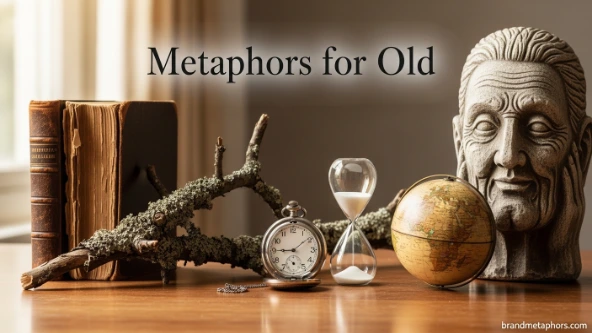
Introduction: When “Old” Is Not an Ending but a Story Still Breathing
In the quiet of an early morning, an old wooden chair sits near a sunlit window. Its paint is chipped, its legs slightly uneven, yet it holds the warmth of decades—people who laughed, cried, waited, and dreamed while resting on it. Nothing about it feels “useless.” Instead, it feels like memory made visible.
This is where metaphors for “old” begin to matter—not as labels of decline, but as bridges to meaning. In language and literature, “old” is never just about age. It can mean wisdom, endurance, memory, survival, or even beauty shaped by time. Metaphors help us reframe aging objects, people, ideas, and even emotions in ways that feel richer and more humane.
We use metaphors for old things in writing, poetry, conversation, branding, and storytelling because they allow us to speak about time without fear. Instead of saying something is “past its prime,” we can describe it as “seasoned,” “time-worn,” or “weathered like stone shaped by rivers.”
In this article, we’ll explore powerful metaphors for “old,” how they work, how to use them creatively, and how they can transform the way you see aging in daily life and writing.
The Language of Time: Understanding Metaphors for “Old”
Metaphors for “old” are linguistic tools that compare age to familiar images—nature, objects, or human experience. Instead of stating age directly, they paint it.
For example:
- “Old as the hills”
- “Weathered by time”
- “A relic of another era”
These expressions do more than describe—they interpret. They add emotional tone. “Old” can sound negative in plain language, but metaphor can turn it into something poetic, respectful, or nostalgic.
Writers, poets, and storytellers rely on these metaphors to:
- Evoke emotion
- Create vivid imagery
- Connect readers to memory and history
- Add depth to characters and settings
Understanding this helps you not only read better but also write more meaningfully.
Metaphor 1: “Weathered Like Stone by the Sea”
Meaning & Explanation
This metaphor compares old age to stone shaped by waves over time. It suggests strength, endurance, and transformation. Instead of breaking down, the subject becomes smoother, more refined, and deeply shaped by experience.
Why it works
Nature is the perfect teacher of aging. Stones in the sea don’t “decay”—they evolve. This metaphor reframes aging as a process of refinement, not decline.
Example Sentence
“The fisherman’s face was weathered like stone by the sea, each wrinkle carved by years of salt wind and endless horizons.”
Mini Story
An old lighthouse keeper once said he no longer remembered his age. “The ocean keeps it for me,” he laughed. Every morning, he watched waves crash against the rocks below. Over time, he began to feel like those rocks—strong, shaped, but never broken.
Alternative Expressions
- “Shaped by tides of time”
- “Carved by years like river stone”
- “Smoothed by life’s currents”
Sensory & Emotional Detail
Imagine cold sea spray, rough stone under your hand, the rhythmic crash of waves. There is loneliness—but also permanence.
Interactive Exercise
Write a description of an elderly person using a natural force (wind, river, desert, or fire). Focus on transformation rather than decay.
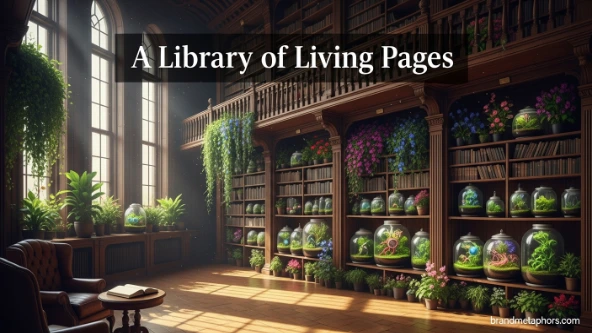
Metaphor 2: “A Library of Living Pages”
Meaning & Explanation
This metaphor describes an old person or object as a collection of stories. Each wrinkle, scar, or detail is like a page filled with memory.
Why it works
It shifts focus from physical age to accumulated experience. It turns “old” into something intellectual and emotional rather than physical alone.
Example Sentence
“Grandmother sat quietly, a library of living pages, each smile a chapter and each silence a forgotten story waiting to be read.”
Mini Story
In a small village, children loved visiting an elderly storyteller. They didn’t see her as simply old. To them, she was a book that spoke. Every evening, she would open her “pages” and let stories spill out—wars survived, love lost, journeys taken. When she passed away, the village said, “A library has closed.”
Alternative Expressions
- “A walking archive of memories”
- “A book written by time”
- “A living chronicle”
Sensory & Emotional Detail
The scent of old paper, the softness of worn book covers, the quiet rustle of turning pages—these sensations bring emotional depth.
Interactive Exercise
Describe your favorite elderly person (real or imagined) as a book. What is the title of their story? What chapter are they in now?
Metaphor 3: “A Candle in Its Long Burn”
Meaning & Explanation
This metaphor compares old age to a candle that has been burning for a long time. It suggests warmth, persistence, and gentle fading light.
Why it works
It captures both fragility and beauty. A candle is not strong forever, but its glow becomes more meaningful as time passes.
Example Sentence
“He moved slowly through the room, like a candle in its long burn—still glowing, though the wax of years had nearly melted away.”
Mini Story
An old artist once painted only at night. He said daylight distracted him from truth. One evening, his granddaughter asked why he painted so slowly. He smiled and replied, “Because I am a candle now. I must make every glow count.” That night, she understood that endings can still give light.
Alternative Expressions
- “A fading yet glowing flame”
- “Light softened by time”
- “A slow-burning ember”
Sensory & Emotional Detail
Warm flickering light, soft shadows on walls, the smell of wax—this metaphor feels intimate and reflective.
Interactive Exercise
Write a short paragraph describing your life as a candle. What would your flame represent?
Cultural Reflections on Aging and Old Metaphors
Across cultures, old age is often seen differently. In many Eastern traditions, age is associated with honor and wisdom, In storytelling traditions, elders are “keepers of fire,” “roots of the family tree,” or “mountains of memory.”
In Western literature, metaphors often mix respect with melancholy—“autumn years,” “golden age,” or “twilight of life.”
These cultural lenses shape how we think:
- East: continuity, respect, lineage
- West: reflection, nostalgia, endings
Understanding this helps writers choose metaphors consciously, depending on tone and message.
Metaphor 4: “Roots Beneath Ancient Trees”
Old age is often compared to roots—hidden, deep, and essential.
An old person or idea can be described as the root system that supports everything above ground. Without roots, nothing grows.
Example: “The village elder was not just respected; he was the roots beneath an ancient tree, unseen but holding the entire community steady.”
Metaphor 5: “Dust of Forgotten Sunlight”
This poetic metaphor suggests memory layered over time. Dust is not just decay—it is the residue of light, movement, and life.
Example: “The attic was filled with the dust of forgotten sunlight, where old letters and photographs waited like sleeping memories.”
How to Use Metaphors for “Old” in Writing and Daily Life
Metaphors are not just for poets—they can improve everyday communication.
Use them in:
- Storytelling (characters, settings)
- Social media captions (nostalgic posts)
- Personal journaling
- Speeches or tributes
- Branding (heritage, legacy, craftsmanship)
Instead of saying: ❌ “This house is very old” Try: ✔ “This house is a keeper of forgotten echoes”
Bonus Tips for Creative Expression
- Combine nature + memory (e.g., “wind-carved memories”)
- Avoid clichés unless reimagined
- Use sensory detail (smell, texture, sound)
- Match metaphor to emotion (warm = candle, strong = stone)
- Keep it simple but vivid
Interactive Creative Practice: Build Your Own Metaphor

Try this formula:
“Old is like ____ because ____.”
Examples:
- Old is like a mountain because it holds stories in its silence.
- Old is like a riverbed because it remembers every drop of water that passed through.
Now write three of your own.
The Emotional Power of Seeing “Old” Differently
When we change how we describe age, we change how we feel about it. “Old” is not just time passing—it is time collected, shaped, and transformed.
A broken object can be discarded, or it can be “a sculpture of use.” A person can be dismissed, or they can be “a story still unfolding.”
Metaphors remind us that nothing truly becomes meaningless with age—it only changes form.
FAQs: Metaphors for Old
1. What are metaphors for “old” used for?
They are used to describe age in more creative, emotional, and symbolic ways instead of using direct words like “old” or “aged.”
2. Why are metaphors important in describing old age?
They help shift perception from decline to wisdom, beauty, and experience, making language more expressive.
3. Can metaphors for “old” be used in everyday speech?
Yes. They are common in storytelling, speeches, social media captions, and even casual conversation.
4. What are some common themes in old-age metaphors?
Nature (stones, trees, rivers), light (candles, sunsets), and knowledge (books, libraries) are the most common.
5. How can I create my own metaphor for “old”?
Think of what “old” feels like emotionally, then compare it to something that shares that feeling—nature, objects, or experiences.
Conclusion
In the end, metaphors for “old” teach us something deeper than language—they teach us perspective. Age is not a closing door; it is a long corridor filled with echoes, textures, and light.
Whether it is a candle still glowing, a stone shaped by waves, or a library of living pages, “old” becomes less about loss and more about transformation.
And perhaps that is the real beauty of metaphors: they do not change what things are—they change how we see them.