
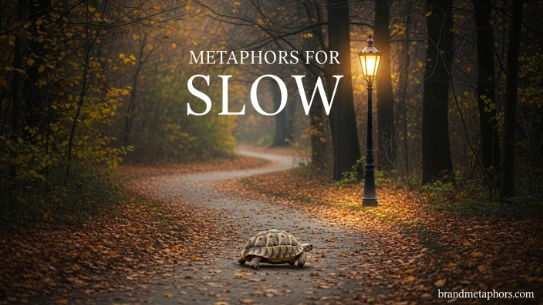
A Quiet Moment Where Time Seems to Stretch
There are days when the world refuses to hurry.
A kettle takes longer to whistle. Footsteps feel heavier on the pavement. Even thoughts seem to move through thick air, like they are wading through invisible water. You check the clock, but the hands barely seem to have shifted. Everything is happening—but at a softer, more deliberate pace.
“Slow” is not always about delay. Sometimes it is about depth. Sometimes it is about presence.
And that is where language begins to lean on metaphor—because “slow” is too simple a word for something so textured. We borrow images from nature, objects, and human experience to describe it: honey that refuses to pour, rivers that hesitate, clocks that grow tired.
These metaphors don’t just decorate language. They help us feel time differently.
Understanding Metaphors for Slow in Language and Thought
A metaphor for slow is a comparison that describes slowness through something else—something we can see, taste, hear, or imagine more vividly.
Instead of saying:
- “It was very slow,”
we might say:
- “It moved like honey in winter.”
This shift matters. It transforms abstract time into sensory experience.
Metaphors for slowness appear in literature, poetry, philosophy, and even everyday speech. They help us:
- Express patience or frustration
- Describe emotional states like grief or fatigue
- Capture natural rhythms of life
- Create atmosphere in storytelling
Slow is not just speed—it is mood, texture, and emotional weight.
Why Metaphors for Slow Matter in Writing and Life
We often live in a world obsessed with speed: fast replies, fast food, fast decisions. But language gives us a way to resist that pressure.
Metaphors for slow:
- Invite mindfulness
- Encourage emotional reflection
- Add depth to storytelling
- Help readers feel time, not just measure it
Writers use them to slow down scenes. Poets use them to stretch emotion. Even everyday speakers use them when they say things like “time crawled” or “the day dragged on.”
Slow metaphors remind us that not everything valuable happens quickly.
Metaphor 1: “Honey Pouring in Winter” – When Time Refuses to Move
Meaning and Explanation
Honey in winter becomes thick, heavy, and reluctant to flow. This metaphor captures extreme slowness—where movement exists, but only barely.
It represents:
- Delayed progress
- Mental fatigue
- Emotional heaviness
- Waiting that feels endless
Example Sentence or Scenario
“The meeting dragged on like honey pouring in winter, every minute stretching longer than the last.”
Alternative Expressions
- “Molasses in cold air”
- “Tar under frost”
- “Time stuck in glass”
Sensory and Emotional Detail
Imagine tilting a jar. Nothing happens at first. Then, slowly, something begins to shift—but it resists you. That resistance is the essence of this metaphor.
Mini Story
A student sits in an exam hall. The clock ticks loudly, each sound exaggerated in silence. The ink from the pen moves slowly across paper, as if it too is tired. Later, they describe the experience: “It felt like writing in honey that refused to leave the jar.”
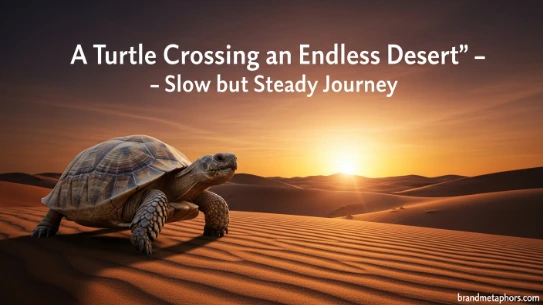
Metaphor 2: “A Turtle Crossing an Endless Desert” – Slow but Steady Journey
Meaning and Explanation
A turtle is already a symbol of slowness, but placing it in a vast desert intensifies the image. It becomes not just slow—but persistently slow across overwhelming distance.
It represents:
- Long-term struggle
- Persistence despite difficulty
- Slow progress with meaning
Example Sentence or Scenario
“His recovery felt like a turtle crossing an endless desert—small steps, no visible horizon, but still moving forward.”
Alternative Expressions
- “Snail across a mountain range”
- “Footsteps through deep sand”
- “A slow journey with no map”
Sensory and Emotional Detail
Feel the heat rising from sand. Each step sinks slightly before lifting again. There is no rush, no shortcut—only endurance.
Mini Story with Cultural Reference
In many cultures, the turtle symbolizes patience and wisdom. In Aesop’s fables, the slow creature famously wins the race—not through speed, but consistency. This metaphor reminds us that slowness is not failure; it is strategy.
A young artist, learning piano, once said her progress felt exactly like this turtle in the desert. “I don’t hear the music I want yet,” she said, “but I’m still walking.”
Metaphor 3: “A Clock with Heavy Hands” – Time That Feels Weighed Down
Meaning and Explanation
Clocks are supposed to be precise and neutral. But imagining a clock with heavy hands changes everything—the movement becomes burdened, reluctant, almost tired.
It represents:
- Emotional boredom
- Waiting under pressure
- Mental exhaustion
- Stagnant environments
Example Sentence or Scenario
“The afternoon in the hospital felt like a clock with heavy hands, every second refusing to lift itself.”
Alternative Expressions
- “A tired clock”
- “Hands of lead on the dial”
- “Time walking through mud”
Sensory and Emotional Detail
You hear ticking, but it feels slower than it should be. Each tick lands like a drop of water in an empty room.
Mini Story
A man waits in a clinic for results. He watches the clock but cannot trust it anymore. Minutes feel distorted. Later, he says, “It was like the clock had forgotten how to be light.”
Interactive Exercise: Creating Your Own Metaphors for Slow
Try this:
Step 1: Choose a slow experience
- Waiting in line
- Healing from illness
- Learning something new
- A boring class or meeting
Step 2: Pick a comparison source
Think of something slow or heavy:
- Thick liquids (oil, syrup, glue)
- Nature (snowfall, desert wind, glaciers)
- Objects (old clocks, rusting machines)
Step 3: Build your metaphor
Example:
- Experience: Waiting for results
- Comparison: Snow falling at night
- Metaphor: “The wait fell like snow that never seemed to land.”
Bonus Challenge
Write 3 sentences describing the same moment using 3 different slow metaphors. Notice how the emotional tone changes.
Bonus Tips: Using Slow Metaphors in Writing and Daily Life
1. In Creative Writing
Use slow metaphors to:
- Build tension
- Extend emotional scenes
- Deepen atmosphere in storytelling
Instead of:
“The room was quiet.”
Try:
“The silence moved through the room like dust settling after a long storm.”
2. In Social Media Captions
Slow metaphors work beautifully for reflective posts:
- “Today felt like honey in winter.”
- “Moving like a turtle through thoughts today.”
They add emotional depth without being long.
3. In Personal Reflection
Using metaphors helps you understand your own emotional pace:
- Are you “walking through sand” or “floating in water”?
- Are you “paused” or “gently unfolding”?
Language becomes a mirror.
Slow in Literature and Culture: A Gentle Tradition

Writers like Marcel Proust often stretched time across pages, showing how memory itself moves slowly. In Japanese aesthetics, concepts like ma (the space between things) value slowness and pause as meaningful parts of experience.
Even in modern storytelling, slow cinema uses long takes to let viewers feel time rather than rush through it.
Slow is not empty. It is full—but quietly so.
FAQs About Metaphors for Slow
What are metaphors for slow used for?
They are used to describe slowness in more vivid, emotional, or sensory ways, helping readers feel time instead of just understanding it.
Why are slow metaphors important in writing?
They enhance storytelling by adding atmosphere, emotional depth, and realism to scenes involving waiting, movement, or reflection.
Can metaphors for slow be used in poetry?
Yes, they are especially powerful in poetry because they create rhythm, mood, and imagery that reflect emotional states.
What is a common metaphor for slow time?
Common ones include “time crawled,” “like molasses,” or “dragging like heavy feet through mud.”
How do I create my own slow metaphors?
Think of something naturally slow or heavy, then connect it to your emotion or experience using “like” or “as” comparisons.
Conclusion
Slow is often misunderstood as absence—of speed, of progress, of urgency. But through metaphor, it becomes something richer.
It becomes honey that resists pouring but rewards patience. A turtle crossing impossible distances yet still moving forward. A clock that grows heavy under the weight of waiting.
These images remind us that slowness is not empty time. It is experienced time.
And when we learn to describe it, we also learn to notice it—more gently, more fully, and perhaps more kindly than before.