
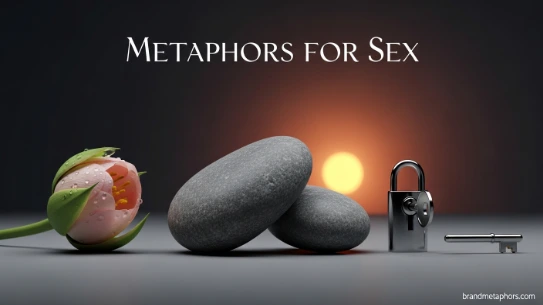
A Quiet Moment Before Words: The Power of Intimate Language
There are moments when language feels both necessary and insufficient at the same time—when experience runs deeper than vocabulary can comfortably hold.
Intimacy is one of those realms. People often reach for softer, indirect, or poetic language when trying to describe closeness, desire, or sexual connection, not because they lack honesty, but because metaphor allows them to express what literal description might flatten.
Imagine a dimly lit room after a long day, two people sitting in silence that feels heavy but not empty. Outside, the world continues its noise, but inside that small space, something unspoken is happening—a shared understanding, a magnetic pull, a warmth that doesn’t need explanation.
If someone tried to describe that moment plainly, it might sound too clinical. But through metaphor, it becomes something else entirely: a tide, a dance, a fire, a journey.
That is the power of metaphors for sex and intimacy—they turn physical and emotional experiences into language that carries feeling, rhythm, and imagination.
This article explores how metaphors shape the way we understand sexual intimacy, why they matter in communication and writing, and how they can be used creatively in storytelling, relationships, and expression.
Understanding Metaphors for Sex and Intimacy in Language
Metaphors are not just decorative language tools; they are cognitive bridges. When people talk about sex indirectly through imagery—like “fire,” “waves,” or “dance”—they are not avoiding meaning. They are translating it.
Sex and intimacy are deeply personal experiences that involve emotion, vulnerability, trust, and physical sensation. Literal descriptions often fail to capture their emotional depth. Metaphors step in to:
- soften sensitive conversations
- express emotional complexity
- create poetic or artistic expression
- allow cultural or personal comfort in discussing intimacy
In literature, music, and even everyday conversation, metaphors give people a way to talk about closeness without reducing it to mechanics. They also reflect cultural attitudes—some societies favor romantic imagery, while others lean toward nature-based or spiritual comparisons.
Understanding these metaphors helps readers not only appreciate literature and art more deeply but also communicate more thoughtfully in relationships.
Why Metaphors for Sexual Intimacy Matter

Before diving into specific examples, it’s important to understand why these metaphors are widely used:
- They protect emotional nuance – Intimacy is layered with feelings that literal language often oversimplifies.
- They encourage emotional safety – Indirect language can make sensitive topics easier to approach.
- They enhance storytelling – Writers use metaphors to make scenes more vivid and meaningful.
- They reflect human psychology – People naturally think in imagery, not just facts.
In short, metaphors don’t replace reality—they enrich it.
Common Metaphors for Sex and Intimacy in Language
1. Sex as a Dance: Rhythm, Connection, and Harmony
One of the most enduring metaphors for intimacy is sex as a dance.
Meaning and Explanation
This metaphor emphasizes coordination, rhythm, mutual awareness, and emotional attunement. Like dancers responding to each other’s movements, partners in an intimate relationship are seen as navigating together—sometimes leading, sometimes following, but always connected.
It highlights balance rather than dominance, and flow rather than force.
Example Sentence or Scenario
“They moved together like a slow, familiar dance, each step unspoken but perfectly understood.”
Alternative Expressions
- “a shared rhythm”
- “moving in sync”
- “an intimate choreography”
Sensory and Emotional Detail
This metaphor often evokes softness, timing, and emotional resonance. The feeling is not rushed—it is deliberate, flowing, and mutual.
Mini Storytelling Moment
In many classical traditions, especially in poetry and romantic literature, dance has symbolized unity between lovers. Think of ballroom scenes in literature where partners don’t speak but communicate entirely through movement. The dance becomes a silent conversation, where every shift in posture carries meaning.
Creative Insight
Writers often use this metaphor to emphasize emotional connection rather than physical detail, making it especially useful in romantic storytelling.
2. Sex as Fire: Passion, Intensity, and Transformation

Another powerful metaphor is sex as fire or flame.
Meaning and Explanation
Fire represents intensity, desire, warmth, and sometimes unpredictability. It can grow, spread, flicker, or fade—just like emotional and physical attraction.
This metaphor often highlights passion and energy, sometimes even danger or loss of control.
Example Sentence or Scenario
“Their attraction wasn’t quiet—it was a fire that grew every time they were near each other.”
Alternative Expressions
- “burning chemistry”
- “a spark between them”
- “consuming passion”
Sensory and Emotional Detail
Fire metaphors often carry heat, brightness, and urgency. They suggest warmth in closeness but also intensity that can overwhelm.
Mini Cultural Reference
Across literature—from ancient poetry to modern novels—fire has represented desire and transformation. In some mythologies, fire symbolizes both creation and destruction, reflecting how powerful emotions can reshape relationships.
Interactive Reflection
Think about a time you described strong attraction as “a spark.” What emotions were you trying to capture—excitement, nervousness, intensity?
3. Sex as Ocean Waves: Flow, Depth, and Emotional Immersion

A more fluid and emotional metaphor is sex as the ocean or waves.
Meaning and Explanation
This metaphor emphasizes movement, depth, surrender, and emotional immersion. The ocean is vast, sometimes calm, sometimes overwhelming, always in motion. It reflects intimacy as something natural and cyclical rather than controlled.
Example Sentence or Scenario
“It felt like drifting with the tide—slow at first, then rising and falling in a rhythm neither of them needed to name.”
Alternative Expressions
- “carried by waves of emotion”
- “lost in the current of feeling”
- “depth of connection”
Sensory and Emotional Detail
This metaphor evokes coolness, fluid motion, and emotional depth. It often suggests surrender rather than control, and connection rather than structure.
Mini Literary Note
Writers like Virginia Woolf often used oceanic imagery to describe inner emotional states, showing how human experience flows like water—unpredictable, deep, and constantly shifting.
Creative Insight
This metaphor is especially powerful in reflective or emotional storytelling, where intimacy is tied to vulnerability and trust.
Interactive Exercises: Practicing Intimate Metaphors in Writing
To understand metaphors more deeply, try these creative exercises:
Exercise 1: Transform Literal to Metaphorical
Take a simple sentence like: “They felt close to each other.”
Now rewrite it using metaphor:
- Dance metaphor
- Fire metaphor
- Ocean metaphor
Example: “They moved through each other’s presence like waves returning to shore.”
Exercise 2: Create Your Own Metaphor System
Choose an element from nature (forest, storm, sky, desert). Now describe emotional or intimate connection using that element.
Prompt: “If intimacy were a forest, what would it sound like, feel like, or look like?”
Exercise 3: Emotional Mapping
Write three emotions connected to intimacy (e.g., excitement, trust, vulnerability). For each emotion, assign a metaphorical image.
Example:
- Trust → “a steady bridge”
- Excitement → “a rising flame”
- Vulnerability → “open water at night”
Exercise 4: Micro Story Challenge
Write a 5–7 sentence story describing two people’s connection without using literal words like “sex,” “kiss,” or “touch.” Only use metaphorical language.
Bonus Tips for Using Metaphors in Writing and Communication
Metaphors for intimacy can be powerful, but they work best when used thoughtfully:
- Avoid overloading imagery – One strong metaphor is often more powerful than many competing ones.
- Match tone to context – Fire metaphors feel intense; ocean metaphors feel reflective.
- Be culturally aware – Some metaphors may carry different meanings across cultures.
- Use consistency in storytelling – If you choose “dance,” stick with movement-based imagery throughout a scene.
- Balance clarity and poetry – Metaphors should enhance understanding, not confuse it.
In social media writing or creative captions, metaphors can add emotional depth without being explicit, making them ideal for poetic expression.
Frequently Asked Questions
What are metaphors for sex used for in writing?
They help express intimacy, emotion, and connection in a poetic or indirect way, making sensitive topics more expressive and meaningful.
Are metaphors for intimacy common in literature?
Yes, many poets and novelists use them to describe emotional and physical closeness in a more artistic and symbolic way.
Why do people avoid literal language when talking about intimacy?
Because literal language can feel too clinical or direct, while metaphors allow emotional depth and creativity.
Can metaphors improve communication in relationships?
Yes, they can help people express feelings that are difficult to say directly, especially in emotional conversations.
What is the most common metaphor for intimacy?
Common ones include dance (connection), fire (passion), and water or ocean (flow and depth).
Conclusion
Metaphors for sex and intimacy are not just poetic tools—they are ways of making sense of something deeply human. Whether it is the rhythm of a dance, the heat of a flame, or the depth of the ocean, each image helps translate private experience into shared understanding.
Language may never fully capture the complexity of intimacy, but metaphors bring it closer. They allow people to speak softly about powerful emotions, to write stories that feel alive, and to understand connection not just as an act, but as an experience layered with meaning.
In the end, metaphors don’t just describe intimacy—they help us feel it more deeply.