
The morning light slipped through a narrow alleyway, barely wide enough for a cat to pass. It felt like the world itself had been folded into a tight crease—compressed, compact, almost whispering instead of speaking.
A child ran through it laughing, and somehow even his joy felt “short”—not lacking, but concentrated, like flavor reduced into something richer.
That is the strange magic of “short.” It is not just about height, length, or duration. It is about intensity packed into a small frame. A short moment can feel eternal, short person can feel larger than life. A short sentence can strike harder than a long speech.
This is where metaphors come in—not as decoration, but as bridges between what we see and what we feel.
Understanding Metaphors for Short: Meaning Beyond Size
Metaphors for “short” are ways of expressing smallness, brevity, or compactness using imaginative comparisons. Instead of simply saying “small” or “brief,” we say something like:
- “a spark in the dark”
- “a pocket of time”
- “a whisper of a life”
These expressions do more than describe—they evoke. They turn measurement into emotion.
Why does this matter?
Because language shapes perception. When we describe something as “short,” we often risk making it feel insignificant. But metaphors can flip that idea completely. A short moment can become precious. A short person can become powerful short story can feel unforgettable.
Writers, poets, marketers, storytellers, and even everyday speakers use metaphors for “short” to compress meaning into something vivid and memorable.
Now let’s explore three powerful metaphor ideas for “short” that you can use in writing, speech, and creative expression.
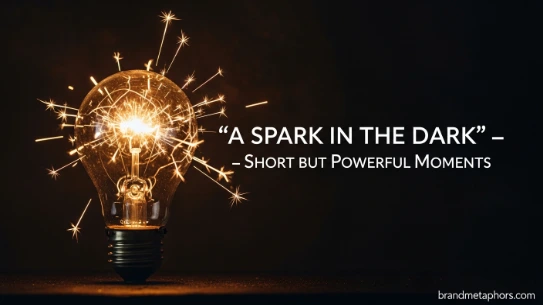
1. “A Spark in the Dark” – Short but Powerful Moments
Meaning and Explanation
This metaphor describes something brief but intensely impactful. A spark lasts only a moment, yet it has the power to light fire, change darkness, and draw attention instantly.
It captures the idea that “short” does not mean weak—it often means concentrated energy.
Example Sentence / Scenario
- Her speech was a spark in the dark—just two minutes long, but it changed how everyone saw the issue.
Imagine a crowded room where everything feels heavy and slow. Then someone speaks just a few sentences. Suddenly, the atmosphere shifts. That is the spark effect—short but transformative.
Alternative Expressions
- A flash of lightning
- A match struck in silence
- A burst of firelight
- A sudden flare in the night
Sensory and Emotional Detail
You can almost hear it—the sharp scratch of the match, the quick hiss of ignition, the sudden glow that vanishes too soon. It feels urgent, alive, and unforgettable.
Mini Story
In an old town hall meeting, an elderly woman stood up. No one expected much. She spoke only 45 seconds. Her words were simple, almost fragile. But they exposed a truth everyone had been avoiding for years. By the time she sat down, the room had changed forever. People later said her words were “a spark in the dark.”
Interactive Exercise
Try writing a 2–3 sentence message (like a quote, caption, or speech line) that could change someone’s perspective. Then describe it using this metaphor.
2. “A Pocket of Time” – Short Duration with Depth
Meaning and Explanation
This metaphor refers to a brief period that feels contained, special, or emotionally rich. Like a pocket holding something valuable, a short moment becomes something you can “carry” in memory.
It emphasizes that short experiences are not empty—they are condensed.
Example Sentence / Scenario
- Their childhood friendship was just a pocket of time, but it shaped their entire adulthood.
Even if something is brief, it can still hold meaning that lasts a lifetime.
Alternative Expressions
- A folded moment
- A capsule of time
- A sealed memory
- A brief chapter
Sensory and Emotional Detail
Think of slipping your hand into a coat pocket and finding something unexpected—a note, a coin, a dried leaf. Small, but meaningful. That’s how short moments feel when they matter.
Mini Story
A traveler missed his train by only ten minutes. Frustrated, he sat on a bench. In that short delay, he met someone who later became his business partner and lifelong friend. He always said, “That missed train wasn’t a delay—it was a pocket of time that changed my life.”
Interactive Exercise
Write about a short real-life moment (a conversation, meeting, or accident). Then reframe it as a “pocket of time” and describe what value it held.
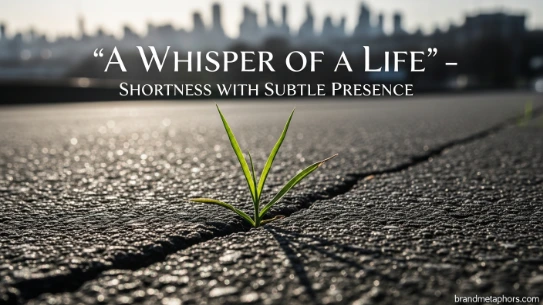
3. “A Whisper of a Life” – Shortness with Subtle Presence
Meaning and Explanation
This metaphor is often used to describe something or someone whose presence is brief, delicate, or understated—but still emotionally powerful.
A whisper is soft, but it demands attention. It makes the listener lean in.
Example Sentence / Scenario
- The old photograph was a whisper of a life she barely remembered, yet it filled her with emotion.
It suggests fragility, fading, or minimal presence—but also intimacy.
Alternative Expressions
- A fading echo
- A breath of existence
- A soft trace
- A vanishing imprint
Sensory and Emotional Detail
Imagine standing in a quiet room where someone just spoke. You can’t see them anymore, but their presence lingers in the air. That is the emotional texture of a “whisper of a life.”
Mini Story
A museum curator once displayed a child’s shoe from a forgotten era. There was no name, no story attached—just the object. Visitors often paused longer at that display than others. It felt like a whisper of a life—small, silent, but deeply human.
Interactive Exercise
Think of an object in your home. Write a short paragraph imagining it as a “whisper of a life” belonging to someone unknown.
Why Metaphors for Short Matter in Writing and Daily Life
Metaphors for “short” help us reshape how we see brevity. Instead of associating shortness with lack, we start associating it with:
- intensity
- emotional weight
- precision
- memory
- meaning
In writing, they help create stronger imagery, conversation, they make speech more expressive. In social media, they make captions more engaging and memorable.
Even in daily life, they help us appreciate small moments—a short laugh, a brief meeting, a quick glance.
Bonus Tips: Using Metaphors for Short in Real Life
1. In Writing
Use metaphors like “spark,” “pocket,” or “whisper” in:
- poetry
- short stories
- journaling
- essays
They make your language feel cinematic.
2. In Social Media Captions
Instead of saying:
- “short trip but nice”
Try:
- “a pocket of time I didn’t want to end”
- “a spark of escape in an ordinary week”
3. In Daily Conversations
Metaphors can make storytelling more engaging:
- “It was just a spark of a moment, but I’ll remember it forever.”
Creative Challenge: Make Your Own Metaphor for Short

Try completing these prompts:
- “A short moment is like ______ because ______.”
- “Her laughter was a ______ in the middle of ______.”
- “That day felt like a ______ I could carry in my pocket.”
You can also combine sensory details:
- sound (whisper, echo, silence)
- light (spark, flash, glow)
- space (pocket, corner, crease)
FAQs About Metaphors for Short
What are metaphors for short?
Metaphors for short are creative expressions that describe smallness, brevity, or limited duration using imaginative comparisons instead of literal language.
Why are metaphors for short important in writing?
They help transform simple ideas into vivid imagery, making writing more emotional, memorable, and engaging for readers.
Can metaphors for short be used in poetry and storytelling?
Yes, they are widely used in poetry and storytelling to express fleeting moments, emotions, or experiences in a powerful way.
What is a simple example of a metaphor for short?
A common example is “a spark in the dark,” which describes something brief but impactful.
How can I create my own metaphors for short?
Think of small things in nature or daily life (spark, whisper, drop, blink) and connect them to emotions or experiences.
Conclusion
“Short” is one of those words that seems simple until you look closer. It can describe a second, a sentence, a person, or a lifetime of memories compressed into a single feeling.
Through metaphors like a spark in the dark, a pocket of time, and a whisper of a life, we discover that brevity is not emptiness—it is concentration. It is the art of saying more with less.
And perhaps that is the real lesson: the shortest things often stay with us the longest.