
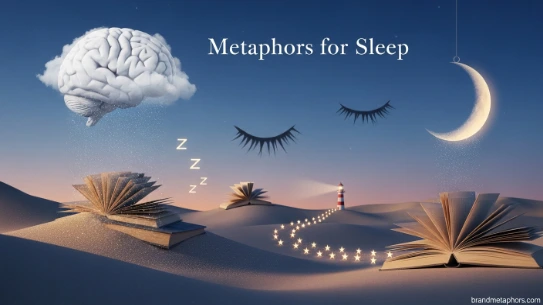
The world slowly fades as the room grows quieter. Lights dim into soft shadows, thoughts loosen their grip, and your body begins to sink—not downward in space, but inward, into something quieter, softer, almost weightless. Sleep arrives like an invisible tide, pulling everything sharp and loud into a distant horizon.
We all experience sleep, but few of us truly describe it in ways that capture its mystery. That is where metaphors for sleep become powerful. They help us translate an invisible biological process into something vivid, emotional, and artistic.
Writers, poets, storytellers, and even everyday communicators use sleep metaphors to express rest, dreams, exhaustion, peace, and escape.
In this article, we’ll explore beautiful metaphors for sleep, their meanings, variations, sensory depth, and real-life usage. You’ll also find creative exercises, storytelling inspiration, and practical ways to use these expressions in writing or daily conversation.
Understanding Metaphors for Sleep: Why They Matter
A metaphor is a figure of speech that describes one thing in terms of another, often unrelated, thing. When we say “sleep is a blanket,” we don’t mean it literally. We mean sleep feels like something warm, covering, and comforting.
Metaphors for sleep are especially powerful because sleep itself is invisible and internal. We cannot watch it directly; we experience it.
Using metaphors for sleep helps to:
- Express emotions like exhaustion, peace, or escape
- Enhance storytelling and poetry
- Create vivid imagery in writing
- Connect physical rest with emotional or psychological states
Now let’s explore some rich, creative metaphors for sleep and how you can use them.
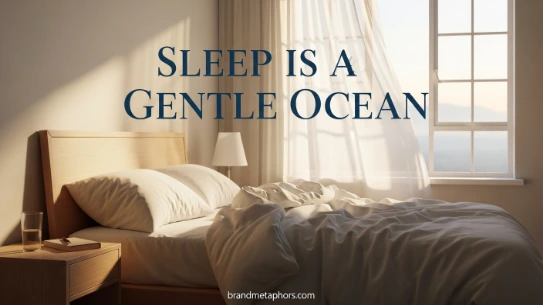
Metaphor 1: Sleep is a Gentle Ocean
Meaning & Explanation
Sleep as an ocean suggests something vast, rhythmic, and deeply immersive. Just as waves pull a swimmer deeper into water, sleep pulls the mind away from waking reality.
This metaphor captures:
- The gradual loss of awareness
- The soothing rhythm of rest
- The feeling of being carried rather than forced
Example Sentence
“By midnight, sleep became a gentle ocean, and I drifted away from the shore of consciousness.”
Alternative Expressions
- Sleep is a tide pulling me under
- Sleep is a sea without edges
- I was carried away on waves of sleep
Sensory & Emotional Details
Imagine floating in warm water under a moonless sky. There is no resistance, no urgency—only slow motion. Thoughts dissolve like salt in water.
Mini Storytelling Element
A fisherman returning after a long day at sea once said that sleep at night felt “like returning to the same ocean I had been fighting all day, except this time it held me instead of pushing me back.” This captures how sleep can feel both familiar and surrendering.
Interactive Exercise
Try writing your own sentence:
- Describe a night when you were extremely tired using the ocean metaphor.
- Replace “sleep” with another ocean-related image (current, reef, deep water, tide).
Metaphor 2: Sleep is a Velvet Curtain Falling
Meaning & Explanation
This metaphor frames sleep as something theatrical and gentle, like a curtain closing at the end of a performance. It suggests finality, softness, and transition.
It emphasizes:
- The shift from waking life to dreams
- The quiet ending of the day
- A sense of closure and peace
Example Sentence
“As soon as my head touched the pillow, sleep dropped like a velvet curtain, ending the noisy stage of the day.”
Alternative Expressions
- Sleep is a curtain of darkness drawn across the mind
- Night closes like soft theater drapes
- Consciousness fades behind a velvet screen
Sensory & Emotional Details
Picture heavy velvet sliding down slowly—silent, thick, comforting. The world behind it fades into dim light, then disappears completely.
Cultural or Literary Touch
In classical theater traditions, the curtain signals the end of a story. Similarly, sleep marks the end of our daily narrative, allowing a new “act” of dreams to begin.
Interactive Exercise
Write a short paragraph describing your bedtime routine as if it were the closing of a theater performance. What is your final “scene”?
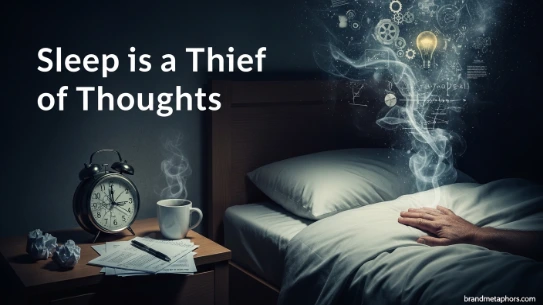
Metaphor 3: Sleep is a Thief of Thoughts
Meaning & Explanation
This metaphor presents sleep as something that quietly steals awareness, worries, and mental activity. It has a slightly mysterious or even playful tone.
It reflects:
- Sudden or unplanned sleepiness
- Loss of control over thought
- The brain shutting down gently but decisively
Example Sentence
“Exhaustion turned sleep into a thief, stealing my thoughts one by one until silence remained.”
Alternative Expressions
- Sleep is a silent burglar of awareness
- Sleep steals my worries before I notice
- Night quietly takes everything heavy from my mind
Sensory & Emotional Details
Imagine thoughts slipping away like objects being quietly removed from a room while you are still half-aware. There is no fear—only surrender.
Mini Storytelling Element
Students often describe falling asleep while studying as “losing the battle against sleep.” One student once said, “I was reading a page, and suddenly sleep stole the paragraph I was on—and then the whole book.”
Interactive Exercise
Think of a stressful day. Rewrite it imagining sleep as something that “steals” each worry from your mind. What does it take first?
Bonus Tips: Using Sleep Metaphors in Writing and Daily Life
Metaphors for sleep aren’t just poetic—they are useful tools for communication.
Writing
- Use them in stories to show character exhaustion
- Enhance mood in poetry or fiction
- Build atmosphere in horror, romance, or fantasy scenes
Social Media
- “Tonight, sleep is a gentle ocean—I’m going under 🌙”
- “My brain just got stolen by sleep again 😴”
- “Curtain closed on another long day”
Daily Conversation
Instead of saying:
- “I’m tired”
You can say:
- “Sleep is calling me like a tide”
- “I feel like I’m slipping behind a velvet curtain”
This makes communication more expressive and memorable.
Creative Practice: Build Your Own Sleep Metaphor
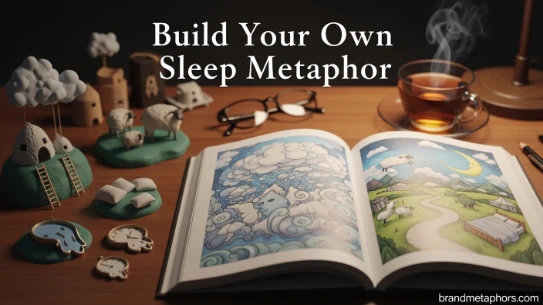
Try this simple exercise:
- Think of sleep as something in nature (river, forest, sky)
- Think of sleep as an object (blanket, door, curtain)
- Think of sleep as an action (stealing, floating, closing)
Now combine them:
- “Sleep is a forest where thoughts lose their path.”
- “Sleep is a door that closes without a sound.”
- “Sleep floats like smoke through the mind.”
There is no right or wrong—only imagination.
Cultural and Literary Inspirations for Sleep Metaphors
Throughout literature, sleep has often been portrayed as:
- A “cousin of death” in classical poetry
- A “healing balm” in romantic literature
- A “portal to dreams” in mythology
For example, in many cultures, sleep is seen as a sacred space where the soul travels. Ancient Greek mythology even imagined Hypnos, the god of sleep, gently guiding humans into rest.
These cultural ideas deepen how we use sleep metaphors today—they are not just artistic, but ancient.
Why Sleep Metaphors Help Us Understand Ourselves
Sleep is not only physical rest—it is emotional reset, mental silence, and sometimes escape. When we use metaphors for sleep, we:
- Understand our relationship with exhaustion
- Express emotional states more clearly
- Transform a daily routine into something meaningful
Language shapes perception. If sleep is a “curtain,” we may see it as closure, it is an “ocean,” we may see it as surrender. If it is a “thief,” we may feel its suddenness.
Frequently Asked Questions (FAQs)
What are metaphors for sleep?
Metaphors for sleep are creative expressions that describe sleep using imagery like nature, objects, or actions to make it more vivid and emotional.
Why do writers use sleep metaphors?
Writers use them to create mood, deepen storytelling, and help readers feel the experience of sleep rather than just understand it logically.
Can sleep metaphors improve my writing?
Yes. They make descriptions more engaging, poetic, and memorable, especially in fiction, poetry, and personal essays.
What is a simple metaphor for sleep?
A simple example is “Sleep is a blanket,” meaning sleep feels warm, comforting, and covering.
How can I create my own sleep metaphor?
Think of sleep as something you experience emotionally, then compare it to an object, place, or action that feels similar.
Conclusion
Sleep is universal, yet deeply personal. Every night, we surrender to it differently—sometimes willingly, sometimes reluctantly, always mysteriously. By using metaphors for sleep, we turn this ordinary experience into something expressive, artistic, and meaningful.
Whether sleep is an ocean carrying you away, a curtain closing your day, or a quiet thief stealing your thoughts, each image helps you see rest in a new light.
And perhaps that is the beauty of language—it allows even silence to be described in the most vivid ways.