

Introduction
Imagine sitting in a quiet room while someone speaks to you. Their words sound smooth, calm, and carefully chosen. But something feels off. You cannot point to it, yet your mind keeps questioning every sentence.
Later, you discover the truth was hidden, shaped, or twisted. This is where metaphors for lying become powerful. They help us understand what deception feels like, not just what it is.
Lying is not only about false words. It is about broken trust, mixed signals, and hidden intentions. That is why we often describe lies using images like masks, smoke, shadows, or webs.
These metaphors make an invisible act visible. They help us recognize patterns in human behavior that are otherwise hard to explain.
In this article, we will explore deep and meaningful metaphors for lying. Each one reveals a different side of deception—how it works, how it spreads, and how it affects relationships in real life.
1. Lies as a Mask: Hiding the True Face
One of the most common metaphors for lying is the mask. A mask hides the real face while showing a different identity to the world. In the same way, a liar presents a version of truth that is carefully shaped.
When someone wears a mask, you cannot see their real emotions. They may smile while feeling something completely different inside. Lies work the same way. The words sound real, but the truth stays hidden behind them.
Everyday meaning
In daily life, this happens when people pretend everything is fine while hiding problems. A friend may say “I’m okay,” even when they are hurting. The mask keeps others from seeing reality.
Deeper insight
This metaphor shows that lying is not only about words. It is about emotional distance. The mask creates separation between who someone is and what they show.
Over time, wearing a mask becomes tiring. The truth always tries to break through, just like a face eventually feels uncomfortable under a covering.
2. Lies as Broken Mirrors: Distorted Reality

A broken mirror is another strong metaphor for lying. When a mirror cracks, it no longer reflects a clear image. Instead, it shows distorted pieces of reality.
Lies work in the same way. They take the truth and break it into fragments. Each fragment may still contain part of reality, but the full picture is gone.
What this means
A liar may mix truth and falsehood together. Because of this, the listener sees something that feels real but is actually incomplete.
Emotional effect
This metaphor also explains confusion. When people are lied to, they often feel unsure about what is real anymore. Just like looking into a broken mirror, they see themselves and the world in distorted ways.
The danger of this kind of lying is not only deception—it is confusion. It makes trust harder to rebuild because the reflection of truth has been shattered.
3. Lies as Smoke and Mirrors: Illusion and Trickery
The phrase smoke and mirrors comes from illusion shows, where performers hide reality using fog and reflections. This is a perfect metaphor for lying.
How it works
Smoke hides clear vision, while mirrors mislead the eye. Together, they create confusion and distraction. A liar uses similar techniques by changing focus, avoiding direct answers, or distracting from truth.
Real-life example
Someone may avoid answering a direct question by changing the topic. The listener becomes focused on something else and forgets the original question.
Deeper meaning
This metaphor shows that lies are not always direct false statements. Sometimes they are distractions that prevent people from seeing clearly.
Smoke eventually clears, and mirrors stop deceiving when examined closely. This teaches us that truth, although hidden, does not disappear.
4. Lies as Spider Webs: Getting Caught in Complexity
A spider web represents how lies grow and connect. One small lie often requires another to support it. Over time, this creates a complex structure that is hard to escape.
How it develops
A person tells a small lie. Later, they must tell another to protect the first one. Slowly, the web expands.
Emotional experience
Being caught in a web of lies feels confusing and stressful. The more you try to escape, the more entangled you become.
Life lesson
This metaphor teaches that honesty is simpler. Lies require memory, planning, and constant repair. Truth, on the other hand, remains stable and easy to maintain.
Like a web, deception may look organized at first, but it becomes fragile when examined closely.
5. Lies as Shadows: Hiding Behind Light
A shadow is formed when something blocks light. In metaphors for lying, shadows represent hidden truths that stay out of sight.
Meaning
A liar often avoids full exposure of facts. Just like shadows follow objects, lies exist wherever truth is blocked.
Everyday example
Someone may hide part of a story, only revealing what benefits them. The missing parts remain in shadow.
Emotional impact
Shadows create uncertainty. You can see shapes but not details. In relationships, this leads to doubt and suspicion.
This metaphor also shows that truth always exists somewhere nearby. If light changes direction, shadows move or disappear. Similarly, honesty can reveal what was hidden.
6. Lies as Cracked Glass: Weakening Trust
Cracked glass is another powerful image. Once glass breaks, even slightly, it loses strength. It may still hold together, but it is fragile.
What it represents
Lies weaken trust between people. Even small lies can create cracks in relationships.
Real-life situation
A friend who lies once may still be trusted, but doubt begins to grow. Over time, the cracks spread.
Deeper insight
This metaphor shows that trust is delicate. It does not break instantly; it weakens slowly.
Repairing cracked glass is difficult, just like rebuilding trust after deception. Even if fixed, the marks often remain visible.
7. Lies as Theater: Acting a False Role
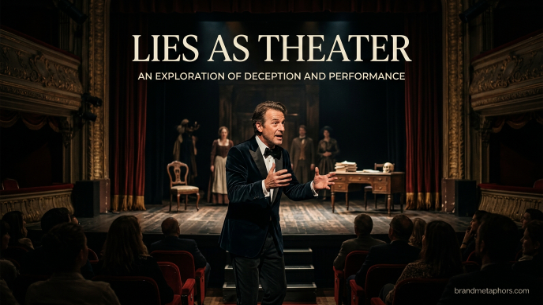
In the metaphor of theater, lying becomes a performance. The liar plays a role, speaks scripted lines, and hides their real self.
How it appears
People may exaggerate, pretend, or act differently depending on their audience.
H3: The audience effect
Just like actors, liars adjust behavior based on who is watching. This creates different versions of the same person.
Emotional meaning
This metaphor shows that lying can involve identity change. The person becomes a performer rather than their true self.
However, acting requires effort. Eventually, the performance becomes hard to maintain, and the real identity struggles to stay hidden.
8. Lies as Poisoned Honey: Sweet but Harmful
Poisoned honey is a striking metaphor. Honey looks sweet and safe, but poison inside makes it dangerous.
Meaning
Some lies sound comforting. They are designed to please or protect feelings, but they hide harmful truth.
Example
A person may give false praise or reassurance that leads someone into wrong decisions.
Insight
This metaphor shows that not all lies feel bad at first. Some feel good but cause harm later.
The sweetness hides the danger. Only time reveals the effect.
9. Lies as a Labyrinth: Getting Lost in Truth
A labyrinth is a complex maze with many paths and dead ends. Lies create similar confusion.
How it works
When information is false or mixed, it becomes hard to find the truth.
Emotional effect
People may feel stuck, unsure which direction is right. Every answer leads to more questions.
Life lesson
This metaphor teaches that clarity is important. Without it, we wander in confusion created by deception.
Truth is usually simple, while lies often overcomplicate reality.
10. Lies as Thin Paper: Fragile Stories
A thin sheet of paper is easy to tear. This metaphor represents how fragile lies are.
Meaning
Lies may look complete at first, but they lack strength.
Real-life example
A single question or contradiction can expose a lie quickly.
Deeper insight
This shows that lies depend on protection. Without support, they collapse easily.
Truth, on the other hand, does not need defense. It stands strong on its own.
11. Lies as Storms: Emotional Turbulence
A storm represents emotional chaos created by lying.
What it shows
Lies often lead to arguments, confusion, and emotional pain.
Example
When truth comes out after a lie, relationships may feel like they are in a storm—unstable and intense.
Insight
This metaphor highlights that deception is not quiet. It creates emotional weather that affects everyone involved.
But like storms, these moments eventually pass, leaving lessons behind.
12. Lies as Threads: Weaving False Stories

Lies can also be seen as threads woven into stories. Each thread represents a detail added to make the story stronger.
Meaning
A liar connects small details to build a believable story.
Example
One false detail requires another to support it, forming a connected narrative.
Deeper insight
This metaphor shows that lies are constructed, not natural. They are built piece by piece.
However, like weak fabric, too many false threads make the story unstable.
13. Lies as Fog: Blurring Understanding
Fog is one of the clearest metaphors for lying. It reduces visibility and makes everything unclear.
Meaning
Lies do not always destroy truth—they blur it.
Real-life example
Conflicting information can make it hard to know what actually happened.
Insight
Fog does not change reality; it only hides it. In the same way, lies obscure truth without removing it.
When clarity returns, the truth is still there, just as objects reappear when fog clears.
Conclusion
Metaphors for lying help us understand deception in a deeper and more human way. Whether it is a mask hiding identity, smoke hiding clarity, or a web trapping truth, each image shows a different side of dishonesty. These metaphors remind us that lying is not just about words—it is about trust, emotion, and perception.
In real life, lies may seem small, but they often grow, distort, or weaken relationships over time. Yet these same metaphors also show something hopeful: truth is never fully destroyed. It may be hidden, cracked, or blurred, but it remains beneath the surface. When clarity returns, honesty always finds its way back.