
Introduction
Imagine standing in front of a mirror that doesn’t just reflect your face, but your memories, your choices, your fears, and your dreams. What would you see? A single, fixed version of yourself—or something shifting, layered, and alive? Identity is one of the most complex and deeply personal aspects of being human. Yet, it can be difficult to define in plain terms. That’s where metaphors come in.
Metaphors give shape to the abstract. They help us explore identity not as a rigid label, but as something dynamic, evolving, and deeply interconnected with our experiences. Whether we see ourselves as a story, a journey, or even a mosaic, these comparisons allow us to better understand who we are and how we change over time.
In this article, we’ll explore a wide range of metaphors for identity—each offering a unique lens through which to view the self. Through relatable examples, storytelling, and thoughtful reflection, you’ll discover new ways to think about your identity and how it influences your life.
Identity as a Story
One of the most powerful metaphors for identity is the idea that we are all living stories. Your identity isn’t just who you are right now—it’s the narrative you’ve been writing since your earliest memory.
Think about it: your past experiences form the “chapters,” your struggles are the plot twists, and your decisions shape the direction of the story. This metaphor emphasizes that identity is not fixed. Just like a story, it evolves.
The Author Within
You are both the main character and the author of your life. While you may not control every event, you do shape how you respond.
- A failure becomes a lesson.
- A heartbreak becomes growth.
- A risk becomes a turning point.
Practical Insight
When you see your identity as a story, you gain agency. You can rewrite limiting beliefs and choose new directions. Instead of feeling stuck, you begin to ask: What kind of story do I want to tell next?
Identity as a Journey
Identity is often compared to a journey—a path filled with movement, change, and discovery.
Unlike a destination, identity isn’t something you “arrive at.” It’s something you continuously experience.
Roads, Detours, and Growth
On a journey:
- Some paths are smooth.
- Others are uncertain or difficult.
- Sometimes you take detours that lead to unexpected growth.
For example, someone who changes careers multiple times might feel lost. But through the journey metaphor, those changes become exploration rather than confusion.
Lesson to Apply
Embrace uncertainty. Not knowing exactly who you are can be part of discovering who you’re becoming.
Identity as a Mosaic
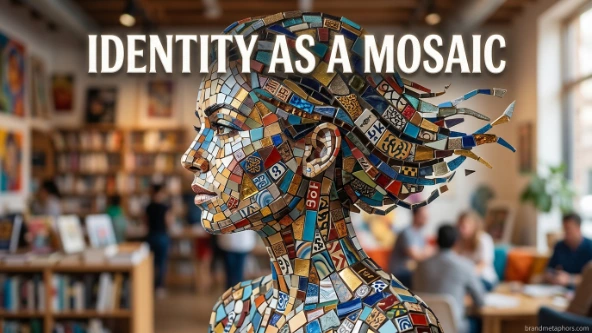
Imagine a mosaic made of tiny, colorful pieces. Each piece represents a different part of your identity—culture, values, relationships, experiences.
Individually, the pieces may seem unrelated. But together, they form something meaningful and unique.
Layers of Self
- Your family background
- Your beliefs
- Your passions
- Your struggles
All of these contribute to your overall identity.
Real-Life Reflection
Someone who feels “inconsistent” may actually have a rich mosaic identity—multi-faceted rather than confused.
Key Insight
You don’t have to reduce yourself to one label. Your identity can be beautifully complex.
Identity as a Mask
Sometimes, identity is described as a mask—something we wear in different situations.
We act differently with friends, family, or at work. These variations don’t necessarily mean we’re fake; they reflect adaptability.
Authenticity vs Performance
The danger lies in forgetting what’s behind the mask.
- Are you expressing yourself?
- Or hiding who you truly are?
Mini Story
A student who acts confident in class but feels insecure inside may be wearing a “confidence mask.” Over time, this mask can either become genuine confidence—or lead to emotional disconnect.
Lesson
Use masks as tools, not prisons. Stay aware of your core self beneath them.
Identity as a Tree
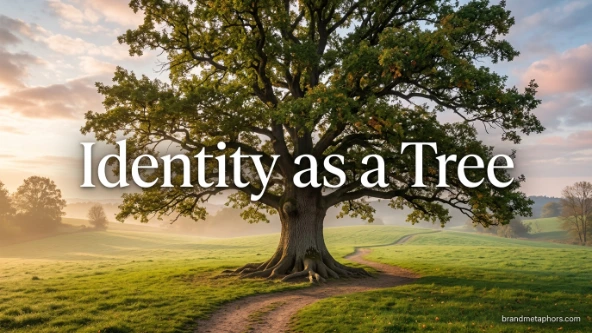
The tree metaphor beautifully captures both stability and growth.
- Roots represent your past and upbringing.
- The trunk symbolizes your core values.
- Branches show your choices and directions.
- Leaves represent experiences and relationships.
Growth Over Time
Trees grow slowly but steadily. They adapt to seasons, storms, and environments.
Emotional Insight
Even if branches break, the tree can still grow.
Practical Takeaway
Your roots matter—but they don’t limit your growth. You can expand beyond where you started.
Identity as a River
A river is constantly moving, yet it remains the same river. This metaphor highlights fluidity.
Constant Change
- Water flows and changes shape.
- It adapts to obstacles.
- It keeps moving forward.
Similarly, your identity shifts with new experiences.
Letting Go
Just as a river doesn’t hold onto the same water, you don’t have to hold onto past versions of yourself.
Reflection
Who you were five years ago isn’t who you are today—and that’s not loss, it’s evolution.
Identity as a Puzzle
Identity can also feel like a puzzle—something you’re trying to piece together.
Missing Pieces
At times, you may feel incomplete:
- Unsure of your purpose
- Conflicted about your beliefs
- Searching for clarity
The Ongoing Process
Unlike a fixed puzzle, identity keeps adding new pieces.
Insight
You don’t need to “complete” yourself to have value. The process of discovering is part of your identity.
Identity as a Mirror
The mirror metaphor explores self-perception.
Who you think you are isn’t always who you truly are—it’s a reflection influenced by others and your own thoughts.
Distorted Reflections
- Praise can inflate identity.
- Criticism can shrink it.
- Social expectations can warp it.
Real-Life Scenario
Someone constantly told they’re “not good enough” may begin to believe it—even if it’s untrue.
Lesson
Question your reflection. Ask whether it’s accurate or shaped by external voices.
Identity as a Garden

Think of identity as a garden that needs care, attention, and intention.
What You Grow Matters
- Positive habits = healthy plants
- Negative patterns = weeds
Daily Choices
What you nurture grows stronger.
Practical Application
If you want to become more confident, kind, or disciplined, you must actively cultivate those traits.
Reflection
Neglecting your identity allows unwanted patterns to take over—just like an untended garden.
Identity as a Role
We all play roles in life—student, friend, parent, professional.
Multiple Identities
Each role highlights a different aspect of who you are.
The Risk
Confusing your role with your entire identity can be limiting.
For example, losing a job might feel like losing yourself—if your identity was tied solely to that role.
Insight
You are more than any single role. Roles change; your deeper identity persists.
Identity as a Shadow
The shadow metaphor represents the hidden or unacknowledged parts of ourselves.
The Unseen Self
- Fears
- Insecurities
- Suppressed desires
Ignoring the shadow doesn’t make it disappear—it influences behavior from the background.
Mini Story
A person who denies their anger may express it in passive-aggressive ways.
Lesson
Understanding your shadow leads to greater self-awareness and balance.
Identity as a Compass

Identity can act as a compass, guiding decisions and actions.
Direction and Values
Your beliefs and values help you navigate life.
- What feels right?
- What aligns with your principles?
When the Compass Breaks
Confusion about identity often leads to feeling lost.
Practical Insight
Clarify your values to strengthen your sense of direction.
Identity as a Canvas
Imagine your identity as a blank canvas.
Creative Freedom
- Your choices are brushstrokes.
- Your experiences add color.
- Your mistakes create texture.
No Single “Right” Version
There’s no perfect painting—only expression.
Real-Life Meaning
You’re not bound by past definitions. You can reinvent yourself.
Identity as a Voice
Your identity is also the voice within—the one that speaks your truth.
Finding Your Voice
Some people struggle to express who they really are.
- Fear of judgment
- Desire to fit in
- Lack of confidence
Strength in Expression
When you speak authentically, your identity becomes clearer and stronger.
Lesson
Your voice matters. Suppressing it weakens your connection to yourself.
Common Misunderstandings About Identity
Identity Is Not Fixed
Many people believe identity is permanent. In reality, it evolves.
Identity Is Not One-Dimensional
You are not just your job, culture, or personality trait.
Identity Is Not Defined by Others
External opinions influence—but don’t define—you.
Identity Is Not Something You “Find” Once
It’s something you continuously shape.
Conclusion
Identity is not a single definition—it’s a collection of meanings, experiences, and possibilities. Through metaphors like stories, journeys, mosaics, and rivers, we begin to see that identity is not something rigid or confined. It is alive, evolving, and deeply personal.
The beauty of these metaphors lies in their flexibility. On some days, you may feel like a puzzle still coming together. On others, you may feel like a tree, grounded and growing. Each perspective offers insight into different aspects of who you are.
Ultimately, understanding your identity is less about reaching a final answer and more about embracing the process. The more you explore, reflect, and express yourself, the clearer your sense of identity becomes. And in that clarity, you find not just who you are—but who you can become.
FAQs
What is a metaphor for identity?
A metaphor for identity is a symbolic comparison (like a journey or story) that helps explain the complex and evolving nature of who we are.
Why are metaphors useful for understanding identity?
Metaphors simplify abstract ideas, making identity easier to explore, reflect on, and relate to in everyday life.
Can identity change over time?
Yes, identity is dynamic and evolves based on experiences, choices, and personal growth.
What is the most common metaphor for identity?
The “identity as a story” metaphor is widely used because it highlights personal growth and narrative development.
How can I discover my identity?
Through reflection, experiences, values exploration, and self-expression—rather than expecting a single fixed answer.
Is having multiple identities normal?
Yes, people naturally have multiple roles and aspects that form a complex, multi-layered identity.
How do I stay true to my identity?
By understanding your values, expressing yourself honestly, and being mindful of external influences on your self-perception.