
Imagine a long table set for a community dinner. Every plate is polished. Every glass catches the warm glow of the lights. But then you notice something: one person has a full meal, another has only a few crumbs, and someone at the end of the table has no chair at all.
At first glance, it looks like everyone has been invited. But is that really equality?
Equality is more than treating people with basic respect. It is the idea that everyone deserves the same fundamental rights, dignity, opportunities, and freedom to participate. Because equality can sometimes feel abstract, metaphors give us a simple and memorable way to understand it. A strong metaphor can turn an idea about fairness into something we can see, feel, and remember.
Whether you are writing an essay, creating a speech, making a social media post, teaching students, or simply trying to explain fairness in everyday conversation, metaphors for equality can make your message more powerful.
Below are vivid metaphors that show equality from different angles, from shared sunlight to balanced scales and open doors.
What Are Metaphors for Equality?
Metaphors for equality are figurative expressions that help us understand fairness, balance, and justice by comparing them to familiar experiences. Instead of defining equality in abstract terms, metaphors turn it into something we can see, feel, and relate to.
Equality, at its core, means giving everyone the same value, rights, and opportunities. But that idea can feel distant or overly formal. Metaphors bring it closer—they make equality human.
Why Metaphors for Equality Matter in Writing and Life
Words shape perception. The way we talk about equality influences how we think about it—and how we act.
Metaphors:
- Simplify complex ideas
- Create emotional connections
- Inspire empathy and action
Think about it: saying “everyone deserves equal opportunities” is powerful—but saying “everyone deserves a fair starting line” paints a picture you can’t ignore.
When we use metaphors, we don’t just explain equality—we make people feel it.
The Level Playing Field: A Classic Metaphor for Equality
Meaning and Explanation
A “level playing field” suggests fairness where no one has an advantage or disadvantage. It comes from sports, where uneven ground would unfairly favor one team.
Example Scenario
Imagine a job interview process where all candidates are judged by the same criteria, with no bias or favoritism. That’s a level playing field.
Example Sentence: “True progress begins when we create a level playing field for everyone, regardless of their background.”
Alternative Ways to Express It
- Equal footing
- Fair ground
- Balanced arena
Sensory & Emotional Layer
You can almost feel it—the steady ground beneath your feet, the certainty that no one is slipping while others sprint ahead.
Mini Storytelling
A young runner once trained on rough terrain while others practiced on smooth tracks. When race day came, she stumbled—not because she lacked skill, but because she’d never been given the same ground. Equality, in this sense, is about smoothing the track for everyone.
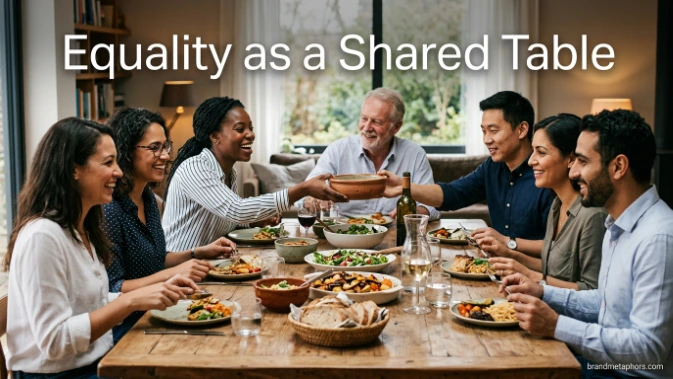
Equality as a Shared Table: A Powerful Social Metaphor
Meaning and Explanation
The metaphor of a “shared table” represents inclusion—everyone has a seat, a voice, and access to resources.
Example Scenario
In a workplace meeting, all team members are encouraged to share ideas, and each opinion is respected.
Example Sentence: “Equality means pulling up more chairs so everyone has a place at the table.”
Alternative Expressions
- A seat for everyone
- An open table
- A circle of voices
Sensory & Emotional Details
Picture the warmth of a meal shared among many, the clinking of glasses, the hum of conversation—no one excluded, no one invisible.
Cultural Reference
Across many cultures, sharing food symbolizes unity. From family dinners to community feasts, the table becomes a quiet declaration: you belong here.
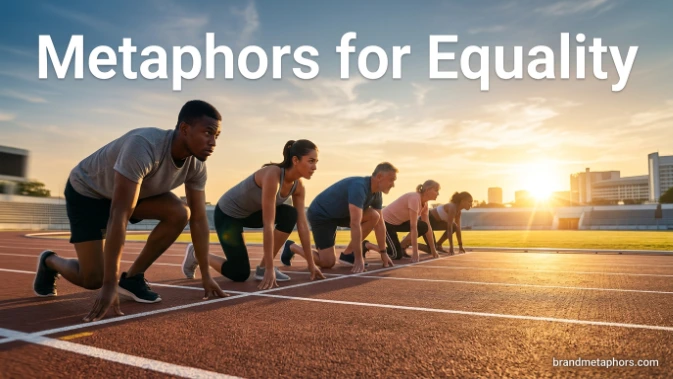
The Same Starting Line: Equality in Opportunity
Meaning and Explanation
This metaphor emphasizes equal beginnings. It doesn’t guarantee identical outcomes, but it ensures everyone starts with the same chance.
Example Scenario
Students from different backgrounds receiving equal access to quality education and resources.
Example Sentence: “Justice isn’t about everyone finishing the race together—it’s about everyone starting from the same line.”
Alternative Expressions
- Equal beginnings
- A fair start
- The same launch point
Emotional Insight
There’s a thrill in standing at a starting line—heart pounding, eyes forward. Equality ensures that moment belongs to everyone.
Real-Life Reflection
In many societies, people begin life at vastly different “starting lines.” Recognizing this metaphor helps us understand why equality often requires more than sameness—it requires fairness.
Balancing the Scales: Justice and Equality
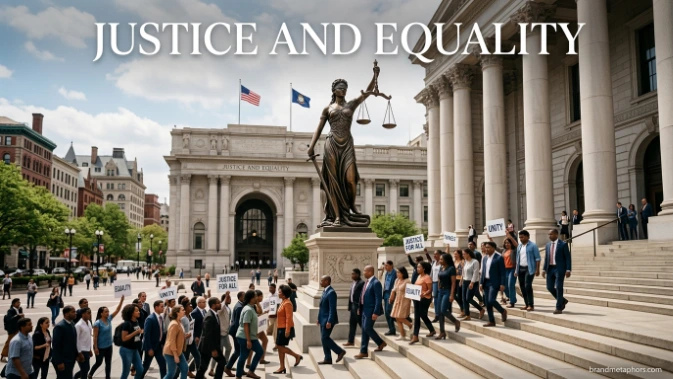
The image of scales balancing evenly is one of the oldest metaphors for equality. It suggests fairness, impartiality, and justice.
When the scales tip too far in one direction, inequality emerges. Restoring balance becomes the goal.
Example Sentence: “Policies must work to balance the scales for those who have been historically disadvantaged.”
Alternative expressions:
- Restoring balance
- Equal weight
- Fair measure
This metaphor carries a quiet gravity. You can almost hear the soft clink as the scales settle into equilibrium.
Equality as Light: Illuminating Every Corner
Light doesn’t choose where to shine—it spreads naturally, reaching every surface it can.
Equality, like light, should be universal.
Example Sentence: “Opportunity should shine like sunlight, reaching every corner of society.”
Alternative expressions:
- Equal illumination
- Shared brightness
- Universal light
This metaphor evokes warmth, clarity, and hope. It suggests that equality isn’t something we ration—it’s something we expand.
Equality as a Bridge: Connecting Divides
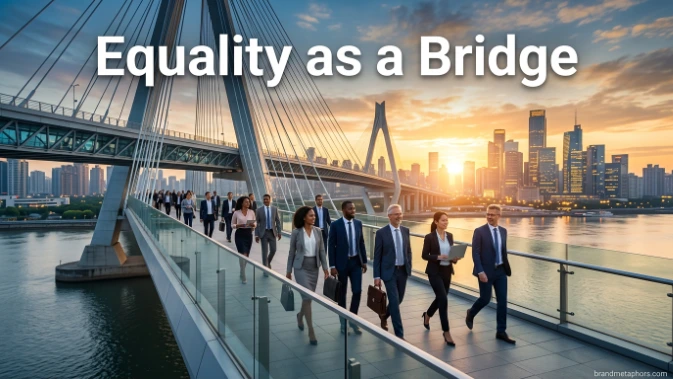
A bridge links two separate places, allowing movement, understanding, and connection.
Equality acts as that bridge between people of different backgrounds, identities, and experiences.
Example Sentence: “Empathy builds the bridge that equality walks across.”
Alternative expressions:
- Closing the gap
- Building connections
- Crossing divides
This metaphor is especially powerful in discussions about social unity—it emphasizes movement toward one another.
Equality as a Garden: Growth with Care
In a garden, every plant needs sunlight, water, and care—but not always in the same way.
Equality doesn’t mean identical treatment—it means giving each plant what it needs to thrive.
Example Sentence: “True equality is like tending a garden—every individual needs care suited to them.”
Alternative expressions:
- Nurtured growth
- Equal care
- Flourishing together
This metaphor gently introduces the idea of equity—an essential companion to equality.
Interactive Exercises: Practice Metaphors for Equality
Ready to create your own? Try these prompts:
Sensory Metaphor Exercise
Think about equality using one of the five senses:
- What does equality sound like?
- What does it feel like?
Prompt: “Equality feels like ______ because ______.”
Personal Experience Prompt
Recall a moment when something felt unfair or fair.
Write: “Equality is like ______ because in my experience ______.”
Creative Comparison Challenge
Compare equality to something unexpected:
- A storm
- A song
- A journey
Push your imagination.
Tips for Using Equality Metaphors in Writing
Make It Relatable
Choose images your audience understands—sports, food, nature, or daily life.
Keep It Simple
Avoid overly complex metaphors. Clarity creates impact.
Add Emotion
The best metaphors don’t just explain—they move people.
Using Equality Metaphors in Social Media and Daily Life
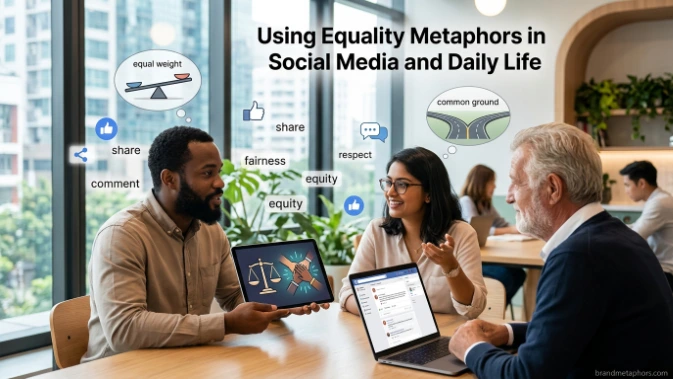
Short, vivid metaphors work beautifully in:
- Instagram captions
- Speeches
- Classroom discussions
Examples:
- “Equality is sunlight—meant for everyone.”
- “Pull up a chair—there’s room for all of us.”
In conversations, metaphors can soften difficult topics and open doors to understanding.
Common Mistakes to Avoid
- Overused clichés without fresh context
- Mixed metaphors that confuse readers
- Overcomplication that dilutes meaning
Keep your imagery consistent and purposeful.
FAQs About Metaphors for Equality
What is the best metaphor for equality?
There’s no single “best” metaphor—it depends on context. Common ones include a level playing field, a shared table, and a starting line.
How do metaphors help explain equality?
They make abstract ideas concrete, helping people visualize and emotionally connect with fairness and justice.
Can metaphors influence social change?
Yes. Powerful metaphors shape how people think, which can influence attitudes, conversations, and policies.
What’s the difference between equality and equity in metaphors?
Equality metaphors focus on sameness (same starting line), while equity metaphors emphasize fairness (different support for different needs, like a garden).
How can I create my own metaphor for equality?
Start with a familiar object or experience, then connect it to fairness or balance. Keep it simple and meaningful.
What does equality really mean?
Equality means recognizing that people deserve equal fundamental dignity, rights, and fair opportunities, even when their lives and identities are different.
Is equality the same as treating everyone exactly the same?
Not always. Equal dignity and rights are central to equality, while fairness may sometimes require addressing different barriers or circumstances.
Why are metaphors useful for explaining equality?
Metaphors turn abstract ideas into familiar images. A balanced scale, open door, or shared table can make fairness easier to understand and remember.
How can I use equality metaphors in an essay?
Choose a metaphor that matches your argument, explain what it represents, and connect it directly to your main point. Avoid using a metaphor without explaining its meaning.
What is the most powerful metaphor for equality?
There is no single best metaphor. A balanced scale works well for justice, a level playing field for opportunity, an open door for access, and a shared table for inclusion.
Conclusion
Equality can sometimes feel like a huge idea floating above everyday life—something discussed in classrooms, courtrooms, speeches, and history books.
But metaphors bring it back down to earth.
Equality can be a balanced scale, where fairness matters.
It can be a level playing field, where everyone gets a genuine chance.
It can be an open door, where opportunity is not unfairly restricted.
And perhaps most importantly, equality can be a garden, where every person has room to grow
The strongest metaphor is not necessarily the most poetic one. It is the one that makes someone pause, picture the idea, and understand it in a new way.
Because fairness is not merely something we define.
It is something we imagine, communicate, practice, and build—one open door, one shared table, and one level playing field at a time.