
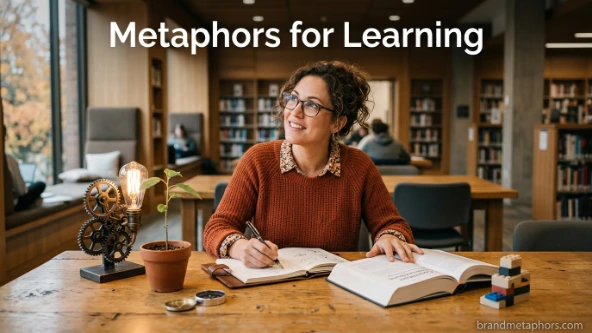
The Lantern in the Fog: Why Learning Needs Metaphors
Picture a child standing at the edge of a forest at dusk. The path ahead is hidden beneath mist, and every step feels uncertain. Then someone places a lantern in the child’s hands. Suddenly, the unknown becomes less frightening. The trees take shape. The ground becomes visible. The journey begins.
That is exactly what metaphors do for learning.
Learning is often invisible. We cannot touch knowledge or hold understanding in our palms. Yet metaphors give learning a physical shape. They transform confusing ideas into vivid experiences we can imagine, feel, and remember. A difficult lesson becomes a mountain to climb, a puzzle to solve, or a seed waiting to grow. Through metaphors, education becomes more human, emotional, and alive.
Writers, teachers, students, and storytellers have used metaphors for centuries to explain how people absorb wisdom and develop skills. From ancient philosophers comparing the mind to a garden to modern educators describing learning as a journey, these comparisons help us connect emotionally with growth and discovery.
In this article, you will explore powerful metaphors for learning, their meanings, creative examples, emotional depth, and practical ways to use them in writing, conversations, social media captions, and daily life. Along the way, you will also discover interactive exercises and storytelling prompts that can help you experience learning in a fresh and imaginative way.
Learning as a Journey
Why This Metaphor Works
One of the most common metaphors for learning compares it to a journey. Every learner starts somewhere, travels through obstacles, and slowly reaches new destinations of understanding.
Unlike a race, a journey allows pauses, detours, and unexpected discoveries. This metaphor reminds us that learning takes time and patience.
Example Scenario
A teenager struggling with mathematics finally understands algebra after months of frustration. Instead of seeing failure, they realize they were simply traveling through a difficult stretch of road.
Example Sentence: “Learning calculus felt like crossing a long desert, but every solved equation became an oasis.”
Alternative Ways to Express It
- Learning is a winding road.
- Knowledge is a map.
- Education is a voyage across unknown seas.
- Wisdom is the destination after many miles.
Emotional and Sensory Details
This metaphor often carries feelings of hope, curiosity, exhaustion, and excitement. You can almost hear the crunch of gravel beneath your feet or feel the wind of change pushing you forward.
Literary Reference
In many classic stories, heroes gain wisdom during physical journeys. In Homer’s Odyssey, every challenge teaches Odysseus something about survival, pride, and humanity.
Learning as Planting Seeds
Meaning Behind the Metaphor
Knowledge rarely blooms overnight. Like seeds planted in soil, ideas require patience, nourishment, and time before growth appears.
Teachers become gardeners. Curiosity becomes sunlight. Practice becomes water.
Example Scenario
A student learns a new language for years before finally speaking fluently during a trip abroad.
Example Sentence: “My teacher planted seeds of confidence that later blossomed into a love for science.”
Alternative Expressions
- Ideas bloom over time.
- Knowledge grows like a tree.
- Curiosity is fertile soil.
- Education waters the mind.
Mini Storytelling Example
An elderly grandfather teaches his granddaughter to read every evening under a mango tree. Years later, she becomes a novelist and remembers those quiet moments as the roots of her dreams.
Bonus Writing Tip
This metaphor works beautifully in emotional speeches, graduation messages, and inspirational social media captions.
Social Caption Example: “Every small lesson today is a seed for tomorrow’s success.”
Learning as Climbing a Mountain

Why People Relate to It
Some lessons feel steep and exhausting. The mountain metaphor captures struggle, perseverance, and achievement.
Every chapter mastered becomes another step upward.
Example Scenario
A medical student spends sleepless nights studying anatomy, eventually graduating after years of sacrifice.
Example Sentence: “Each exam felt like another rocky ledge on the mountain of becoming a doctor.”
Alternative Phrases
- Education is an uphill climb.
- Knowledge sits at the summit.
- Learning requires endurance.
- Wisdom waits above the clouds.
Sensory Imagery
This metaphor evokes cold winds, aching muscles, and breathtaking views from the top. It transforms education into a heroic adventure.
Cultural Connection
Many spiritual traditions use mountains as symbols of enlightenment and personal growth. Climbing becomes both physical and emotional transformation.
Learning as Building a House
The Core Idea
Knowledge needs structure. One lesson supports another like bricks in a house.
Without a strong foundation, advanced ideas may collapse.
Example Scenario
A child learns basic grammar before writing essays and stories later in life.
Example Sentence: “Her vocabulary became the bricks that built her confidence as a writer.”
Alternative Ways to Say It
- Education lays foundations.
- Skills are building blocks.
- Learning creates architecture in the mind.
- Understanding supports higher knowledge.
Real-Life Reflection
Think about musicians learning scales before symphonies or athletes mastering balance before complex movements. Foundations matter in every field.
Bonus Tip for Daily Life
Use this metaphor when encouraging someone who feels behind. Remind them that even skyscrapers begin with a single stone.
Learning as Lighting a Fire
Meaning and Symbolism
This metaphor focuses on passion and inspiration rather than memorization.
Learning is not about filling an empty bucket. It is about igniting curiosity.
Example Scenario
A history teacher tells stories so vividly that students begin researching ancient civilizations for fun.
Example Sentence: “One inspiring lecture lit a fire in her heart for astronomy.”
Alternative Expressions
- Curiosity sparks learning.
- Education fuels the flame of imagination.
- Knowledge burns brightly.
- Passion ignites growth.
Emotional Impact
Fire represents energy, warmth, danger, and transformation. This metaphor creates emotional intensity and motivation.
Literary Connection
The Greek myth of Prometheus stealing fire for humanity symbolizes the gift of knowledge and progress.
Learning as Opening Doors
Why This Metaphor Is Powerful
Education creates opportunities. Every new skill unlocks another room of possibility.
This metaphor emphasizes freedom, access, and discovery.
Example Scenario
Someone learns coding online and eventually changes careers into software development.
Example Sentence: “Reading opened doors she never knew existed.”
Alternative Ways to Express It
- Knowledge unlocks potential.
- Education opens hidden gates.
- Learning creates pathways.
- Wisdom holds the key.
Sensory Details
Imagine rusty doors creaking open into bright rooms filled with possibility. The metaphor feels hopeful and adventurous.
Practical Use in Writing
This metaphor is especially effective in motivational articles, scholarship essays, and educational campaigns.
Learning as a River
Understanding the Comparison
A river constantly moves and changes direction. Learning flows in the same way.
Sometimes it moves gently. Sometimes it crashes through obstacles.
Example Scenario
An artist continuously experiments with new techniques throughout life.
Example Sentence: “Her understanding of music flowed like a river, always moving and deepening.”
Alternative Expressions
- Knowledge flows endlessly.
- Learning follows changing currents.
- Wisdom runs deep.
- Education moves like water.
Emotional Texture
Rivers can feel peaceful or overwhelming. This flexibility makes the metaphor useful for describing different educational experiences.
Cultural Symbolism
In many cultures, rivers symbolize life, transformation, and spiritual renewal. Learning shares those same qualities.
Learning as Solving a Puzzle
Why It Connects with Learners
Every lesson contains pieces that must fit together. This metaphor highlights logic, patience, and discovery.
Example Scenario
A programmer spends hours debugging code until the solution suddenly clicks into place.
Example Sentence: “Physics became less terrifying once he learned how the pieces fit together.”
Alternative Ways to Say It
- Knowledge is a puzzle waiting to be solved.
- Understanding connects the pieces.
- Learning reveals hidden patterns.
- Education completes the picture.
Interactive Reader Exercise
Take a difficult subject you are learning right now. Imagine it as a giant puzzle.
Ask yourself:
- Which pieces do I already understand?
- Which pieces are missing?
- What small section can I solve today?
This exercise reduces overwhelm and creates clarity.
Learning as Sailing Through Storms
The Deeper Meaning
Not every educational experience is easy. Some moments feel chaotic, discouraging, or frightening.
This metaphor teaches resilience.
Example Scenario
A student fails an important exam but studies harder and succeeds later.
Example Sentence: “She learned to steer through storms instead of abandoning the ship.”
Alternative Expressions
- Education weathers storms.
- Learning survives rough seas.
- Wisdom guides the ship.
- Knowledge becomes the compass.
Emotional Resonance
This metaphor captures anxiety, uncertainty, courage, and hope all at once.
Mini Storytelling Example
A young entrepreneur loses money during her first business attempt. Instead of quitting, she studies marketing and finance, eventually building a successful company. The storm becomes her teacher.
Learning as Discovering Treasure

Why This Metaphor Inspires People
Learning often rewards effort with unexpected riches. Those riches may be confidence, skill, opportunity, or understanding.
Example Scenario
A child reads a random science book and discovers a lifelong passion for space exploration.
Example Sentence: “Every library felt like a treasure chest waiting to be opened.”
Alternative Ways to Express It
- Knowledge is hidden gold.
- Education uncovers gems of wisdom.
- Learning reveals priceless treasures.
- Curiosity leads to riches.
Sensory and Emotional Details
Treasure metaphors create excitement and wonder. They remind readers that discovery can feel magical.
Writing Tip
Use treasure imagery in children’s writing, motivational content, or educational storytelling to create excitement around learning.
Creative Exercises for Using Metaphors for Learning
Exercise 1: Describe Your Current Learning Journey
Choose something you are learning right now.
Then complete this sentence:
“Learning ___ feels like ___ because ___.”
Example: “Learning photography feels like learning to dance in the dark because I am slowly finding rhythm through mistakes.”
Exercise 2: Create a Personal Learning Symbol
Draw or imagine an object that represents your growth.
It could be:
- A bridge
- A lantern
- A compass
- A staircase
- A growing tree
Write five sentences explaining why it matches your educational experience.
Exercise 3: Social Media Challenge
Write a short caption using a learning metaphor.
Examples:
- “Every mistake is another stepping stone.”
- “My mind is a garden, and curiosity keeps blooming.”
- “Still climbing, still learning.”
These captions work beautifully on Instagram, Facebook, LinkedIn, or journals.
Tips for Using Metaphors for Learning in Writing and Daily Life
Use Familiar Images
Readers connect more deeply with metaphors they already understand. Nature, travel, fire, and buildings are universal experiences.
Match the Emotion
Choose a metaphor that reflects the emotional tone of your message.
- Hopeful tone → doors opening
- Difficult struggle → mountain climbing
- Slow growth → planting seeds
- Inspiration → lighting a fire
Avoid Mixing Too Many Metaphors
Keep imagery consistent. Switching from rivers to mountains to rockets in one paragraph can confuse readers.
Add Sensory Language
Good metaphors engage the senses.
Instead of saying:
“Learning was hard.”
Try:
“Learning felt like dragging heavy boots through thick snow.”
Use Metaphors in Conversations
Metaphors are not only for poets and authors. They help explain emotions and experiences in everyday life.
For example:
- “I finally see the bigger picture.”
- “I’m still finding my footing.”
- “That lesson opened my eyes.”
The Emotional Power of Learning Metaphors
Why the Brain Loves Metaphors
Humans naturally think in images and stories. Metaphors connect abstract concepts to physical experiences, making ideas easier to remember.
When students hear that “knowledge is a bridge,” they instantly imagine connection and movement.
Emotional Connection Creates Memory
Facts alone are often forgotten. But emotional imagery stays alive in memory for years.
Many people cannot recall every school lesson, yet they remember a teacher saying:
“Your future is waiting just beyond this hill.”
That sentence becomes unforgettable because it paints a picture.
Real-Life Importance
Metaphors encourage resilience during difficult learning experiences. They remind people that confusion is temporary and growth is possible.
A struggling student may feel hopeless. But if learning becomes a mountain climb instead of a personal failure, the challenge suddenly feels meaningful.
Conclusion
Learning is one of the most beautiful and mysterious experiences in human life. It changes who we are, how we think, and how we understand the world around us. Yet because learning is invisible, metaphors help give it shape and color.
Sometimes learning is a winding journey through unfamiliar lands. At times it is a tiny seed waiting for rain. Sometimes it is a roaring fire, a hidden treasure, or a stormy sea that teaches survival.
These metaphors do more than decorate language. They create emotional connection, deepen understanding, and make education feel alive. Whether you are a writer, teacher, student, parent, or lifelong learner, using metaphors for learning can transform ordinary communication into something vivid and memorable.
The next time you struggle to learn something new, pause for a moment and ask yourself:
“What metaphor describes my journey today?”
The answer may reveal not only how you learn, but who you are becoming along the way.
FAQs
What are metaphors for learning?
Metaphors for learning are imaginative comparisons that describe education, growth, and understanding using vivid images or experiences. Examples include learning as a journey, a garden, or a mountain climb.
Why are metaphors important in education?
Metaphors make complex ideas easier to understand and remember. They also create emotional connection and encourage creativity in both teaching and learning.
What is the best metaphor for learning?
There is no single best metaphor. Some people relate most to learning as a journey, while others connect with growth, fire, rivers, or puzzles depending on their experiences.
How can students use learning metaphors?
Students can use metaphors in essays, journaling, presentations, storytelling, and personal reflection to describe challenges, goals, and achievements more creatively.
Can metaphors improve writing skills?
Yes. Metaphors add depth, emotion, and imagery to writing. They make descriptions more engaging and help readers visualize ideas clearly.