
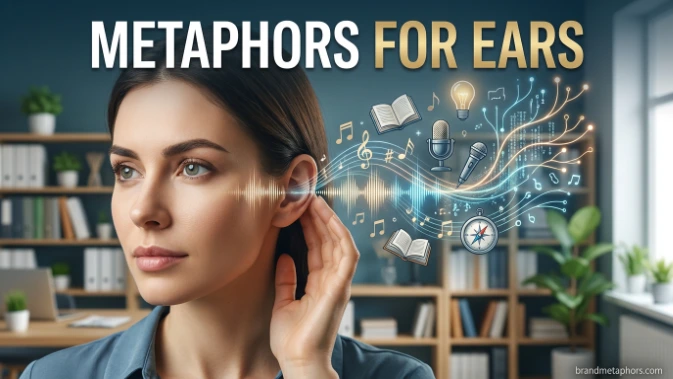
Imagine sitting beside a quiet window while rain taps against the glass. At first, you hear only a soft rhythm—tap, tap, tap. Then you notice the deeper rumble of thunder, the whisper of wind through the trees, and perhaps even the faint sound of someone walking down the hallway.
Your ears have been working all along.
But ears do more than simply receive sounds. In writing and everyday speech, they can become doors, bridges, antennas, windows, or even hungry creatures that take in the world around us. These comparisons are called metaphors, and they help us describe hearing and listening in ways that feel vivid, emotional, and memorable.
Instead of saying, “She listened carefully,” you might write, “Her ears were open doors, welcoming every word.”
That single image tells us much more.
Metaphors for ears can make stories more expressive, explain the difference between hearing and listening, describe someone’s attention, or capture the emotional effect of a voice, song, whisper, or silence. They are especially useful for writers, students, teachers, speakers, social media creators, and anyone who wants ordinary language to sound more alive.
Below are powerful ways to describe ears, listening, and hearing through imaginative comparisons.
What Are Metaphors for Ears? (And Why They Matter)
Metaphors for ears are imaginative comparisons that describe listening in a symbolic or poetic way. Instead of saying “she listened carefully,” you might say, “her ears were open windows catching every breeze of sound.”
Why does this matter?
Because listening is not just physical—it’s emotional, psychological, and sometimes even spiritual. The metaphors we use reflect:
- Attention (Are we truly listening?)
- Emotion (How do we receive words?)
- Intent (Are we open, guarded, selective?)
Good metaphors make your writing:
- More vivid
- More relatable
- More memorable
They also help readers feel what listening is like, not just understand it.
Why Use Ear Metaphors in Writing and Speech
Think about the difference:
- “He ignored her.”
- “Her words fell on ears sealed like stone.”
The second one lingers. It paints a picture. It creates emotion.
Using metaphors for ears helps you:
- Show character traits (attentive, dismissive, curious)
- Build atmosphere in storytelling
- Add poetic depth to everyday language
- Make communication more expressive and engaging
Whether you’re writing a story, a social media caption, or even having a heartfelt conversation, these metaphors can elevate your words.
Ears as Open Doors
Meaning and Explanation
This metaphor suggests receptiveness and willingness to listen. Open doors invite entry—just as open ears welcome ideas, emotions, and stories.
Example Sentence
“Whenever I needed to talk, her ears were open doors, always ready to let my thoughts in.”
Alternative Expressions
- “His ears were wide gates to every story.”
- “She listened like an unlocked room waiting to be filled.”
- “His ears stood open like a porch on a summer evening.”
Mini Storytelling Moment
Think of a teacher who stays after class, not because they have to, but because they want to hear what students are struggling with. Their ears are not just open—they are inviting. In many ways, this metaphor reflects empathy.
Sensory & Emotional Detail
Warmth. Light spilling through a doorway. The quiet comfort of being welcomed.
Ears as Filters or Sieves

Meaning and Explanation
This metaphor highlights selectivity—how people choose what to hear and what to ignore.
Example Sentence
“His ears were like sieves, catching praise but letting criticism slip through.”
Alternative Expressions
- “Her ears filtered truth from noise.”
- “He listened through a net, keeping only what pleased him.”
- “Her ears were selective gates, choosing which voices mattered.”
Real-Life Reflection
We all do this. In a crowded room—or even in life—we don’t hear everything equally. Compliments stick. Criticism stings (or gets blocked).
Sensory & Emotional Detail
The soft rustle of things slipping away. The tension of deciding what stays and what goes.
Ears as Hungry Mouths
Meaning and Explanation
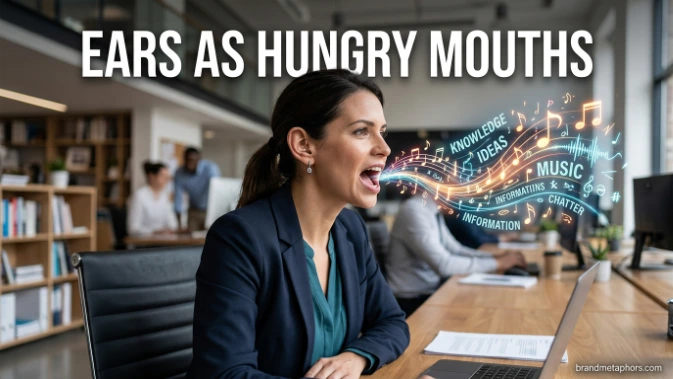
This metaphor suggests eagerness—an intense desire to hear more.
Example Sentence
“The children’s ears were hungry mouths, devouring every word of the bedtime story.”
Alternative Expressions
- “Her ears drank in every syllable.”
- “He fed on stories with eager ears.”
- “Their ears consumed the music like a feast.”
Mini Storytelling Moment
Picture a grandparent telling stories of the past, while grandchildren sit wide-eyed, leaning closer. Their ears aren’t passive—they are active participants, hungry for every detail.
Sensory & Emotional Detail
Taste, anticipation, satisfaction—the feeling of being filled by words.
Creative Variations: Expanding Your Metaphor Toolbox
Once you understand the core metaphors, you can mix and match ideas:
- Ears as Gardens → nurturing words, growing ideas
- Ears as Shields → blocking unwanted noise
- Ears as Antennas → detecting subtle signals
- Ears as Echo Chambers → repeating what’s heard
Try combining them:
“Her ears were gardens with selective gates—only kind words were allowed to bloom.”
Interactive Exercise: Create Your Own Ear Metaphors
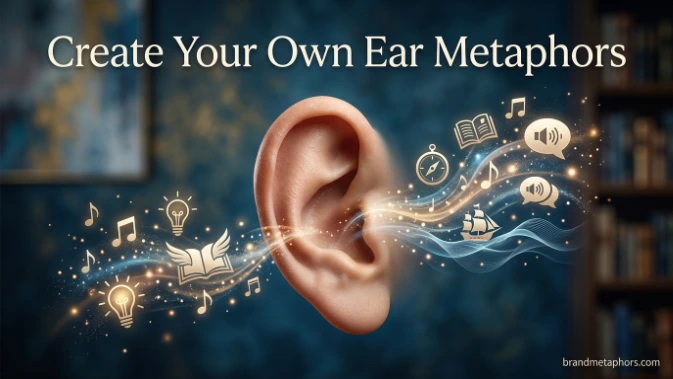
Try this simple but powerful exercise:
Choose a Quality
Think about how someone listens:
- Attentively
- Selectively
- Indifferently
- Passionately
Match It to an Object
What object behaves similarly?
- Sponge
- Wall
- Door
- Radio
Build the Metaphor
Example: “His ears were like a sponge, soaking up every whispered secret.”
Your Turn
Complete these:
- “Her ears were like ______ because ______.”
- “His ears became ______ when he heard the news.”
- “Their ears felt like ______ in the noisy room.”
Using Ear Metaphors in Storytelling
In storytelling, ears reveal character.
- A detective has antenna-like ears, catching subtle clues
- A stubborn character has stone ears, refusing to listen
- A lover has open-door ears, absorbing every word
These metaphors help readers understand characters without direct explanation.
Example Scene
“She spoke softly, but his ears were walls. Her words hit, echoed, and fell—never once getting through.”
This shows emotional distance more effectively than simply stating it.
Metaphors for Ears in Everyday Conversations
You don’t need to be a writer to use these.
Try them in daily life:
- “I’m all ears” (classic and effective)
- “My ears were glued to the conversation”
- “His ears shut the moment criticism began”
These phrases make your speech more colorful and expressive.
Social Media & Creative Writing Tips
Want to stand out online or in creative work?
Quick Tips
- Use short, vivid metaphors in captions
- Pair metaphors with emotion
- Avoid overcomplicating—clarity matters
Example Caption
“Tonight, my ears were open windows, catching every note of the music drifting through the city.”
Bonus Tips: Making Your Metaphors More Powerful
To elevate your metaphors:
1. Add Sensory Layers
Combine sound with sight, touch, or emotion → “Her ears were velvet doors, softly opening to every word.”
2. Keep It Relatable
Choose objects people understand → doors, water, light, food
3. Avoid Clichés (When Possible)
“I’m all ears” is fine—but try new variations for originality.
4. Match Tone to Context
- Poetic → “ears like moonlit lakes”
- Casual → “ears like Bluetooth receivers”
Practice Prompts for Deeper Creativity
Try these:
- Write a paragraph describing someone who refuses to listen using at least two metaphors.
- Describe a magical character whose ears can hear emotions.
- Create a metaphor for ears in a noisy city versus a quiet forest.
Frequently Asked Questions (FAQs)
What is a metaphor for ears?
A metaphor for ears is a figurative expression that compares ears to something else (like doors or sponges) to describe how someone listens or responds to sound.
Why are ear metaphors useful in writing?
They add vivid imagery, emotional depth, and help readers better understand characters and situations.
Can I use ear metaphors in everyday speech?
Absolutely. They make conversations more engaging and expressive.
How do I create original metaphors?
Think about the listening behavior, match it with an object that behaves similarly, and build a comparison.
Are ear metaphors only for creative writing?
No—they can be used in speeches, social media, teaching, and even casual conversation.
What is a good metaphor for ears?
A strong metaphor is “ears are open doors.” It suggests that someone is receptive, attentive, and willing to listen. Other choices include ears as antennas, windows, bridges, shelters, or radar.
What is a metaphor for listening carefully?
A useful metaphor is “her attention was a spotlight following every word.” You can also describe careful listening as radar, a net catching details, or an antenna tuned to a particular voice.
How can I describe ears in creative writing?
Compare ears to an object that matches the mood. Use doors for openness, walls for refusal, antennas for alertness, gardens for music, and shelters for emotional listening. Add sensory details to make the image stronger.
What is a metaphor for hearing a beautiful sound?
You could write, “The music was a river flowing through her ears.” Other possibilities include “notes bloomed in his ears” or “the melody poured into the room like sunlight.”
What is the difference between hearing and listening in metaphorical language?
Hearing can be imagined as sound knocking on a door, while listening is opening that door and inviting the sound inside. The first emphasizes receiving sound; the second emphasizes attention and intention.
Conclusion
Our ears are small physical features, but metaphorically they can become enormous landscapes.
They can be open doors welcoming stories, antennas searching for signals, windows revealing distant worlds, bridges connecting hearts, gardens where music blooms, or shelters where vulnerable words can rest.
That is why metaphors for ears are so useful. They transform an ordinary act—hearing—into something readers can see, feel, and remember.
The next time you write about someone listening, pause before using the simple phrase “she listened carefully.”
Ask yourself:
What does her listening feel like?
Is it a door opening?
A radar searching?
A bridge forming?
A garden receiving rain?
A hungry creature waiting for one more story?
Choose the image that matches the emotion, and suddenly your sentence has a heartbeat.