
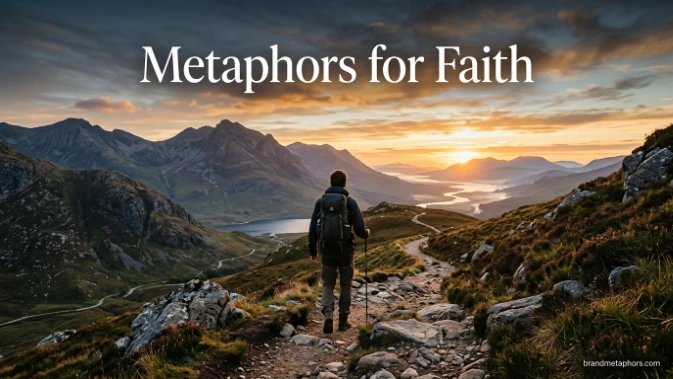
Imagine standing outside just before sunrise. The sky is still dark, the air is cool, and you cannot yet see the sun. Still, you know morning is coming. You wait. You trust the light will arrive, even though the horizon gives you only the faintest hint of what is ahead.
That quiet confidence is one way to understand faith.
Faith can be difficult to explain because it is often deeply personal. It may involve trust, hope, belief, courage, or a sense that something meaningful exists beyond what we can immediately see. A metaphor gives these invisible feelings a visible shape. Instead of simply saying that faith means trust, we can describe it as a lighthouse in a storm, a seed beneath the soil, or a bridge across uncertainty.
These comparisons make faith easier to understand and more powerful to express. They can help writers create emotional images, help speakers explain difficult ideas, and help ordinary people describe what faith feels like in daily life.
What Is Faith? Understanding the Abstract Through Imagery

Faith is often described as belief without proof—but that definition feels incomplete. Faith is also trust, hope, endurance, and sometimes even quiet rebellion against despair.
Metaphors help bridge the gap between the abstract and the tangible. They allow us to “see” faith, to experience it through familiar images—like light, seeds, or journeys. When we use metaphors, we aren’t just explaining faith; we’re making it felt.
Why Metaphors for Faith Matter in Writing and Life
Metaphors are not just literary devices—they are tools for connection. When you describe faith as a “bridge over uncertainty” or a “seed in winter soil,” you invite others into your experience.
They matter because:
- They make complex emotions relatable
- They add beauty and depth to communication
- They help us process our own beliefs
In a world that often demands certainty, metaphors allow space for mystery—and that’s where faith thrives.
Faith as a Seed: Growth in the Unseen
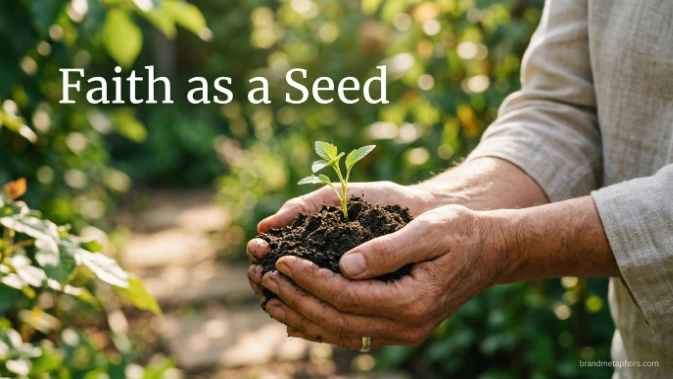
Meaning/Explanation: Faith as a seed represents potential, patience, and trust in unseen growth. A seed buried in soil looks lifeless, yet it contains everything needed to become something extraordinary.
Example Scenario: A student keeps working toward a dream career despite repeated failures. Their belief in eventual success is like planting seeds they cannot yet see.
Example Sentence: “Her faith was a seed buried deep, quietly preparing to bloom in its own time.”
Alternative Expressions:
- Faith is a garden waiting for spring
- Faith is a root growing in silence
- Faith is a hidden harvest
Sensory/Emotional Details: Imagine damp soil under your fingers, the quiet stillness of earth, the patience of waiting for green to break through.
Mini Storytelling: Think of farmers who sow fields before the rains arrive. They trust cycles they cannot control. Faith works the same way—we plant hope before we see results.
Faith as a Bridge: Crossing the Unknown
Meaning/Explanation: This metaphor emphasizes transition and trust. A bridge connects where you are to where you want to be—even if the path below feels dangerous.
Example Scenario: Someone leaving a stable job to pursue a passion relies on faith to “cross” into uncertainty.
Example Sentence: “Faith became the bridge she walked when the ground beneath her disappeared.”
Alternative Expressions:
- Faith is a pathway through doubt
- Faith is a crossing over fear
- Faith is a rope stretched across uncertainty
Sensory/Emotional Details: Feel the sway beneath your feet, the wind against your skin, the tension between fear and hope as you step forward.
Cultural Reference: In many spiritual traditions, crossing water symbolizes transformation—faith is often the unseen structure that makes that crossing possible.
Faith as a Flame: Light in Darkness
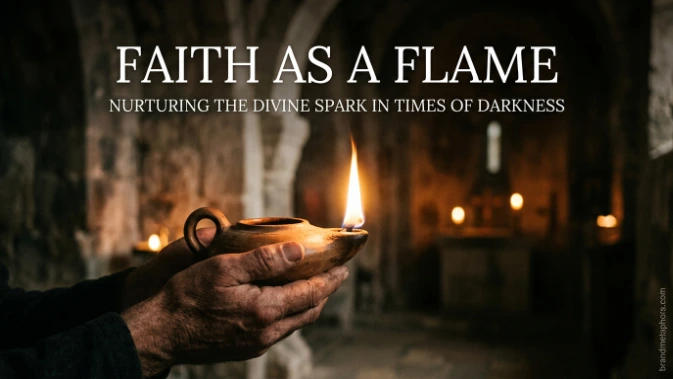
Meaning/Explanation: Faith as a flame represents resilience, warmth, and guidance. Even a small flame can push back darkness.
Example Scenario: During a personal crisis, someone holds onto hope despite overwhelming odds.
Example Sentence: “In the darkest hours, his faith flickered like a stubborn flame, refusing to go out.”
Alternative Expressions:
- Faith is a candle in the night
- Faith is a spark that refuses extinction
- Faith is a quiet fire within
Sensory/Emotional Details: Picture the soft glow of firelight, the warmth on your face, the fragile yet persistent flicker.
Mini Storytelling: Consider stories of people who survived hardship—war, loss, illness—often describing a “light” that kept them going. That light is faith in metaphorical form.
More Metaphors for Faith to Enrich Your Expression
Faith as an Anchor: Stability in Storms
Trust keeps you grounded when life becomes chaotic.
Faith as a Compass: Direction Without Certainty
It doesn’t show the full map, but it points you forward.
Faith as Wings: Rising Above Fear
Faith gives courage to leap when logic says stay.
How to Create Your Own Metaphors for Faith
Creating metaphors is an art, but it’s also a practice. Here’s how you can do it:
- Start with a feeling: What does faith feel like to you? Calm? Tension? Hope?
- Connect it to something tangible: Nature, objects, or everyday experiences
- Expand the image: Add sensory details—what does it look, sound, or feel like?
Example Exercise: Faith feels like waiting → Waiting like dawn → Faith is dawn breaking after a long night.
Practice Your Faith Metaphors
Fill in the Blank
“Faith is like ______ because ______.”
Try to write at least five variations.
Sensory Expansion
Pick one metaphor and describe it using all five senses.
Story Prompt
Write a short paragraph where a character relies on faith. Use at least one metaphor to show (not tell) their belief.
Using Faith Metaphors in Writing and Social Media
Tips for Writers
- Use metaphors sparingly but meaningfully
- Avoid clichés—add a unique twist
- Match the tone of your metaphor to your message
Social Media Ideas
- “Faith is my anchor in today’s storm.”
- “Planting seeds of faith, even when I see no rain.”
- Pair metaphors with visuals (e.g., candles, bridges, seeds)
Common Mistakes to Avoid
- Overcomplicating the metaphor: Keep it clear
- Mixing metaphors: Don’t confuse your imagery
- Forgetting emotional resonance: Metaphors should feel, not just sound clever
Expanding Faith Metaphors Across Cultures and Literature
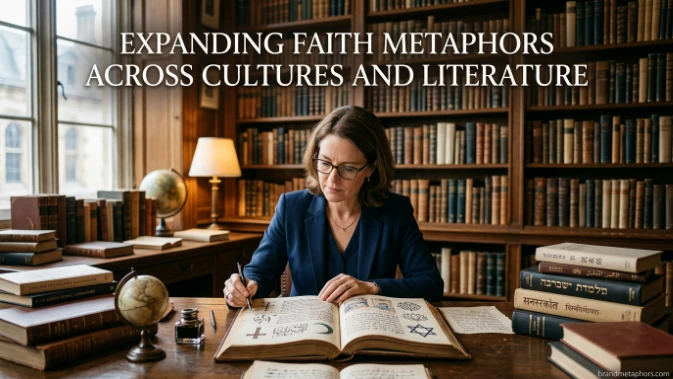
Faith appears in countless forms across cultures:
- In poetry, it’s often light or water
- In religious texts, it’s a path or a shepherd’s guidance
- In modern storytelling, it may be resilience or inner strength
Exploring these variations can deepen your understanding and enrich your writing.
Bringing It All Together: Living Your Metaphors
Metaphors are not just words—they can shape how you live. If you see faith as a seed, you may become more patient. If you see it as a bridge, you may take more risks.
The metaphors you choose influence the way you experience belief itself.
FAQs About Metaphors for Faith
Why are metaphors important for understanding faith?
They make abstract ideas tangible, helping people relate to and express their beliefs.
Can I create my own metaphors for faith?
Absolutely. Personal metaphors often feel more authentic and meaningful.
What are the most common metaphors for faith?
Light, seeds, bridges, anchors, and journeys are among the most common.
How can I avoid clichés in faith metaphors?
Add unique details, combine unexpected elements, or draw from personal experiences.
Are metaphors for faith used in all cultures?
Yes, though the imagery may differ, the use of metaphor is universal in expressing belief.
What Does Faith Mean to Me Personally?
Think beyond dictionary definitions. Consider the experiences, people, values, or beliefs that have shaped your understanding of faith.
When Have I Needed Faith the Most?
Remember a difficult moment when you had to continue without knowing exactly what would happen next.
What Object Best Represents My Faith?
Would it be a candle, compass, anchor, seed, bridge, mountain, key, or something completely different?
How Has My Understanding of Faith Changed?
Consider whether your beliefs have become stronger, more complex, more peaceful, or more open over time.
What Would Faith Say to Me During a Difficult Day?
Imagine faith as a person, voice, place, or object. What message would it give you?
Conclusion
Faith can be difficult to define because it lives in a place words cannot always reach.
It can feel like a lighthouse when life becomes stormy.
It can stand like a mountain, shine like a candle, guide like a compass, and comfort like a warm blanket.
The beauty of metaphors for faith is that they allow us to describe something invisible through things we can see, touch, and imagine.
And perhaps that is what faith itself sometimes asks us to do: take the next step even when we cannot see the entire road.
When you write about faith, choose an image that carries genuine emotion. Let the metaphor breathe. Give readers something they can picture—and, more importantly, something they can feel.