
The Sky as a Living Storybook: Why Metaphors for Sky Matter
Look up.
Even if only for a second.
There it is—the sky—stretching endlessly like a thought you cannot finish, shifting colors as if it remembers every moment ever lived beneath it. Some mornings it feels like a pale sheet of silk being gently pulled over the world. Other times it burns like a giant lantern spilling gold over rooftops. And at night, it becomes something entirely different: a quiet ocean of scattered diamonds, breathing in silence.
The sky is never just “above.” It is always something else in disguise.
That is where metaphors for sky come alive.
We use them to translate the untranslatable. To give language to something too vast, too emotional, too ever-changing to pin down. Whether in poetry, storytelling, journaling, or even casual speech, sky metaphors allow us to turn ordinary observation into emotional meaning.
More importantly, they help us feel connected—to nature, to memory, and sometimes even to ourselves.
This article explores the beauty, depth, and creative power of sky metaphors, offering vivid examples, practical writing tips, and exercises to help you use them naturally in your own expression.
Understanding Metaphors for Sky in Writing and Life
A metaphor for sky is a way of describing the sky by comparing it to something else without using “like” or “as.” Instead of saying “the sky is like a blanket,” you might say “the sky is a blanket wrapped around the sleeping earth.”
Why does this matter?
Because metaphors don’t just describe—they transform perception.
The sky becomes:
- A mood
- A memory
- A symbol of freedom or limitation
- A reflection of human emotion
Writers from ancient poets to modern storytellers have used sky imagery to express everything from love and longing to despair and hope. In Persian poetry, the sky often becomes a mirror of fate, Romantic English literature, it reflects emotional turbulence. In modern writing, it often symbolizes mental space or emotional clarity.
Simply put: the sky becomes a canvas for meaning.
Let’s explore three powerful metaphors for sky and learn how to use them creatively.
1. The Sky as a Painted Canvas of Emotions
Meaning and Explanation
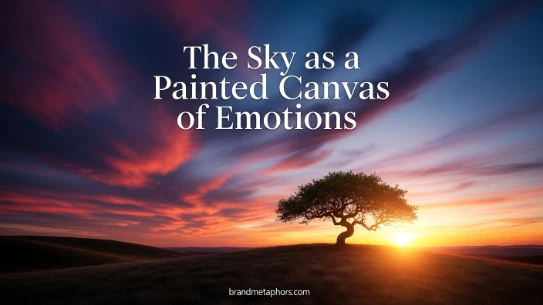
One of the most popular metaphors for the sky is the idea that it is a canvas—constantly being painted by unseen hands. Sunrise becomes a soft watercolor wash. Sunset becomes bold strokes of fire and crimson. Storm clouds resemble dark charcoal sketches smeared across an unfinished artwork.
This metaphor works because it connects nature with creativity and emotion. The sky is not static—it is always “in progress,” just like human feelings.
Example Sentence or Scenario
“The evening sky was a trembling canvas of violet and gold, as if the day had spilled its final emotions across the horizon before fading away.”
Alternative Expressions
- The sky is an ever-changing masterpiece
- The sky is a living painting
- The heavens are an artist’s restless canvas
Sensory and Emotional Detail
Imagine standing in an open field after rain. The air smells like wet earth. Above you, the clouds break apart slowly, revealing streaks of orange light. It feels like watching an invisible painter finish a final stroke before stepping away forever.
Mini Storytelling Moment
A young artist once sat on a rooftop in Istanbul, sketching the skyline but constantly erasing her work. “I can’t compete with that,” she whispered, pointing at the sky. Every evening it changed faster than she could draw. Eventually, she stopped drawing buildings and started painting skies instead—trying not to copy them, but to understand them.
2. The Sky as an Ocean Above Us
Meaning and Explanation
Another powerful metaphor is the sky as an upside-down ocean. Clouds become drifting islands, birds become ships, and wind becomes invisible tides moving across vast atmospheric depths.
This metaphor works beautifully because both sky and sea share qualities of vastness, unpredictability, and depth.
Example Sentence or Scenario
“The clouds drifted across the sky like silent ships on a pale blue ocean, carried by winds that no sailor could see.”
Alternative Expressions
- The sky is a boundless sea above
- The heavens are an upside-down ocean
- Clouds are floating continents in the air
Sensory and Emotional Detail
On windy days, this metaphor feels especially real. You can hear the rush of air like waves crashing somewhere far above. Watching birds glide feels like observing creatures navigating invisible currents.
Mini Storytelling Moment
In coastal Greece, an old fisherman once told his grandson that storms were “the sky remembering the sea.” When thunder rolled across the horizon, the boy would look upward, imagining waves breaking not below him—but above, where the sky and sea secretly met in another world.
3. The Sky as a Vast Emotional Memory
Meaning and Explanation
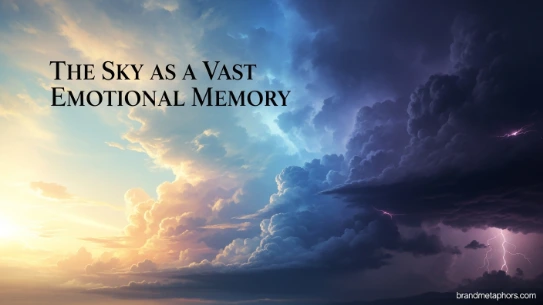
Sometimes the sky is not just nature—it becomes memory itself. It holds moments, emotions, and time. A morning sky might remind you of beginnings. A grey sky might echo sadness. A clear night sky might feel like silence after heartbreak.
In this metaphor, the sky becomes an emotional archive.
Example Sentence or Scenario
“The sky felt like a forgotten memory unfolding slowly above him, each cloud carrying echoes of things he could no longer name.”
Alternative Expressions
- The sky is a memory written in light
- The heavens are a diary of emotions
- The sky is a silent witness to everything
Sensory and Emotional Detail
Think of standing alone after a difficult goodbye. The sky is pale and quiet. Nothing dramatic happens above, yet everything feels heavy. The stillness above mirrors the stillness inside.
Mini Storytelling Moment
A traveler once returned to his hometown after ten years away. Nothing had changed—except the sky. Or so it felt. “It remembers me,” he thought, as he stood under the same evening sky he had once watched as a child. The sky didn’t speak, but somehow it answered.
Interactive Exercises: Practicing Sky Metaphors Creatively
Try these exercises to strengthen your ability to create your own sky metaphors:
Exercise 1: Emotional Sky Mapping
Look at the sky right now. Describe it using an emotion instead of weather.
- Is it anxious?
- Calm?
- Joyful?
- Heavy?
Now turn that emotion into a metaphor.
Example: “The sky is a quiet sadness stretched across the afternoon.”
Exercise 2: Object Transformation Game
Choose any object and turn the sky into it.
- A curtain
- A mirror
- A diary page
- A glowing lantern
Write one sentence using that comparison.
Exercise 3: Memory Association Practice
Think of a memory—happy or sad. Now describe the sky during that moment, even if you don’t remember it clearly. Let imagination fill the gaps.
Example: “In my memory, the sky was a soft notebook of light, waiting for me to rewrite the day.”
Bonus Tips for Using Sky Metaphors in Writing and Daily Life
1. Match the sky to emotion, not just weather
Don’t just describe clouds—describe what they feel like.
2. Use movement words
Words like drifting, spilling, stretching, collapsing, and blooming make sky metaphors more alive.
3. Combine sky with human experience
Let the sky reflect human emotions rather than just scenery.
4. Keep it simple but vivid
A strong metaphor doesn’t need complexity—it needs clarity and feeling.
5. Use sky metaphors in social media captions
Instead of saying “beautiful sunset,” try:
- “The sky wrote a goodbye in colors tonight.”
FAQs about Metaphors for Sky
What is a metaphor for the sky in simple words?
A metaphor for the sky is a way of describing it as something else, like an ocean, painting, or memory, to create deeper meaning.
Why are sky metaphors common in literature?
Because the sky is universal, emotional, and constantly changing, making it perfect for expressing human feelings and ideas.
How can I create my own sky metaphor?
Observe the sky, think about how it makes you feel, and compare it to something meaningful like an object, emotion, or experience.
Can sky metaphors be used in everyday writing?
Yes, they are great for journaling, poetry, storytelling, captions, and even speeches.
What emotions are often linked with sky metaphors?
Freedom, sadness, hope, mystery, nostalgia, and peace are commonly associated emotions.
Are sky metaphors only used in poetry?
No, they are also used in novels, essays, songs, films, and everyday conversation.
Conclusion
The sky is never just a backdrop. It is a living metaphor waiting to be shaped by human imagination.
When we call it a canvas, an ocean, or a memory, we are not changing the sky—we are changing how we see it. And in that shift of perception lies the real magic of language.
Metaphors for the sky teach us something quietly powerful: that even the most ordinary view above us can become extraordinary when seen through the lens of imagination.
So next time you look up, don’t just notice the weather.
Notice the story unfolding overhead.