
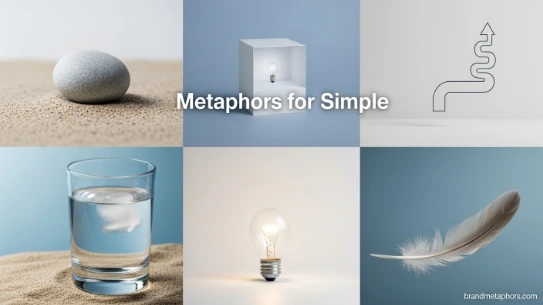
There is a quiet kind of magic in simplicity. It doesn’t shout. It doesn’t overwhelm. Instead, it slips into our lives like morning sunlight through half-open curtains—soft, clear, and comforting. Yet, in a world full of noise, complexity, and constant rushing, “simple” can sometimes feel hard to explain.
That’s where metaphors step in.
Metaphors for simple are like bridges between ideas and imagination. They help us understand simplicity not just as a concept, but as a feeling, a visual image, or even a lived experience.
When we say something is “simple,” we often mean it is easy—but metaphors allow us to show how it is easy, why it feels easy, and what kind of ease it carries.
In this article, we’ll explore vivid metaphors for simplicity, their meanings, emotional depth, and practical use in writing and daily communication.
You’ll also find creative exercises, storytelling moments, and real-life applications that help you use simplicity not just as a word—but as a powerful expressive tool.
Why Metaphors for Simplicity Matter in Writing and Communication
Simplicity is often misunderstood as “less.” But in reality, simplicity is clarity, focus, and elegance stripped of unnecessary weight.
Metaphors help us:
- Turn abstract simplicity into something visual and relatable
- Make communication more memorable and engaging
- Add emotional depth to everyday expressions
- Improve storytelling, teaching, and creative writing
When you say “it’s simple,” the listener understands. But when you say “it’s as simple as peeling a banana,” they feel it.
Metaphor 1: “Simple as a Clear Stream”

Meaning & Explanation
A clear stream flows effortlessly over stones, bends gently around obstacles, and remains transparent despite movement. This metaphor suggests that something simple is natural, smooth, and uncluttered.
Emotional & Sensory Detail
Imagine standing beside a mountain stream. You hear water trickling over rocks, soft and rhythmic. You can see the bottom clearly—no confusion, no murkiness. Everything feels calm and easy to understand.
Example Sentence
- “Her explanation of the math concept was as simple as a clear stream flowing through a quiet valley.”
Alternative Expressions
- As clear as spring water
- As smooth as flowing water
- As transparent as glass water
Mini Storytelling Moment
A student once struggled for weeks with physics equations. Every explanation felt like tangled threads. Then one teacher walked in and explained it like a stream finding its way downhill—no resistance, no complication, just flow. Suddenly, everything clicked. The student later said, “It wasn’t difficult. It was just never shown to me simply enough.”
Where You Can Use It
- Teaching complex ideas
- Writing educational content
- Explaining processes or instructions
Metaphor 2: “Simple as a Single Brushstroke”
Meaning & Explanation
A single brushstroke in painting represents minimal effort creating something meaningful. It reflects elegance, precision, and the idea that simplicity can still be expressive and powerful.
Emotional & Sensory Detail
Picture an artist holding a brush. One steady movement across a blank canvas. No hesitation. Just intention. That one stroke carries emotion, direction, and beauty without excess detail.
Example Sentence
- “Her design philosophy is as simple as a single brushstroke—clean, intentional, and impactful.”
Alternative Expressions
- As minimal as a sketch line
- As clean as a pencil stroke
- As direct as ink on paper
Cultural & Literary Reference
In Japanese calligraphy, known as shodō, a single stroke can represent discipline, emotion, and centuries of artistic tradition. Simplicity here is not emptiness—it is mastery.
Interactive Exercise
Try this: Think of a problem you often explain. Now reduce it to one “brushstroke sentence.” For example: Instead of “Time management requires planning, discipline, and prioritization,” try 👉 “Time management is choosing what matters most first.”
Metaphor 3: “Simple as Unfolding a Paper Boat”

Meaning & Explanation
A paper boat is easy to make and requires only a few folds. This metaphor suggests simplicity in steps, accessibility, and childlike ease.
Emotional & Sensory Detail
You might remember childhood afternoons—scrap paper, quiet rooms, and tiny boats floating in puddles after rain. There’s nostalgia here, a sense of innocence and uncomplicated joy.
Example Sentence
- “Learning to use the app was as simple as unfolding a paper boat.”
Alternative Expressions
- As easy as folding paper
- As simple as origami steps
- As light as a child’s craft
Mini Storytelling Moment
A grandmother once taught her grandchild how to write thank-you notes. Instead of giving a lecture, she simply folded a paper boat and said, “Each step is like this—small, clear, and gentle.” Years later, that child grew into a writer who believed that good writing should always feel like folding paper—natural and satisfying.
Where You Can Use It
- Explaining step-by-step instructions
- Making user guides or tutorials
- Social media storytelling
How to Use Metaphors for Simplicity in Everyday Writing
Simplicity is not just a topic—it’s a writing style. You can apply metaphors for simple in multiple ways:
1. In Teaching or Explanation
Instead of saying:
- “This process is easy”
Say:
- “This process is as simple as following footprints in fresh snow.”
2. In Social Media Content
People scroll fast. Metaphors help you stop their attention.
Example:
- “Healing isn’t complicated—it’s as simple as letting a wound breathe.”
3. In Storytelling
Metaphors help transform plain narratives into emotional experiences.
Example:
- “His apology was simple, like rain after a long drought.”
Creative Practice: Build Your Own Metaphors for Simple
Try these exercises to strengthen your creativity:
Exercise 1: Everyday Objects
Pick any object around you (cup, door, pen). Now describe “simple” using it.
Example:
- A pen → “Simple is like a pen writing one straight line without hesitation.”
Exercise 2: Nature Comparison
Choose something in nature and connect it to simplicity.
Example:
- Wind → “Simple is like wind that doesn’t ask for direction.”
Exercise 3: Emotional Translation
Rewrite a complex idea in a simple emotional metaphor.
Example:
- “Forgiveness is simple like opening a window after a storm.”
Bonus Tips for Writers and Content Creators
1. Keep Metaphors Familiar
The best metaphors for simplicity use everyday experiences people instantly recognize.
2. Avoid Overcomplication
A metaphor for “simple” should not itself become complex. If it needs explanation, it may not be simple enough.
3. Match Tone with Audience
- Educational content → clear, natural metaphors
- Creative writing → poetic, emotional metaphors
- Marketing → short, impactful metaphors
4. Use Contrast
Sometimes simplicity stands out best against complexity.
Example:
- “In a world of tangled wires, simplicity is a single glowing bulb.”
Metaphors for Simple in Real Life Communication
We often underestimate how much metaphors shape understanding:
- Teachers use them to clarify lessons
- Writers use them to create imagery
- Speakers use them to persuade audiences
- Brands use them to connect emotionally
Even in daily conversations, metaphors make speech warmer and more human.
Frequently Asked Questions (FAQs)
What are metaphors for simple?
Metaphors for simple are figurative expressions that describe simplicity using familiar images, actions, or experiences instead of direct definitions.
Why are metaphors useful for explaining simplicity?
They help people visualize abstract ideas, making them easier to understand, remember, and emotionally connect with.
Can metaphors make writing more engaging?
Yes. Metaphors add imagery and emotion, making writing more vivid, memorable, and appealing to readers.
What are some common themes used in simplicity metaphors?
Nature (water, wind), art (brushstrokes), and everyday objects (paper, tools) are commonly used to express simplicity.
How can I create my own metaphors for simple?
Start with something familiar, identify its natural behavior, and connect it to the feeling of ease or clarity.
Conclusion
Simplicity is not the absence of meaning—it is meaning made visible. Through metaphors, we learn that “simple” can flow like water, appear like a brushstroke, or unfold like paper in our hands.
When you use metaphors for simplicity, you are not just explaining—you are revealing. You are turning ordinary understanding into something that lingers in memory, something that feels natural, human, and deeply clear.
In a world that often rewards complexity, choosing simplicity in expression is a form of wisdom. And sometimes, the simplest words—when shaped like metaphors—carry the deepest truth.