
The first thing you notice is the stillness—until you don’t. Leaves whisper in a language older than memory, branches stretch like arms toward a sky that never quite answers, and beneath your feet, roots grip the earth with a quiet determination.
Trees don’t rush, yet they tell stories of time, resilience, and transformation.
To write about trees is to write about life itself.
Metaphors for trees allow us to translate their silent wisdom into human experience. Whether you’re crafting poetry, storytelling, social media captions, or simply trying to express something deeply felt, tree metaphors can give your words depth, texture, and emotional resonance. They connect growth with struggle, stillness with strength, and seasons with change.
In this article, we’ll explore powerful metaphors for trees, unpack their meanings, and show you how to use them creatively in your own writing and everyday expression.
Why Use Metaphors for Trees in Writing?
Trees are universal symbols. Across cultures and centuries, they’ve represented life, knowledge, family, endurance, and rebirth. Because of this, tree metaphors are instantly relatable and rich with meaning.
Using metaphors for trees helps you:
- Add emotional depth to your writing
- Create vivid imagery that readers can visualize
- Express abstract ideas like growth, patience, or connection
- Make your message memorable and poetic
A tree is never just a tree—it’s a mirror of human experience.
1. The Tree as a Symbol of Growth and Transformation
Meaning & Explanation
One of the most powerful metaphors for trees is growth. Trees start as fragile seeds and slowly evolve into towering forms of life. This makes them perfect symbols for personal development, learning, and transformation.
Just like people, trees don’t grow overnight. Their progress is slow, often invisible, but undeniably steady.
Example Sentence or Scenario
- “She was like a tree in early spring—uncertain, budding, but full of quiet promise.”
Imagine a young student stepping into a new phase of life. They may feel unsure, but like a sapling, they are growing roots beneath the surface.
Alternative Ways to Express It
- Growing like rings inside a tree trunk
- Stretching toward the sun
- Blooming after a long winter
- Rooting deeper with each passing storm
Sensory or Emotional Details
Think of the soft green of new leaves, the warmth of sunlight filtering through branches, the smell of fresh bark after rain. Growth feels hopeful, gentle, and alive.
Mini Storytelling Example
A writer once described his journey as “a crooked tree.” He didn’t grow straight like others—his path twisted with failures, doubts, and detours. Yet, over time, those bends gave him character. His story wasn’t perfect—but it was uniquely his.
2. The Tree as a Metaphor for Strength and Resilience
Meaning & Explanation
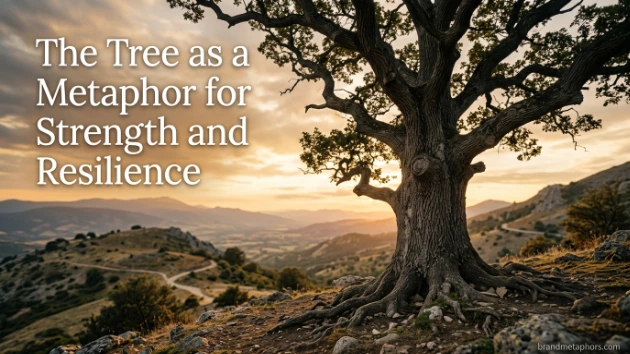
Trees endure storms, droughts, and harsh seasons, yet they remain standing. This makes them powerful metaphors for resilience, endurance, and inner strength.
Unlike rigid structures that break under pressure, trees bend. Their flexibility is what allows them to survive.
Example Sentence or Scenario
- “He stood like an old oak, weathered by storms but unbroken.”
Picture someone who has faced hardship—loss, failure, struggle—but continues to stand tall. Their strength isn’t loud; it’s deeply rooted.
Alternative Ways to Express It
- Bending but not breaking
- Rooted in strength
- Standing through storms
- Weathering the winds of change
Sensory or Emotional Details
Hear the wind roaring through branches, feel the rough bark under your fingertips, imagine rain lashing against leaves. There’s tension—but also survival.
Cultural Reference
In many traditions, trees symbolize endurance. Ancient stories often describe sacred trees that stand for centuries, witnessing generations pass. These trees become living monuments of time and resilience.
Real-Life Reflection
Think about someone in your life who reminds you of a tree. Maybe it’s a grandparent who has lived through decades of change, or a friend who quietly supports everyone around them. Their strength is steady, like roots buried deep.
3. The Tree as a Metaphor for Connection and Belonging
Meaning & Explanation
Trees are deeply connected—to the earth through roots, to the sky through branches, and even to each other through underground networks. This makes them beautiful metaphors for relationships, family, and belonging.
A tree doesn’t stand alone—it exists within a system.
Example Sentence or Scenario
- “Our family is like a tree—each branch growing in its own direction, yet all rooted in the same soil.”
This metaphor works wonderfully for describing family ties, friendships, or even communities.
Alternative Ways to Express It
- Branches of the same tree
- Rooted together
- Connected beneath the surface
- Growing from shared ground
Sensory or Emotional Details
Picture roots intertwining beneath the soil, unseen but essential. Feel the warmth of sitting under a tree with loved ones, sharing stories and laughter.
Mini Storytelling Example
At a family gathering, an elderly woman once pointed to a tree in her yard and said, “This is us.” She explained how each branch represented a family member—some close, some distant—but all connected by the same roots. That simple image stayed with everyone.
Interactive Exercises: Practice Using Tree Metaphors

Ready to grow your creativity? Try these exercises:
1. Personal Growth Prompt
Write a paragraph describing your life as a tree.
- What kind of tree are you?
- What season are you in?
- Are you growing, resting, or weathering a storm?
2. Emotion Mapping Exercise
Choose an emotion (e.g., happiness, sadness, anxiety) and describe it using a tree metaphor. Example: “My anxiety is like a tree with tangled roots, pulling me in every direction.”
3. Story Starter
Begin a short story with this line:
- “The tree in the middle of the field knew all my secrets.”
Let your imagination take over.
Bonus Tips: Using Tree Metaphors in Writing & Daily Life
1. In Creative Writing
Use tree metaphors to show character development instead of telling it directly. Instead of saying “he became stronger,” say:
- “He grew roots where he once had none.”
2. In Social Media Captions
Short, poetic metaphors work beautifully:
- “Still growing, even on quiet days 🌿”
- “Rooted, not stuck.”
3. In Everyday Conversations
Tree metaphors can make your thoughts more expressive:
- “I just need time to grow through this.”
- “I’m trying to stay grounded.”
4. Combine with Seasons
Enhance your metaphors by pairing trees with seasons:
- Winter → rest, endings
- Spring → renewal, beginnings
- Summer → fullness, joy
- Autumn → change, letting go
SEO Spotlight: Popular Tree Metaphor Keywords to Use
To make your writing more discoverable, try incorporating these related phrases naturally:
- metaphors for trees in poetry
- tree symbolism in literature
- tree metaphors for life
- creative writing tree imagery
- nature metaphors examples
FAQs About Metaphors for Trees
What do trees usually symbolize in metaphors?
Trees often symbolize growth, strength, stability, connection, and the passage of time. Their natural life cycle makes them ideal for representing human experiences.
Why are tree metaphors so powerful in writing?
They are visually vivid and emotionally rich. Most people have seen or experienced trees, making these metaphors easy to understand and deeply relatable.
Can tree metaphors be used in modern writing or social media?
Absolutely. Tree metaphors work well in captions, blogs, poetry, and even casual conversations because they are short, meaningful, and visually engaging.
How can I create my own tree metaphors?
Observe real trees—how they grow, bend, lose leaves, and regenerate. Then connect those traits to human emotions or experiences.
Are tree metaphors only used in poetry?
No, they are widely used in storytelling, motivational writing, speeches, and everyday language. Their versatility makes them useful in many forms of communication.
Conclusion
Trees teach us that growth is not always visible, strength is often quiet, and connection runs deeper than we can see. When you use metaphors for trees, you bring these truths into your writing—turning simple words into living, breathing images.
So the next time you struggle to express something meaningful, think of a tree. Think of its roots, its branches, its seasons. Somewhere within its story, you’ll find your own.
And when you do, let your words grow. 🌿