

The first time I held a snowflake in my palm, I watched it melt before I could fully understand it. For a fleeting moment, it existed—intricate, delicate, unlike any other I had ever seen or would ever see again.
That’s what “unique” feels like: something rare, almost magical, and impossible to replicate.
Yet, the word unique itself can feel… overused. In writing, conversations, and even social media captions, it often loses its sparkle. That’s where metaphors come in. They breathe life into the ordinary, transforming a simple idea into something vivid and unforgettable.
This article explores metaphors for unique—how to express individuality in ways that feel fresh, meaningful, and powerful. Whether you’re a writer, student, or storyteller, learning to describe uniqueness creatively can elevate your communication and leave a lasting impression.
What Does “Unique” Really Mean?
At its core, unique refers to something that is one of a kind—distinct, unmatched, and incomparable. But language thrives on nuance. Instead of repeating the same word, metaphors allow us to show uniqueness rather than simply state it.
Why is this important?
- It enhances storytelling and emotional impact
- It makes your writing more memorable
- It helps your voice stand out in a crowded world
Think of metaphors as a lens: they don’t change the subject, but they change how we see it.
1. A Snowflake in a Storm
Meaning & Explanation
A snowflake symbolizes individuality within sameness. In a storm filled with countless flakes, each one carries its own intricate design—just like people, ideas, or creations that stand out despite being part of a larger whole.
Example Sentence
“She walked into the crowded room like a snowflake in a storm—delicate, distinct, and impossible to overlook.”
Alternative Expressions
- A fingerprint among shadows
- A single note rising above a chorus
- A star in a sky full of echoes
Sensory & Emotional Layer
Imagine the cold sting of winter air, the quiet hush of falling snow, and the fleeting beauty of something that exists only for a moment. This metaphor carries a gentle, almost poetic uniqueness.
Mini Storytelling Touch
A teacher once told her students they were all snowflakes. One student frowned, thinking it meant they were all the same—until she held a magnifying glass over a real snowflake. “Look closer,” she said. “Difference hides in detail.”
2. A Wildflower in a Field of Roses
Meaning & Explanation
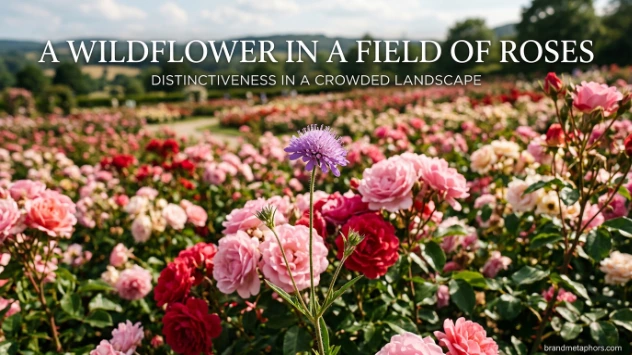
This metaphor emphasizes standing out in a place where uniformity dominates. Roses may be admired, but a wildflower catches attention precisely because it defies expectation.
Example Sentence
“His ideas bloomed like a wildflower in a field of roses—unexpected, vibrant, and refreshingly different.”
Alternative Ways to Express It
- A splash of color on a grayscale canvas
- A jazz note in a classical symphony
- A spark in a sea of stillness
Emotional & Sensory Details
Picture a vast garden of identical red roses—and then, suddenly, a burst of purple, yellow, or blue. The contrast is what makes the wildflower unforgettable.
Real-Life Reflection
In creative industries, the most successful voices often aren’t the most polished—they’re the most different. Think of artists who broke norms rather than followed them. That’s the wildflower effect.
3. A Lone Lighthouse in the Fog
Meaning & Explanation
A lighthouse represents guidance, clarity, and singular presence. In a dense fog where everything feels lost or indistinct, a lighthouse becomes a beacon—unique not just in form, but in purpose.
Example Sentence
“In a world clouded by noise, her voice stood like a lone lighthouse in the fog—steady, clear, and unmistakably her own.”
Alternative Expressions
- A flame in the darkness
- A compass in chaos
- A signal through static
Sensory & Emotional Impact
Feel the damp chill of fog, the disorientation of not knowing where you are—and then, the sudden comfort of a distant light cutting through it all.
Cultural Note
Lighthouses often symbolize hope and individuality in literature. They remind us that being unique isn’t just about standing out—it’s about guiding others.
Creative Exercises: Practice Metaphors for Unique

Want to sharpen your metaphor skills? Try these interactive prompts:
1. The Object Swap Exercise
Pick an everyday object (e.g., a cup, a pen, a tree). Now describe it as if it were unique:
- “This pen isn’t just a pen—it’s…” Try turning it into a metaphor that highlights individuality.
2. The Crowd Contrast Challenge
Imagine a crowded place—a market, a classroom, a concert. Now describe one person or thing that stands out using a metaphor.
3. The Emotion Match Game
Choose an emotion (joy, loneliness, confidence). Now create a metaphor that makes that emotion feel unique:
- “Her happiness was like…”
4. Rewrite the Ordinary
Take a simple sentence:
- “He is unique.” Rewrite it using at least three different metaphors.
Bonus Tips: Using Metaphors for Unique in Daily Life
1. In Writing
- Avoid clichés—push for fresh imagery
- Combine metaphors with sensory details
- Use contrast to highlight uniqueness
2. On Social Media
- Replace “unique” with a vivid metaphor
- Keep it short but impactful
- Pair with visuals for stronger engagement
Example: Instead of “Be unique,” try: “Be the wildflower in a field of roses.”
3. In Conversations
- Use metaphors to make your point memorable
- Tailor imagery to your audience
- Keep it natural—don’t force it
4. In Personal Branding
Think of yourself as a metaphor:
- Are you a lighthouse? A wildfire? A rare gem? This helps define how others perceive your uniqueness.
Why Metaphors for Unique Matter in Modern Communication

In a world flooded with content, originality is currency. Whether you’re writing a blog, crafting a speech, or posting online, your ability to express uniqueness creatively can set you apart.
Metaphors:
- Engage the imagination
- Create emotional resonance
- Make abstract ideas tangible
They don’t just describe uniqueness—they embody it.
Expanding Your Metaphor Toolbox
Here are a few more quick metaphors for inspiration:
- A rare gem hidden in plain sight
- A comet streaking across a quiet sky
- A handwritten letter in a digital age
- A vintage melody in a modern playlist
- A secret garden behind a crowded street
Each one tells a story. Each one invites the reader to feel uniqueness rather than just understand it.
FAQs About Metaphors for Unique
1. What is a metaphor for unique?
A metaphor for unique is a figurative expression that describes something as one-of-a-kind using imagery, such as “a snowflake in a storm” or “a wildflower in a field of roses.”
2. Why should I use metaphors instead of the word “unique”?
Metaphors make your language more vivid, engaging, and memorable. They help readers visualize and emotionally connect with your message.
3. How can I create my own metaphors for unique?
Start by thinking of something rare or distinctive in nature or life, then connect it to your subject through comparison.
4. Are metaphors useful in everyday communication?
Yes! They can make conversations more expressive and help you communicate ideas more effectively.
5. Can metaphors improve my writing skills?
Absolutely. They enhance creativity, deepen meaning, and make your writing stand out.
6. What are some common mistakes when using metaphors?
Overusing clichés, mixing incompatible metaphors, or forcing them into sentences can weaken your writing.
Conclusion
At the heart of it all, metaphors for unique aren’t just about language—they’re about perspective. They remind us that uniqueness isn’t loud or forced; sometimes, it’s quiet, subtle, and deeply personal.
We don’t have to say something is unique. You can show it. You can paint it.We can feel it.
So the next time you reach for the word “unique,” pause. Look closer. Find the snowflake, the wildflower, the lighthouse—and let your words become something just as unforgettable.