

The classroom hums with quiet energy—the scratch of pens, the soft glow of screens, the weight of ideas forming in young minds. A student stares at a blank page, unsure where to begin, until suddenly a thought sparks: What if learning isn’t a burden… but a journey? In that moment, something shifts. The page is no longer empty—it becomes a map.
This is the power of metaphors.
Metaphors for students are more than decorative language; they are bridges between confusion and clarity. They help learners grasp complex ideas, express emotions, and make their academic and personal journeys more meaningful.
Whether you’re writing essays, preparing speeches, or simply trying to understand your own growth, metaphors can transform the way you think and communicate.
In this article, we’ll explore vivid and practical metaphors for students, along with examples, storytelling elements, and interactive exercises to help you use them creatively in your daily life.
Why Metaphors Matter for Students
Before diving into examples, let’s understand why metaphors are so valuable.
A metaphor compares one thing to another in a way that reveals deeper meaning. For students, this means turning abstract ideas—like effort, stress, growth, or ambition—into something tangible and relatable.
Think about it: saying “I’m overwhelmed with studies” feels different from saying “I’m drowning in a sea of assignments.” The second paints a picture. It creates emotion. It connects.
Metaphors:
- Improve writing and storytelling skills
- Make learning more engaging and memorable
- Help express emotions clearly
- Boost creativity and confidence
Now, let’s explore three powerful metaphor ideas every student can use.
1. The Student as a Traveler on a Journey

Meaning & Explanation
This metaphor compares a student’s academic life to a journey filled with roads, obstacles, milestones, and destinations. It emphasizes growth, exploration, and progress rather than perfection.
Example Sentence or Scenario
- “My education is a long road, and every exam is just another milestone along the way.”
- A student preparing for finals might say: “I’m climbing a steep hill right now, but I know the view from the top will be worth it.”
Alternative Ways to Express It
- Learning is a road/map/path
- School is a voyage
- Knowledge is a destination
- Challenges are bumps or detours
Sensory & Emotional Details
Imagine dusty roads under your feet, unexpected turns, and the thrill of discovering something new at every corner. There’s uncertainty—but also excitement.
Mini Storytelling
A student once failed an important test and felt like giving up. But instead of seeing it as failure, they reframed it: “This is just a wrong turn, not the end of the road.” That simple metaphor gave them the strength to keep going—and eventually succeed.
2. The Mind as a Garden
Meaning & Explanation
This metaphor suggests that a student’s mind is like a garden that needs care, patience, and attention. Thoughts are seeds, habits are water, and knowledge grows over time.
Example Sentence or Scenario
- “If I don’t water my mind with practice, my knowledge will wither.”
- A teacher might say: “Plant good ideas today, and they’ll grow into wisdom tomorrow.”
Alternative Ways to Express It
- Ideas are seeds
- Learning is planting
- Practice is watering
- Distractions are weeds
Sensory & Emotional Details
Picture soft soil, tiny green shoots pushing through, and the slow, satisfying growth of something you nurtured yourself. There’s calmness, patience, and quiet pride.
Real-Life Reflection
Students often expect instant results. But like a garden, learning takes time. You don’t plant a seed and expect a tree the next day. This metaphor teaches patience and consistency.
3. The Student as a Builder of Their Future

Meaning & Explanation
In this metaphor, a student is like an architect or builder constructing their future piece by piece. Every lesson, skill, and effort is a brick in a larger structure.
Example Sentence or Scenario
- “Every assignment I complete adds another brick to my future.”
- “I’m laying the foundation now so my dreams can stand strong later.”
Alternative Ways to Express It
- Education is construction
- Skills are tools
- Effort is cement
- Goals are buildings
Sensory & Emotional Details
Think of the solid feel of bricks, the rhythm of building, and the satisfaction of watching something rise from nothing. There’s strength, purpose, and vision.
Mini Storytelling
A struggling student once said, “I feel like I’m not getting anywhere.” Their mentor replied, “Even the tallest building starts with invisible foundations.” That shift in perspective changed everything.
Interactive Exercises: Practice Metaphors for Students
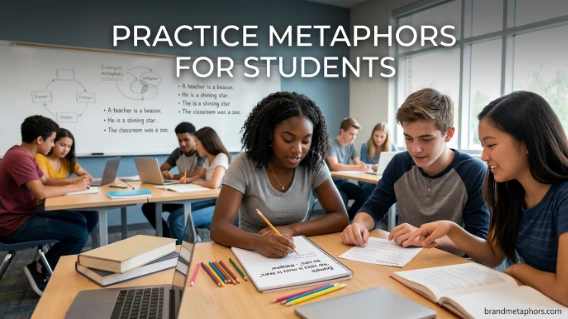
Let’s turn theory into action. Try these creative exercises:
Exercise 1: Rewrite Your Day as a Metaphor
Take a normal school day and describe it using one metaphor.
Example prompt:
- “Today at school felt like…”
Try turning your day into:
- A storm
- A race
- A movie
Exercise 2: Create Your Own Student Metaphor
Fill in the blank:
- “Being a student is like ______ because ______.”
Example:
- “Being a student is like a puzzle because every subject helps complete the bigger picture.”
Exercise 3: Transform Emotions into Metaphors
Pick an emotion you often feel as a student and express it metaphorically.
Examples:
- Stress → “a ticking clock in my chest”
- Motivation → “a fire pushing me forward”
Exercise 4: Social Media Challenge
Write a short caption using a metaphor about your studies.
Example:
- “Still climbing, still learning—this mountain won’t defeat me.”
Bonus Tips: Using Metaphors in Writing, Social Media, and Daily Life
1. Keep It Relatable
Use metaphors people can easily understand—like nature, travel, or everyday objects.
2. Don’t Overcomplicate
A simple metaphor is often more powerful than a complex one.
3. Use Metaphors in Essays
Adding a metaphor in your introduction or conclusion can make your writing stand out.
Example:
- “Education is not a race, but a journey of discovery.”
4. Make Your Speech Memorable
If you’re giving a presentation, metaphors can make your message stick.
5. Reflect on Your Growth
Use metaphors in journaling to better understand your experiences.
SEO Keywords to Remember
- metaphors for students
- student metaphors examples
- creative metaphors for learning
- metaphors about education
- student journey metaphors
FAQs About Metaphors for Students
What are metaphors for students?
Metaphors for students are creative comparisons that describe a student’s experiences, emotions, or learning process in a vivid and imaginative way.
Why should students use metaphors?
They help improve writing, make ideas easier to understand, and allow students to express thoughts and feelings more effectively.
Can metaphors improve academic performance?
Yes, especially in writing and communication. They make essays, speeches, and creative work more engaging and impactful.
How can I create my own metaphors?
Think about what you want to describe, then compare it to something familiar. Ask yourself: What does this feel like?
Are metaphors only useful in English class?
Not at all. They can be used in presentations, journaling, social media, and even to understand complex subjects in science or life.
What’s the difference between a metaphor and a simile?
A metaphor says something is something else, while a simile uses “like” or “as” to compare.
Conclusion
Being a student isn’t just about textbooks and exams—it’s about transformation. It’s about becoming someone new, one lesson at a time.
Whether you see yourself as a traveler, a gardener, or a builder, remember this: your metaphor shapes your mindset. If you view challenges as storms, you might feel overwhelmed. But if you see them as mountains to climb, you’ll feel stronger with every step.
So the next time you sit down to study or write, pause for a moment and ask yourself:
What story am I living right now?
Then turn it into a metaphor—and watch how your perspective, creativity, and confidence begin to grow.