
The rain didn’t stop that evening. It fell like a heavy curtain over the city—soft at first, then insistent, then almost unkind. Streets shimmered under streetlights, trees bowed under wind, and somewhere in the distance, thunder rolled like an old drum remembering war.
And yet, inside a small house on a quiet street, a candle still burned.
It flickered. It bent. It almost went out once or twice. But it didn’t.
That tiny flame—fragile, uncertain, but stubbornly alive—captures something deeply human: resilience. Not loud. Not perfect. But persistent.
We all have moments when life feels like that storm—loss, failure, change, uncertainty, pressure. And in those moments, we often don’t need instructions as much as we need meaning. This is where metaphors for resilience become powerful. They don’t just describe survival; they help us feel it, understand it, and even become it.
Understanding Resilience Through Metaphors: What It Really Means
Resilience is the ability to adapt, recover, and keep moving forward after adversity. It’s not about avoiding pain or pretending everything is fine. It’s about bending without breaking, rebuilding after collapse, and continuing even when the path is unclear.
But resilience is hard to explain in plain language alone. That’s why metaphors matter. They turn abstract emotional strength into vivid images we can hold onto—like mental anchors in stormy times.
When we say someone is “like a bamboo in the wind,” or “a phoenix rising from ashes,” we are not just being poetic. We are giving the mind something to grip when life feels slippery.
Why Metaphors for Resilience Matter in Everyday Life and Writing
Metaphors do more than decorate language—they shape perception.
- In writing, they make ideas memorable and emotionally rich.
- In daily life, they help us reframe suffering into meaning.
- In social expression, they allow us to communicate deep emotional truths quickly.
A person saying, “I feel broken,” might shift their internal story if they instead think, “I am a river carving through stone.” The situation may not change immediately—but the identity does.
And that shift is where resilience begins.
Metaphor 1: The Bamboo in the Storm — Strength in Flexibility
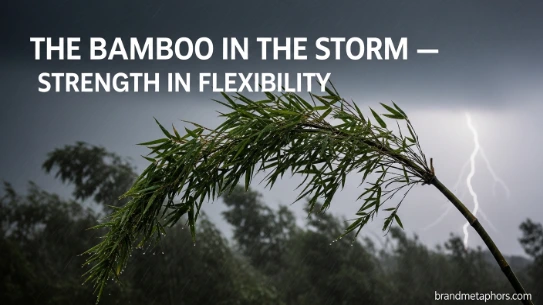
Bamboo is one of nature’s quiet miracles. During storms, while stronger-looking trees snap under pressure, bamboo bends low with the wind. It sways, it yields—but it does not break. And when the storm passes, it rises again, intact.
Meaning and Emotional Insight
This metaphor represents adaptability. Resilience is not always about resisting pressure; sometimes it is about flowing with it.
Being strong like bamboo means:
- Accepting change instead of fighting it blindly
- Staying grounded even when everything bends around you
- Recovering quickly after emotional storms
Example Sentence or Scenario
“She didn’t resist the sudden change in plans; she adjusted like bamboo in a storm, trusting she would stand tall again when the winds settled.”
Alternative Expressions
- Flexible like a willow in the wind
- Adaptable like grass after rain
- Bending without breaking under pressure
Sensory & Emotional Detail
Imagine the sound of wind rushing through tall bamboo groves—whispering, not screaming. The stems bend almost gracefully, like dancers responding to an unseen rhythm. There is no panic in their movement, only survival through harmony.
Mini Story
A young teacher once lost her job unexpectedly. At first, she felt uprooted, like a tree struck by lightning. But instead of resisting change, she adapted. She started tutoring online, then built educational content, and eventually reached more students than she ever had in a classroom. She didn’t stand rigid against change—she bent, shifted, and grew elsewhere.
Metaphor 2: The Phoenix Rising from Ashes — Rebirth After Destruction
The phoenix is a mythical bird from ancient stories, said to burn into ashes at the end of its life and rise again, reborn and renewed. It is one of the most powerful symbols of transformation.
Meaning and Emotional Insight
This metaphor speaks to recovery after loss. It is about starting again after everything seems destroyed.
It represents:
- Emotional healing after trauma
- Reinvention after failure
- Finding strength in endings
Example Sentence or Scenario
“After the business collapsed, he didn’t give up; he rebuilt himself like a phoenix rising from ashes, stronger and more focused than before.”
Alternative Expressions
- Rising stronger after destruction
- Rebuilding from ruins
- Transforming pain into power
Sensory & Emotional Detail
Imagine fire—not as punishment, but as cleansing. Heat consuming what no longer serves you. Then silence. Then something unexpected: wings unfolding from embers, glowing faintly, lifting into dawn.
Mini Story with Cultural Echo
Across many cultures, the idea of rebirth is sacred. In literature, in mythology, and even in modern biographies, we see this pattern. A writer rejected repeatedly later becomes a bestselling author. An athlete injured beyond expectation returns to win championships. The phoenix is not just myth—it is a reflection of human reinvention.
Metaphor 3: The River That Carves Stone — Persistence Over Time
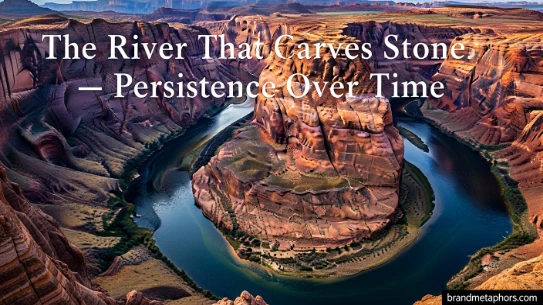
A river may seem gentle, even powerless compared to rock. But given enough time, it shapes valleys, cuts canyons, and transforms entire landscapes.
Meaning and Emotional Insight
This metaphor represents slow, consistent resilience. Not dramatic recovery, but quiet endurance.
It teaches:
- Small efforts accumulate into major change
- Persistence outlasts resistance
- Time itself becomes an ally
Example Sentence or Scenario
“She kept studying a little every day, like a river carving stone, until she eventually mastered what once felt impossible.”
Alternative Expressions
- Slow but unstoppable force
- Gentle persistence that reshapes reality
- Quiet determination over time
Sensory & Emotional Detail
Picture the steady sound of water flowing over rocks—soft, repetitive, patient. No urgency, no panic. Just movement. Over years, even mountains change shape under that patience.
Mini Story
A farmer once worked a dry, rocky field that everyone said was useless. But year after year, he added soil, watered it, and cared for it. Decades later, that land became fertile enough to feed an entire community. The river does not rush—but it wins.
Creative Exercises: Practicing Metaphors for Resilience
To truly understand these metaphors, try shaping them into your own thoughts.
Exercise 1: Personal Metaphor Creation
Think of a challenge you’ve faced. Now answer:
- If your struggle were a natural force, what would it be?
- If your recovery were an object, what would it be?
Example: “My anxiety is a storm, but my calmness is the lighthouse that survives it.”
Exercise 2: Daily Metaphor Journal
Each day, complete one sentence:
- “Today I felt like _______ because _______.”
This builds emotional awareness and creative expression.
Exercise 3: Turn Pain into Symbol
Rewrite a difficult experience using one of the metaphors:
- Bamboo (adaptation)
- Phoenix (rebirth)
- River (persistence)
This reframing can change emotional perspective over time.
Bonus Tips: Using Resilience Metaphors in Writing, Social Media, and Life
- In writing: Use metaphors to open essays or emotional scenes. They immediately engage readers.
- On social media: Short metaphorical captions (“Still standing like bamboo in the storm”) are powerful and relatable.
- In daily thinking: Replace harsh self-talk (“I failed”) with imagery (“I am still shaping like a river against stone”).
The goal is not to escape reality, but to reimagine it in a way that strengthens you.
FAQs About Metaphors for Resilience
What are metaphors for resilience?
They are symbolic comparisons—like bamboo, phoenix, or rivers—that represent the ability to recover, adapt, and endure through challenges.
Why are metaphors important for understanding resilience?
Because they turn abstract emotional strength into vivid images, making difficult experiences easier to process and remember.
Can metaphors actually help emotional healing?
While they are not a replacement for support or therapy, metaphors can help reframe thinking and improve emotional awareness and coping.
What is the most common resilience metaphor?
The phoenix rising from ashes is one of the most widely used metaphors for transformation and recovery after hardship.
How can I create my own resilience metaphor?
Think about your experience and compare it to something in nature, objects, or stories that reflect similar qualities like endurance, change, or growth.
Conclusion
Resilience is not always loud. Sometimes it is the quiet bamboo bending in silence, the patient river reshaping stone, or the mythical phoenix rising when everything seems lost.
Metaphors do not just describe resilience—they teach it. They help us see ourselves not as victims of circumstance, but as part of a larger, enduring pattern of growth and renewal.
And perhaps that is the most powerful realization: you are not only surviving the storm—you are becoming the language of it.