
The morning light slips through a half-open window, falling gently on two coffee cups left on a kitchen table. One is warm, half-finished. The other is cold, untouched. Between them lies a silence that says more than words ever could
. Relationships often speak like this—not in sentences, but in symbols, rhythms, pauses, and patterns we feel before we fully understand them.
This is where metaphors for relationships come alive. They give shape to something invisible. Love, trust, conflict, intimacy—these are not objects we can hold, but experiences we can imagine through comparison. A metaphor turns emotional complexity into something the mind can picture, like a map for the heart.
Understanding relationship metaphors is more than a literary exercise. It helps us communicate better, reflect deeper, and even heal. When we say “our relationship is a garden,” we begin to see what needs watering. When we say “we are drifting apart like two boats at sea,” we start to understand distance in emotional terms.
Let’s explore powerful metaphors for relationships that reveal how love and connection truly work.
What Are Metaphors for Relationships and Why They Matter
Metaphors for relationships are symbolic comparisons that describe emotional bonds through familiar images—nature, movement, architecture, or art. Instead of saying “our relationship is strong but requires effort,” a metaphor might say, “our relationship is a rope bridge that sways but holds when we walk carefully together.”
These metaphors matter because:
- They help us understand complex emotions.
- They improve communication in love, friendship, and family dynamics.
- They make abstract feelings more tangible and relatable.
- They enrich writing, storytelling, and even everyday conversations.
In literature, psychology, and daily life, metaphors act like emotional translators. They turn feelings into images we can see, feel, and remember.
Now, let’s explore three powerful relationship metaphors that capture the beauty and struggle of human connection.
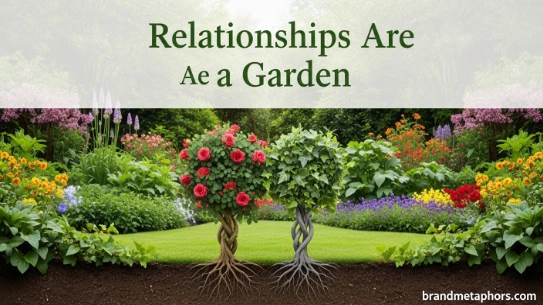
1. Relationships Are a Garden: Growth, Care, and Seasons of Change
A relationship is often compared to a garden—alive, evolving, and deeply dependent on care.
Meaning and Explanation
This metaphor suggests that relationships require consistent nurturing. Love doesn’t survive on its own; it must be watered with attention, patience, and understanding. Like plants, relationships go through seasons—some periods bloom with joy, while others feel dry or dormant.
Example Sentence or Scenario
“Our relationship is a garden; when we stop communicating, the flowers start to wilt, but when we spend time together, everything blooms again.”
Imagine a couple who once shared daily conversations but slowly drifted into silence due to busy routines. Over time, emotional distance grows like weeds. But when they decide to reconnect—talking again, sharing meals, listening—the garden begins to revive.
Alternative Expressions
- “Our love needs tending.”
- “We’ve stopped watering what we planted.”
- “Our bond is blooming again.”
Sensory and Emotional Detail
Picture soil warmed by sunlight, hands gently digging into earth, the smell of rain after a dry spell. Emotionally, this metaphor carries hope—it reminds us that neglect is reversible, and growth is always possible.
Mini Storytelling Moment
An elderly man once said about his 50-year marriage: “We’ve had winters where nothing grew, but we never stopped planting seeds.” That simple reflection captures the truth of long-term relationships—resilience through seasons.
2. Relationships Are a Dance: Rhythm, Balance, and Emotional Flow
Another powerful metaphor is that relationships are a dance.
Meaning and Explanation
This metaphor emphasizes coordination, timing, and mutual awareness. In a dance, one partner cannot move without the other. There is lead and follow, but also constant adjustment. Similarly, relationships require emotional rhythm—knowing when to step forward, when to pause, and when to give space.
Example Sentence or Scenario
“Our relationship feels like a dance; sometimes we move in perfect sync, and other times we step on each other’s toes, but we keep learning the rhythm.”
Think of two people navigating disagreements. One rushes forward emotionally, while the other retreats. Instead of breaking apart, they learn to adjust their pace—like dancers finding harmony after missteps.
Alternative Expressions
- “We’re out of sync right now.”
- “We need to find our rhythm again.”
- “We move together when things are right.”
Sensory and Emotional Detail
Imagine soft music in a dim room, footsteps echoing lightly on wooden floors, hands finding balance. Emotionally, this metaphor highlights vulnerability and cooperation—it reminds us that perfection is not the goal, but connection is.
Cultural Reference and Insight
Across cultures, dance symbolizes unity. From ballroom waltzes to traditional folk dances, movement in pairs reflects trust. Even when steps are imperfect, the shared intention keeps the connection alive.
3. Relationships Are a Bridge: Connection Across Distance

The metaphor of relationships as a bridge captures connection, separation, and effort across emotional gaps.
Meaning and Explanation
A bridge connects two separate places. In relationships, it represents the effort required to overcome differences—emotional, physical, or psychological. A strong bridge allows people to meet halfway, even when they come from different worlds.
Example Sentence or Scenario
“Our relationship is a bridge; sometimes storms shake it, but we keep rebuilding the planks whenever something breaks.”
Imagine two friends living in different countries. Time zones, responsibilities, and distance could weaken their bond. But calls, messages, and visits act as maintenance work on the bridge, keeping it stable.
Alternative Expressions
- “We’re trying to reconnect the gap between us.”
- “There’s still a bridge between our hearts.”
- “We are spanning different worlds.”
Sensory and Emotional Detail
Picture a long wooden bridge swaying over deep water, wind brushing against its cables. Walking across it requires trust. Emotionally, this metaphor carries both tension and hope—it acknowledges distance but also the possibility of crossing it.
Mini Storytelling Moment
A traveler once wrote about returning home after years away: “I crossed the bridge I thought had collapsed long ago, and found it still standing—just weathered, not broken.” Relationships often feel the same: worn but not gone.
Interactive Exercises: Explore Your Own Relationship Metaphors
Try these creative prompts to deepen your understanding:
Exercise 1: Create Your Own Metaphor
Complete the sentence:
- “My relationship is like a ______ because ______.”
Examples:
- “My friendship is like a campfire because it needs constant attention to stay warm.”
- “My love is like a river because it changes shape but keeps flowing.”
Exercise 2: Emotional Mapping
Think of a current relationship in your life. Ask:
- What image comes to mind when I think of it?
- Is it stable, fragile, growing, or fading?
- If it were a place or object, what would it be?
Exercise 3: Rewrite a Memory
Take a past emotional moment and describe it using a metaphor:
- Instead of “we argued and stopped talking,” try “we became two radios stuck on different frequencies.”
Bonus Tips: Using Relationship Metaphors in Writing and Daily Life
Metaphors are powerful tools beyond literature. Here’s how to use them effectively:
Writing
- Use metaphors to open essays or stories with emotional impact.
- Avoid clichés unless you give them a fresh twist.
- Blend sensory details with symbolic meaning.
Social Media
- Short metaphorical captions often perform well:
- “Still learning the rhythm of us.”
- “Some gardens take time to bloom.”
- Pair metaphors with minimal imagery for emotional depth.
Daily Life
- Use metaphors in conversations to express feelings gently:
- “I feel like we’re drifting right now.”
- “We need to water this relationship again.”
- They can soften conflict and make communication more reflective.
FAQs About Metaphors for Relationships
What are the most common metaphors for relationships?
Common ones include relationships as gardens, journeys, dances, bridges, storms, or fires. Each highlights a different emotional aspect like growth, movement, connection, or intensity.
Why do metaphors help in understanding relationships?
Metaphors simplify complex emotions by turning them into familiar images. This helps people understand feelings that are otherwise difficult to express directly.
Can metaphors improve communication in relationships?
Yes. Metaphors allow people to express emotions more gently and creatively, reducing misunderstandings and encouraging empathy.
How can I create my own relationship metaphors?
Think about how your relationship feels emotionally, then compare it to something in nature, movement, or objects that share similar qualities.
Are relationship metaphors used in psychology?
Yes. Psychologists often use metaphors to help clients describe emotions and patterns in relationships, making abstract experiences easier to discuss.
Conclusion
Relationships are never just what they appear to be on the surface. They are gardens that bloom and wither, dances that require rhythm and trust, bridges that connect distant hearts. Through metaphors, we don’t just describe relationships—we understand them more deeply.
Each metaphor becomes a lens, revealing something new about love, friendship, and human connection. Some days your relationship may feel like a flourishing garden; other days, like a shaky bridge in the wind. But in every form, it tells a story worth noticing, nurturing, and reflecting upon.
And perhaps that is the real power of metaphors for relationships—they remind us that love is not a fixed state, but a living image always changing shape in the light of our experience.