
There are few images in nature as universally beloved as the rose. It is soft yet guarded, delicate yet fierce, timeless yet ever-changing. A rose is not just a flower—it is a language, a symbol, and a story that has traveled through centuries of poetry, art, and human emotion.
On a quiet morning, imagine walking through a garden still heavy with dew. The air is cool, almost trembling with fragrance. You bend slightly, and there it is—a rose, half-opened, as if it is whispering a secret it has carried all night. In that moment, it is more than a flower. It becomes a feeling.
That is the power of metaphors for roses: they allow us to turn a simple bloom into something deeply human, something we can feel, understand, and use in writing, storytelling, and everyday expression.
Understanding Metaphors for Roses in Writing and Expression
Metaphors for roses are imaginative comparisons that describe roses (or anything symbolically connected to them—love, beauty, pain, growth) in terms of something else. Instead of saying “the rose is beautiful,” a metaphor might say “the rose is a blush of dawn trapped in petals.”
These expressions matter because they:
- Add emotional depth to writing
- Make descriptions more vivid and memorable
- Help communicate abstract emotions like love, loss, or hope
- Enrich poetry, storytelling, captions, and speeches
Roses have long been associated with romance, secrecy (“sub rosa” meaning “under the rose”), and even struggle, since every bloom carries thorns beneath its beauty. This duality makes them perfect for metaphorical expression.
Let’s explore three powerful metaphors for roses that can elevate your writing and imagination.
Metaphor 1: “A Rose is a Whisper of Love in Bloom”
Meaning and Explanation
This metaphor suggests that a rose is not just a flower, but a gentle expression of love that has taken physical form. The word “whisper” implies softness, intimacy, and emotional closeness.
It reflects the idea that love does not always need loud declarations—it can exist quietly, like a rose opening petal by petal.
Example Sentence or Scenario
He left a single rose on her doorstep each morning, as if the garden itself had learned to whisper his feelings for her.
Alternative Expressions
- A rose is a silent letter written in petals
- A rose is love speaking without words
- A rose is affection folded into color and scent
Sensory and Emotional Detail
Imagine the faint scent of rose oil lingering in the air, soft and lingering like memory. The petals feel like silk against your fingertips. There is no noise—only presence.
Mini Storytelling Moment
In an old French village, a baker once placed a rose in his wife’s window every morning before dawn. He never wrote her poems or sang songs. But over time, the villagers began to say, “Their love is not spoken—it blooms.”
Interactive Prompt
Think of someone you care about. How would you “gift” a rose metaphorically without using words? Write one sentence describing it.
Metaphor 2: “A Rose is a Battle Wearing Perfume”
Meaning and Explanation
This metaphor highlights the contrast between beauty and struggle. Roses are not just soft petals; they have thorns. So this expression captures resilience, survival, and hidden strength beneath elegance.
It is especially useful when describing people or experiences that look graceful on the outside but carry deep strength or pain within.
Example Sentence or Scenario
She walked into the room like a rose—a battle wearing perfume, every smile hiding a story she had survived.
Alternative Expressions
- A rose is survival wrapped in elegance
- A rose is strength disguised as softness
- A rose is war softened by beauty
Sensory and Emotional Detail
Picture the sharpness of a thorn pricking your finger, followed immediately by the sweet fragrance of petals. Pain and beauty coexist in the same moment.
Cultural and Literary Connection
In classical Persian poetry, roses often symbolize lovers who endure pain for beauty and truth. The rose is never just gentle—it is always layered with struggle.
Mini Storytelling Moment
A soldier returning home after years of silence planted roses in her yard. Neighbors saw only flowers. But she saw memories—each bloom a battle survived, each thorn a wound turned into wisdom.
Interactive Prompt
Write a short line describing yourself or someone you admire using this metaphor style. What kind of “battle” do they carry behind their beauty?
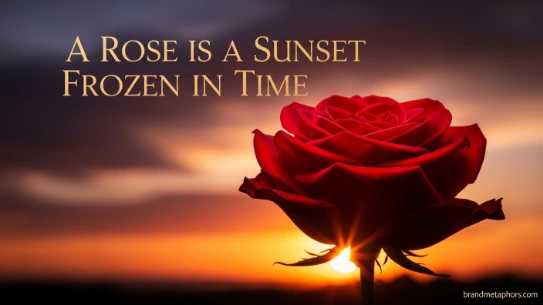
Metaphor 3: “A Rose is a Sunset Frozen in Time”
Meaning and Explanation
This metaphor captures the visual and emotional beauty of a rose as something eternal, like a sunset paused mid-glow. It emphasizes color, warmth, and fleeting beauty preserved.
It is often used in poetic or romantic writing to describe moments that feel too beautiful to pass.
Example Sentence or Scenario
The garden was filled with roses that looked like sunsets frozen in time, refusing to fade even as night approached.
Alternative Expressions
- A rose is evening light caught in petals
- A rose is dusk holding its breath
- A rose is the sky’s last kiss made visible
Sensory and Emotional Detail
Imagine golden-pink hues melting into deep crimson, the air warm but fading. The rose feels like a memory you want to hold forever.
Mini Storytelling Moment
A photographer once tried to capture the perfect sunset but missed it. The next morning, he found a rose blooming outside his window. He smiled and whispered, “So that’s where you went.”
Interactive Prompt
Recall a moment you wished could last forever. Now describe it using the “rose as a sunset” metaphor style.
How to Use Rose Metaphors in Writing, Captions, and Daily Life
Metaphors for roses are not just for poets—they are practical tools for communication.
1. In Creative Writing
Use rose metaphors to:
- Describe love scenes or emotional turning points
- Add depth to character descriptions
- Create symbolic imagery in fiction or poetry
Example: “Her words were roses—soft, dangerous, unforgettable.”
2. In Social Media Captions
Short metaphors work beautifully for Instagram or status updates:
- “Still blooming, even with thorns 🌹”
- “A sunset in petal form.”
- “Love, quietly blooming like a rose.”
3. In Personal Reflection
Use rose metaphors to understand emotions:
- Growth = blooming rose
- Pain = thorn beneath beauty
- Healing = petals slowly opening
This helps turn abstract feelings into something visual and manageable.
Bonus Tips for Mastering Rose Metaphors Creatively
- Mix senses: Combine sight, smell, and touch in your metaphor (e.g., “a rose that smells like forgotten memories”).
- Avoid overuse: Let the metaphor surprise the reader instead of repeating clichés.
- Blend contrasts: Roses naturally carry both softness and sharpness—use that tension.
- Observe real roses: Spend time noticing how they open, wilt, and change colors.
- Keep it personal: The best metaphors reflect your own emotional experience.
Creative Exercise: Build Your Own Rose Metaphor Garden
Try this simple exercise:
- Think of a rose
- Choose an emotion (love, grief, hope, strength)
- Compare that emotion to something unexpected
example:
- “A rose is hope learning how to breathe again”
- “A rose is memory wearing color”
- “A rose is silence learning to speak softly”
Now write your own three rose metaphors and refine them into poetic lines.
FAQs on Metaphors for Roses
What is a metaphor for a rose?
At metaphor for a rose is a creative comparison that describes a rose (or its symbolic meaning) as something else, such as love, beauty, or strength, to create vivid imagery.
Why are roses commonly used in metaphors?
Roses carry rich symbolism—love, beauty, pain, and transience—making them perfect for expressing complex human emotions in poetry and storytelling.
How can I use rose metaphors in writing?
You can use them in creative writing, poetry, captions, speeches, or personal reflections to add emotional depth and visual imagery.
What emotions do rose metaphors usually represent?
They often represent love, passion, longing, resilience, beauty, and sometimes sorrow or loss.
Can rose metaphors be used in non-romantic writing?
Yes. Rose metaphors can describe personal growth, struggle, memory, strength, and even professional or life experiences beyond romance.
Conclusion
A rose is never just a flower. It is a story unfolding in petals, a contradiction of softness and strength, a symbol that carries centuries of human emotion. Through metaphors, we transform it into something even greater—a language of feeling.
Whether it is a whisper of love, a battle wearing perfume, or At sunset frozen in time, rose metaphors help us see beauty in deeper, more meaningful ways. They remind us that language itself can bloom—quietly, powerfully, and endlessly.
And like a rose, the best metaphors are not rushed. They open slowly, revealing meaning one petal at a time.