
Introduction (A New Way to See Math)
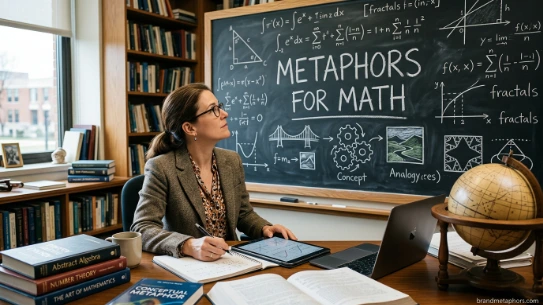
Imagine sitting in a quiet room where numbers are not just symbols on paper but living things. A student stares at a math problem and instead of feeling pressure, they see a story unfolding—like pieces of a puzzle slowly clicking into place.
Outside, rain taps the window, and each drop feels like a reminder that patterns exist everywhere, even in nature. Math is often seen as cold, strict, or difficult, but what if that is only one way of looking at it?
Metaphors for math help us see numbers as something familiar and human. They turn equations into language, problems into puzzles, and formulas into tools for understanding life. Instead of fear or confusion, math becomes a way to explore the world with curiosity. This matters because math is not only for classrooms—it shapes buildings, music, technology, business, and even daily decisions.
When we understand math through metaphors, we remove fear and build confidence. We start to see that math is not about memorizing rules but about recognizing patterns, solving real problems, and thinking clearly. In this article, we will explore powerful metaphors that make math easier, deeper, and more meaningful in everyday life.
1. Math as a Language of Patterns
Math can be seen as a language that speaks through patterns instead of words. Just like English or Urdu uses letters to form sentences, math uses numbers and symbols to express ideas. But instead of emotions or events, it describes relationships and structures.
When someone says “2 + 2 = 4,” it is like saying a simple sentence that expresses truth. More complex equations are like longer sentences that describe how things connect in the world.
H3: Why This Language Matters
This metaphor helps us understand that math is not random. It has grammar, rules, and meaning. For example, algebra is like learning sentence structure. Once you understand it, you can “read” problems more easily.
H3: Real-Life Connection
In daily life, budgeting money or measuring ingredients in cooking uses this language of patterns. You are translating real situations into mathematical expressions. Once you see math as a language, it feels less like memorization and more like communication.
2. Math as a Map for Understanding the World
Math is like a map that guides us through complex places. A map does not change the world, but it helps us understand it. In the same way, math helps us navigate science, engineering, and daily decisions.
Without math, we would be lost in uncertainty. With it, we can estimate distances, calculate time, and predict outcomes.
H3: Finding Direction in Problems
When solving a math problem, it is like reading a map step by step. You choose a direction, follow rules, and reach a destination—an answer.
H3: Real-Life Example
GPS systems, architecture plans, and weather predictions all depend on mathematical maps. Even simple tasks like planning travel routes use this hidden map of logic.
Math does not give the journey itself, but it shows the way.
3. Math as Building Blocks of Reality
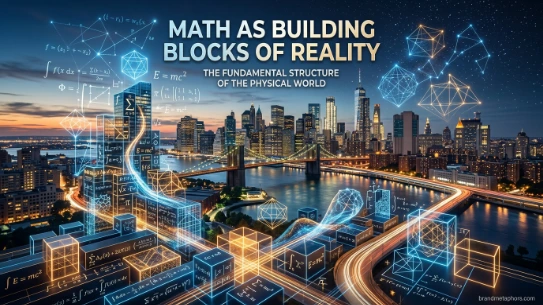
Math can be imagined as building blocks used to construct everything around us. Just like bricks build houses, numbers and formulas build systems in science and nature.
From the shape of bridges to the design of smartphones, math forms the foundation.
H3: Small Blocks, Big Structures
Simple concepts like addition and multiplication are like basic bricks. More advanced topics like calculus are like complex designs built on top of them.
H3: Everyday Observation
When you stack books or arrange chairs, you are unknowingly working with structure and balance—both mathematical ideas. Math becomes the invisible structure behind physical reality.
4. Math as Music and Rhythm
Numbers and music are deeply connected. Math is like rhythm, and numbers are like beats. Patterns in music follow mathematical rules, even if we do not notice them.
H3: Harmony in Numbers
Fractions and ratios explain musical harmony. A perfect rhythm depends on timing, which is pure mathematics in action.
H3: Emotional Connection
When you listen to music, you feel emotion. In the same way, math has rhythm and flow. A well-solved problem has balance and satisfaction, like a completed melody.
Math is not silent—it has its own rhythm that structures beauty.
5. Math as a Puzzle Waiting to Be Solved
Math is like a puzzle where each piece must fit perfectly. At first, the picture is unclear, but slowly patterns emerge.
H3: The Joy of Discovery
Solving math problems feels like uncovering hidden clues. Each step brings you closer to the final image.
H3: Life Analogy
In life, challenges often feel like puzzles too. Budgeting, planning, or making decisions all require putting pieces together. Math trains the mind to enjoy solving instead of fearing difficulty.
6. Math as a Bridge Between Ideas
Math acts like a bridge that connects different ideas and fields. It links science with art, logic with creativity, and theory with real life.
H3: Connecting Knowledge
Physics uses math to explain motion. Economics uses math to explain markets. Even art uses math for symmetry and design.
H3: Mental Connection
When you understand math, you can move between different subjects more easily. It becomes a universal connector, helping ideas meet and interact.
7. Math as a Garden That Grows with Care
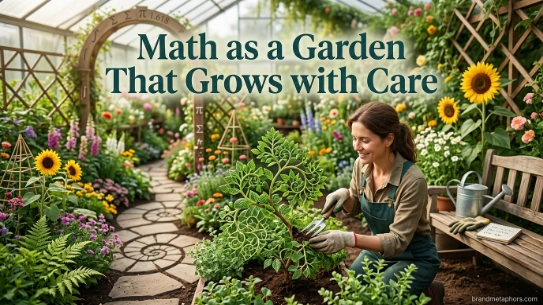
Math can be seen as a garden that grows slowly over time. You start with simple seeds—basic numbers—and with practice, your understanding grows into complex ideas.
H3: Growth Through Practice
Like plants need water, math needs practice. Without care, knowledge fades. With regular effort, it flourishes.
H3: Patience in Learning
Many students struggle because they expect instant results. But like gardening, math rewards patience and consistent effort.
The more you nurture it, the more it grows into something strong and useful.
8. Math as a Game of Strategy
Math is like a game where rules guide actions, and strategy leads to success. Every problem has moves, choices, and outcomes.
H3: Thinking Ahead
In math, you must plan steps before solving. Like chess, every decision affects the result.
H3: Learning Through Play
When seen as a game, math becomes less stressful. It becomes a challenge to enjoy rather than a task to fear. Winning the game means reaching the correct solution.
9. Math as a Machine That Processes Logic
Math can be imagined as a machine that takes input, applies rules, and produces output. It is precise, structured, and reliable.
H3: How the Machine Works
You enter numbers, apply formulas, and get results. Each step follows a logical system, like gears working together.
H3: Everyday Machines
Calculators, computers, and smartphones all rely on mathematical machines. Even simple apps depend on this logical system working in the background.
Math ensures that the machine of reasoning runs smoothly.
10. Math as a Story of Numbers
Math is also a story where numbers play characters and equations form the plot. Each problem tells a journey from question to answer.
H3: Beginning, Conflict, Resolution
A math problem starts with confusion, builds tension through steps, and ends with clarity.
H3: Personal Learning Story
Every learner has their own math story. Some chapters are easy, some are difficult, but all lead toward understanding.
Math becomes a narrative of growth and discovery.
11. Math as Light That Reveals Hidden Truths
Math is like light that reveals things we cannot see directly. It helps uncover patterns hidden in nature, behavior, and systems.
H3: Seeing the Invisible
Without math, many scientific truths would remain hidden. It helps us “see” gravity, growth, and probability.
H3: Clarity in Confusion
When problems feel dark or unclear, math acts like a flashlight, showing the next step forward. It brings clarity where there was confusion.
12. Common Misunderstandings of Math Metaphors
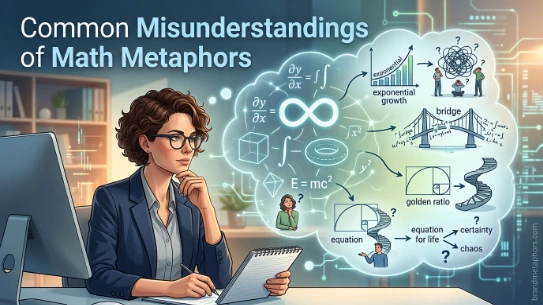
Many people misunderstand math because they see it as rigid or disconnected from life. But metaphors help break these wrong ideas.
H3: Math Is Not Just Memorization
Math is not about remembering formulas—it is about understanding patterns and relationships.
H3: Math Is Not Separate from Life
From shopping to cooking, from travel to technology, math is everywhere. It is not isolated; it is part of daily experience.
H3: Practical Lessons
When you view math through metaphors—language, music, games—you reduce fear and increase curiosity. Learning becomes natural instead of forced.
Conclusion
Math is often treated as a subject filled with rules, symbols, and pressure. But when we look through metaphors, it transforms into something far more meaningful. It becomes a language that communicates patterns, a map that guides decisions, a garden that grows with care, and even a story that unfolds step by step.
These metaphors help us understand that math is not separate from life—it is deeply woven into everything we do. Whether we are solving problems, making decisions, or exploring the world, math quietly supports our thinking. When we stop fearing it and start seeing it in familiar forms, it becomes easier to learn and more enjoyable to use. Ultimately, math is not just about answers; it is about understanding the world with clarity, patience, and curiosity.