
Introduction
Imagine walking through a crowded street on a difficult day. Your mind feels heavy, your thoughts scattered, and even the smallest tasks feel overwhelming. Then something subtle happens—a stranger holds the door open a little longer than necessary, a friend sends a message that simply says, “I’m here,” or a shopkeeper offers a quiet smile that feels unusually warm.
Nothing dramatic changes in your life, yet something inside you shifts. The weight feels slightly lighter. The world feels a little less harsh.
Kindness often works like this—quiet, invisible, and deeply powerful in ways we struggle to describe directly.
That is where metaphors for kindness become important. They help us understand something abstract and emotional by comparing it to familiar, tangible experiences. Instead of defining kindness in rigid terms, metaphors allow us to feel it, visualize it, and carry it in memory.
In real life, kindness is not just a moral idea; it is a force that shapes relationships, communities, and even personal healing. By exploring metaphors for kindness, we gain a richer understanding of how compassion moves through human life—softly, unexpectedly, and sometimes transformatively.
This article explores those metaphors in depth, revealing how kindness behaves like light, water, seeds, bridges, and more, helping us see its role in everyday existence with greater clarity and emotional insight.
1. Understanding Kindness Through Metaphors
Kindness is difficult to define in strict language because it is not just an action—it is a feeling, a choice, and a ripple of emotional impact. This is why metaphors are so powerful. They allow us to translate emotional experiences into physical or visual concepts.
When we say kindness is “like sunshine,” we instantly understand warmth, brightness, and comfort. When we say it is “like a seed,” we imagine growth over time. These comparisons help us understand not only what kindness is but how it behaves.
Metaphors also deepen emotional awareness. Instead of seeing kindness as a simple social rule, we begin to see it as something living and dynamic. It spreads, it grows, it reflects, and it returns in unexpected ways. In everyday life, this understanding changes how we act. We begin to notice that small gestures matter more than we assumed.
In essence, metaphors transform kindness from an abstract moral idea into a lived, sensory experience that we can recognize in ourselves and others.
2. Why Kindness Needs Metaphors
Kindness is universal, but it is also invisible. You cannot measure it like temperature or weight. You cannot always prove it, yet you can feel its effects deeply. Because of this, literal language often fails to capture its full meaning.
Metaphors bridge this gap. They give shape to something intangible. They help us communicate emotional truths that are otherwise difficult to express.
Emotional Accessibility
A metaphor makes kindness relatable. Saying “kindness is a bridge” immediately suggests connection between people who are otherwise distant.
Memory and Learning
People remember images better than abstract definitions. A child may forget a definition of kindness but will remember the idea of it as “water helping things grow.”
Cultural Understanding
Different cultures interpret kindness differently, but metaphors allow shared understanding. A flower, light, or shelter is recognizable across languages and traditions.
Ultimately, metaphors make kindness easier to understand, easier to teach, and easier to practice.
3. Kindness as Light
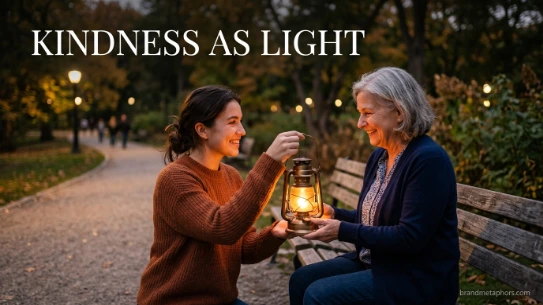
One of the most common metaphors for kindness is light. Light represents clarity, warmth, and hope.
When someone enters a room and their kindness “lights it up,” it suggests emotional brightness. This metaphor works because light naturally changes how we perceive everything around it.
Kindness as light does not need to be loud or overwhelming. Even a small candle can change darkness. Similarly, a small act of kindness—a gentle word or a patient response—can shift someone’s emotional state.
Real-Life Interpretation
Think of a student struggling with self-doubt. A teacher’s encouraging comment can act like light breaking through clouds. The situation may not change immediately, but perception does.
Kindness as light reminds us that we do not need to solve everything to make a difference. Sometimes, simply illuminating someone’s moment is enough.
4. Kindness as Water
Water is another powerful metaphor for kindness because it represents flow, nourishment, and adaptability.
Water does not force its way through obstacles; it moves around them. Similarly, kindness often works best when it is flexible and gentle rather than rigid or demanding.
Emotional Nourishment
Just as plants need water to survive, people need kindness to emotionally thrive. A lack of kindness can make emotional environments feel dry and harsh.
Healing Quality
Water cleanses and refreshes. In the same way, kindness can help heal emotional wounds, even if slowly.
Everyday Example
A friend listening without judgment is like water soaking into dry soil. It does not fix everything instantly, but it creates conditions for growth and recovery.
Kindness as water teaches patience. It reminds us that emotional change often happens gradually.
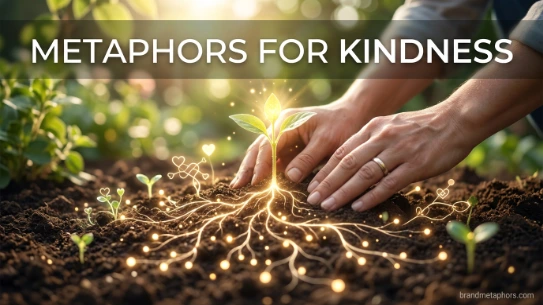
5. Kindness as a Seed or Garden
When kindness is compared to seeds or gardens, it emphasizes growth and long-term impact.
A seed is small, almost invisible, yet it holds the potential for something much larger. Similarly, a small act of kindness can grow into a lasting change in someone’s life.
Planting Emotional Seeds
A simple compliment may stay in someone’s memory for years. It can shape confidence, decisions, and even identity.
The Garden Effect
Kindness requires care. Just like a garden, it needs attention, consistency, and nurturing. Neglected kindness fades, but tended kindness multiplies.
Story Insight
A parent’s consistent encouragement may become the “garden” where a child’s self-esteem grows strong roots.
This metaphor reminds us that kindness is not always immediate—it is cumulative.
6. Kindness as a Bridge
Kindness as a bridge represents connection between people, especially when differences or distance exist.
A bridge allows movement over gaps—whether emotional, cultural, or social. In human relationships, kindness often acts as that structure.
Emotional Connection
When people misunderstand each other, kindness can rebuild communication. A calm response during conflict is like laying down a plank on unstable ground.
Social Healing
In communities, kindness helps reduce division. It creates pathways where there were once barriers.
Example Scenario
Two coworkers with different opinions may not agree, but mutual respect acts as a bridge that keeps collaboration possible.
Kindness as a bridge teaches that connection is more important than perfection in relationships.
7. Kindness as Currency or Gift

In this metaphor, kindness is something valuable that can be given and received.
Unlike material currency, kindness increases when shared. The more it is given, the more it circulates.
Emotional Exchange
A smile or supportive message is like a gift that costs nothing but carries emotional value.
Reciprocity
While kindness should not be transactional, it often returns in unexpected ways. A helpful gesture today may inspire support tomorrow.
Reflection
In workplaces or families, environments rich in kindness tend to be more cooperative and stable.
This metaphor highlights kindness as something that strengthens social “economies” without depletion.
8. Kindness as Shelter
Kindness as shelter represents protection and safety during emotional storms.
Everyone experiences moments of vulnerability—loss, failure, confusion, or fear. In such moments, kindness acts like a roof during rain.
Emotional Safety
A non-judgmental listener provides psychological shelter. It allows people to express themselves without fear.
Stability in Crisis
During difficult times, even small acts of kindness can feel like protection from emotional exposure.
Example
A teacher who supports a struggling student offers shelter from discouragement and shame.
This metaphor reminds us that kindness is not always about action—it is also about presence.
9. Kindness During Conflict: The Fire Extinguisher Metaphor
Conflict often feels like fire—fast, reactive, and destructive. In this metaphor, kindness is a fire extinguisher.
It does not deny the fire exists; it simply helps control it.
Cooling Emotional Heat
In arguments, kindness can reduce emotional intensity. A calm tone or pause can prevent escalation.
Preventing Damage
Without kindness, conflicts can burn relationships. With it, even disagreements remain manageable.
Real-Life Insight
A couple choosing respectful communication during disagreement is using kindness to prevent emotional damage.
This metaphor shows that kindness is not weakness—it is control and emotional intelligence.
10. Misunderstandings About Kindness Metaphors

While metaphors enrich understanding, they can also create misconceptions.
Kindness Is Not Always Soft
Some assume kindness always means softness or agreement. However, kindness can be firm. A boundary set respectfully is still kindness.
Over-idealization
Metaphors like “kindness is always light” may ignore situations where kindness is challenging or requires courage.
Emotional Misinterpretation
People may expect constant emotional warmth from others, forgetting that kindness also includes honesty and truth.
Understanding these limitations ensures metaphors guide us without oversimplifying reality.
11. Real-Life Applications of Kindness Metaphors
Metaphors are not just poetic—they influence behavior.
In Communication
Seeing kindness as a bridge encourages better listening and reduced judgment.
In Education
Teachers who view kindness as seeds are more patient with long-term student growth.
In Relationships
Partners who see kindness as shelter prioritize emotional safety during conflict.
In Personal Growth
Individuals who view kindness as light may focus on small positive actions daily.
These metaphors become practical tools for shaping behavior and emotional intelligence.
12. How to Practice Thinking Through Kindness Metaphors
Developing awareness of kindness metaphors can change how you perceive everyday life.
Step 1: Notice Emotional Moments
Pay attention to when kindness is given or received.
Step 2: Assign a Metaphor
Ask yourself: Was this kindness like water, light, or a bridge?
Step 3: Reflect on Impact
Consider how the metaphor helps you understand the emotional effect more deeply.
Step 4: Apply Intentionally
Use metaphors to guide your actions. For example, think “How can I be shelter in this moment?”
Over time, this practice strengthens emotional awareness and empathy.
Conclusion
Kindness is not a single action or definition—it is a living experience that moves through human life in subtle and powerful ways. Metaphors help us understand this complexity by turning invisible emotions into familiar images. Whether kindness is seen as light, water, seeds, bridges, shelter, or currency, each metaphor reveals a different layer of its meaning.
These comparisons remind us that kindness is both simple and profound. It can brighten a moment, heal emotional dryness, build long-term growth, or protect someone in distress. Most importantly, it connects people across differences and distances.
By learning to recognize kindness through metaphors, we begin to see it everywhere—in conversations, gestures, and silence. And in doing so, we also become more intentional in offering it ourselves.