
Introduction
Imagine a child looking up at the night sky and saying, “The stars are tiny lanterns hanging in the dark.” In that simple sentence, something magical happens. The world becomes more colorful, more meaningful, and easier to understand. Children naturally think this way—through imagination, comparison, and storytelling. But what if we could nurture that instinct more intentionally?
Metaphors are more than just poetic language. For kids, they are bridges between the known and the unknown. They help explain feelings that are hard to describe, simplify complex ideas, and spark creativity in everyday life. Whether it’s calling a busy classroom “a buzzing beehive” or describing a brave child as “a lion,” metaphors allow children to see beyond the surface.
This article explores metaphors for kids in depth—what they mean, why they matter, and how they can be used in real-life situations. From emotional expression to learning and creativity, metaphors open doors to deeper understanding and richer communication. Let’s step into this imaginative world and discover how powerful simple comparisons can be.
What Is a Metaphor and Why It Matters for Kids
A metaphor is a way of describing something by saying it is something else. It’s not meant to be taken literally but helps paint a clearer picture in the mind. For kids, this idea can feel natural because their imagination is already vivid and flexible.
Think of a teacher saying, “Your brain is a sponge.” The child immediately understands that learning means absorbing information. No complicated explanation needed. That’s the beauty of metaphors—they simplify without oversimplifying.
Metaphors matter because they:
- Make learning engaging and memorable
- Help children understand abstract ideas
- Encourage creative thinking
- Improve communication skills
Children who grasp metaphors early often develop stronger language abilities. They also learn to express themselves in ways that go beyond basic vocabulary. Instead of saying “I’m scared,” a child might say, “My heart is a drum,” which communicates both feeling and intensity.
In short, metaphors are tools for thinking, feeling, and expressing—wrapped in imagination.
How Metaphors Help Kids Understand the World
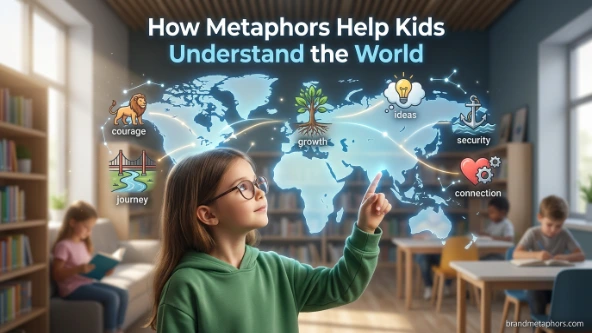
Children constantly try to make sense of the world around them. Metaphors act like shortcuts to understanding. When something new or confusing appears, comparing it to something familiar makes it easier to grasp.
For example, explaining time as “a flowing river” helps kids visualize that it keeps moving forward. Describing emotions as weather—“anger is a storm” or “happiness is sunshine”—gives children a framework to understand their feelings.
Everyday Learning Through Metaphors
- A classroom becomes “a garden,” where ideas grow
- A teacher is “a guide,” helping students find their way
- Friendship is “a bridge” connecting two people
These comparisons make abstract concepts more concrete. Instead of memorizing definitions, kids build mental images.
When children understand the world through metaphors, they also begin to create their own. That’s when true learning happens—not just repeating information, but transforming it into something meaningful.
Metaphors and Emotional Expression
One of the most powerful uses of metaphors is helping children express emotions. Kids often struggle to name what they feel. Metaphors give them a voice.
A child might not say, “I feel anxious,” but they might say, “There’s a knot in my stomach.” That image communicates emotion more clearly than a label ever could.
H3: Common Emotional Metaphors for Kids
- “My heart feels heavy” → sadness
- “I’m boiling inside” → anger
- “I feel like floating” → happiness
- “My mind is a storm” → confusion
These expressions allow children to process emotions safely. Instead of bottling feelings, they externalize them through imagery.
Parents and teachers can encourage this by asking questions like:
- “If your feeling was weather, what would it be?”
- “What does your sadness look like?”
This approach not only builds emotional intelligence but also strengthens communication between children and adults.
Encouraging Creativity Through Metaphors
Metaphors are fuel for creativity. They allow children to think beyond literal meanings and explore endless possibilities.
When a child says, “The playground is a jungle,” they’re not just describing—it’s storytelling, imagination, and interpretation all at once.
Creative thinking developed through metaphors leads to:
- Better problem-solving skills
- Stronger storytelling abilities
- Increased confidence in self-expression
H3: Simple Creative Activities
- Ask kids to describe their day as an object
- Let them compare animals to human traits
- Encourage drawing metaphors (e.g., “draw what happiness looks like”)
These activities make learning fun and interactive. They also show children that there’s no single “correct” answer—only creative exploration.
Over time, kids begin to see connections everywhere, turning ordinary experiences into imaginative insights.
Metaphors in Storytelling for Kids
Stories and metaphors go hand in hand. Many children’s stories are built on metaphorical ideas—heroes representing courage, villains symbolizing fear, and journeys reflecting growth.
When kids use metaphors in storytelling, their narratives become richer and more engaging.
For example, instead of saying, “He was very brave,” a child might say, “He stood like a mountain.” This instantly creates a stronger image.
Storytelling with metaphors helps children:
- Build descriptive language
- Develop narrative skills
- Understand deeper meanings
Parents and teachers can support this by encouraging kids to:
- Replace plain descriptions with imaginative ones
- Add comparisons to their stories
- Explore “what something feels like” instead of just “what it is”
The result is storytelling that feels alive and memorable.
Using Metaphors in the Classroom
Classrooms become more engaging when metaphors are used effectively. Teachers can turn complex topics into relatable ideas.
For example:
- Math can be “a puzzle waiting to be solved”
- Science experiments can be “adventures of discovery”
- Reading can be “a journey into different worlds”
These metaphors shift learning from obligation to exploration.
H3: Practical Classroom Applications
- Introduce new topics with metaphorical comparisons
- Encourage students to create their own metaphors
- Use visuals to reinforce metaphorical thinking
When students connect emotionally and imaginatively with lessons, they retain information better.
Metaphors for Building Confidence in Kids
Confidence grows when children feel understood and capable. Metaphors can reinforce positive self-image.
Calling a child “a shining star” or “a growing tree” emphasizes potential and progress rather than perfection.
H3: Empowering Metaphors
- “You’re a seed that’s growing stronger every day”
- “Your voice is a powerful light”
- “You’re a builder of your own path”
These metaphors encourage resilience and self-belief. They remind children that growth takes time and effort.
Instead of focusing on mistakes, metaphors shift attention to development and possibility.
Common Misunderstandings About Metaphors
While metaphors are helpful, kids sometimes take them literally. This can lead to confusion.
For instance, if you say “time flies,” a child might imagine actual flying clocks. That’s why guidance is important.
Adults should:
- Explain that metaphors are comparisons, not facts
- Encourage questions
- Use simple, relatable examples
Understanding metaphors is a skill that develops over time. Patience and repetition help children grasp the concept fully.
Cultural and Personal Interpretations of Metaphors

Not all metaphors mean the same thing to every child. Cultural background, experiences, and environment shape interpretation.
For example:
- A “desert” metaphor may feel different to someone who lives near one
- “Snow” might be magical for some and unfamiliar for others
This diversity makes metaphors even more powerful. They reflect personal experiences and perspectives.
Encouraging kids to create their own metaphors allows them to express their unique worldview.
Metaphors in Everyday Conversations
Metaphors aren’t just for stories or classrooms—they’re everywhere in daily life.
Parents might say:
- “Clean your room; it’s a disaster zone”
- “Your ideas are bright”
- “Let’s tackle this problem together”
These expressions shape how children think and communicate.
By being mindful of language, adults can use metaphors intentionally to:
- Teach values
- Encourage behavior
- Strengthen relationships
Helping Kids Create Their Own Metaphors
Creating metaphors is a skill that improves with practice. The goal isn’t perfection but expression.
H3: Simple Steps
- Pick something (emotion, object, situation)
- Ask: “What does this remind me of?”
- Create a comparison
For example:
- “School is like a maze”
- “My dog is a bouncing ball”
Encouragement matters more than correctness. When kids feel safe to experiment, creativity flourishes.
Metaphors and Problem-Solving Skills
Metaphors help children think differently about problems. Instead of seeing challenges as obstacles, they can reframe them.
For example:
- A problem becomes “a knot to untangle”
- A mistake becomes “a stepping stone”
This shift in perspective builds resilience and adaptability.
Children learn that difficulties are not dead ends but opportunities for growth.
The Role of Parents and Teachers
Adults play a key role in nurturing metaphorical thinking. By modeling creative language, they inspire children to do the same.
Ways to support kids:
- Use metaphors in conversations
- Encourage imaginative descriptions
- Celebrate creative expressions
The goal is not to teach metaphors formally but to integrate them naturally into everyday life.
Long-Term Benefits of Learning Metaphors Early
Children who learn to use metaphors early often develop:
- Stronger communication skills
- Better emotional awareness
- Enhanced creativity
- Improved critical thinking
These skills extend far beyond childhood. They influence how individuals understand the world, solve problems, and connect with others.
Metaphors are not just language tools—they are thinking tools.
Conclusion
Metaphors open a doorway into a richer, more imaginative way of seeing the world. For kids, they transform ordinary experiences into meaningful stories, complex emotions into understandable images, and learning into an adventure. By encouraging children to explore metaphors, we give them more than just words—we give them a way to think, feel, and express themselves deeply.
From classrooms to conversations at home, metaphors can shape how children grow and connect with the world around them. When a child learns to say, “My dreams are wings,” they are not just speaking creatively—they are learning to see possibilities.
In nurturing metaphorical thinking, we nurture imagination, confidence, and understanding—skills that last a lifetime.
FAQs
What is a simple definition of a metaphor for kids?
A metaphor is a way of describing something by saying it is something else to make it easier to understand or more interesting.
At what age can children understand metaphors?
Most children start understanding simple metaphors around ages 5–7, but it develops gradually with exposure and practice.
Why are metaphors important for kids?
They help kids understand complex ideas, express emotions, and develop creativity and communication skills.
How can I teach metaphors to my child?
Use simple comparisons in everyday conversation and encourage your child to create their own imaginative descriptions.
What are some easy metaphor examples for kids?
Examples include “The classroom is a zoo,” “Her smile is sunshine,” and “Time is a race.”
Can metaphors help with emotional development?
Yes, they help children describe and process feelings in a safe and understandable way.
What’s the difference between a metaphor and a simile?
A metaphor says something is something else, while a simile uses “like” or “as” to compare.
How can teachers use metaphors effectively?
Teachers can use metaphors to explain lessons, encourage creativity, and make learning more engaging and relatable.