
Introduction (The Feeling You Can’t Quite Shake)
You know the moment. You’re trying to explain something simple, but the words refuse to come out right. Or you’re fixing a small problem, and it keeps getting worse no matter what you try. Your jaw tightens. Your thoughts feel crowded. Time seems to move slower, as if it is mocking your effort. That quiet pressure building inside is frustration—an emotion we all know but rarely understand deeply.
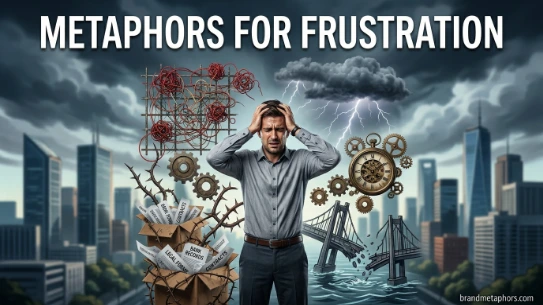
Frustration is more than just “being annoyed.” It is a mix of blocked goals, rising tension, and emotional overload. Because it is hard to describe directly, we often use metaphors to explain it. These metaphors turn invisible feelings into clear images—like a boiling pot, a broken machine, or a traffic jam in the mind.
In this article, we explore powerful metaphors for frustration. Each one helps you see the emotion in a new way, understand its triggers, and recognize it in everyday life. By the end, you will not only understand frustration better—you may also learn how to handle it with more calm and clarity.
1. Understanding Metaphors for Frustration
Metaphors for frustration are mental pictures that translate emotional tension into physical or visual experiences. Instead of saying “I feel stuck,” we say “I’m hitting a wall.” Instead of “I feel overwhelmed,” we say “my mind is overflowing.”
These expressions matter because frustration is abstract. You cannot see it, but you can feel its pressure. Metaphors help bridge that gap between emotion and understanding.
For example, a student struggling with math might say, “It feels like my brain is locked.” This metaphor shows both confusion and helplessness in a simple image. Similarly, a worker facing endless tasks might describe their day as “running in circles.”
Why metaphors help
- They make emotions easier to explain
- They help others understand your experience
- They reduce emotional confusion
Metaphors also give frustration shape. Once an emotion has shape, it becomes easier to manage. Instead of feeling lost inside it, you can “see” it outside yourself, which creates distance and clarity.
2. The Boiling Pot: Pressure Building Inside

One of the most common metaphors for frustration is a boiling pot. Imagine a pot on a stove. Water heats slowly, then starts to bubble, and finally reaches a boiling point where steam rushes out uncontrollably.
This is exactly how frustration builds. Small problems—like delays, misunderstandings, or repeated mistakes—add heat. At first, you stay calm. But as pressure increases, your emotional “temperature” rises.
Real-life example
A person stuck in traffic while already late for work may start with mild irritation. But as cars stop moving and time passes, the internal pressure builds. Eventually, even small things—like a horn or slow driver—can trigger anger.
What it teaches us
The boiling pot metaphor shows that frustration is not sudden. It builds gradually. Recognizing early “heat signs” helps prevent emotional overflow.
Common signs include:
- Restlessness
- Short patience
- Repeating thoughts like “this is not working”
Understanding this metaphor encourages emotional awareness before the “boil over” moment happens.
3. Traffic Jam in the Mind
Frustration often feels like being stuck in traffic—especially when applied to thinking. A traffic jam metaphor describes how thoughts, plans, or actions get blocked despite effort.
In this mental image, your mind is a busy road. Ideas are vehicles moving toward a goal. But suddenly, everything slows down or stops. You want progress, but nothing moves.
H3: Everyday example
A writer trying to finish an article may know exactly what they want to say. But the sentences do not flow. Ideas pile up, but none move forward. It feels like mental congestion.
H3: Emotional impact
- Feeling stuck
- Loss of momentum
- Rising impatience
This metaphor is powerful because it shows that frustration is not always about lack of ability—it is about blocked flow. Sometimes the problem is external (delays, obstacles), and sometimes internal (confusion, pressure).
The traffic jam reminds us that forcing movement rarely helps. Often, patience or a new route is needed instead of pushing harder.
4. A Glitching Machine: When Things Don’t Work
Another strong metaphor for frustration is a malfunctioning machine. You press buttons, but nothing responds correctly. Or worse, the system reacts in unexpected ways.
This represents moments when effort and outcome do not match. You try repeatedly, but results remain broken or inconsistent.
Example in daily life
Think of a phone freezing right when you need it most. You tap, swipe, restart—but it still refuses to work. That helpless repetition creates frustration quickly.
What it reflects emotionally
- Loss of control
- Repeated failure
- Confusion about “what went wrong”
Frustration here comes from expectation mismatch. You expect logic and response, but experience randomness or resistance.
This metaphor is common in work, technology, and learning situations. It highlights how frustration often arises when systems—external or internal—stop responding in predictable ways.
5. The Balloon Under Pressure
Imagine a balloon slowly filling with air. At first, it expands smoothly. But as more air enters, the surface tightens. One more breath could make it burst.
This is how frustration builds inside people. Each annoyance adds “air” to the balloon. The person may appear calm outside, but pressure increases internally.
H3: Emotional buildup signs
- Tight chest or jaw
- Short replies
- Desire to “escape” the situation
H3: Why it matters
This metaphor shows that emotional capacity is limited. Everyone has a breaking point, and ignoring pressure does not remove it—it increases it.
The balloon image teaches awareness. Releasing small amounts of pressure early (like taking breaks or stepping back) prevents emotional explosion.
6. Tangled Wires: Confused Emotions

Frustration can also feel like tangled wires. You know something should work, but everything is twisted together. Pulling one thread seems to make another knot worse.
This metaphor is especially useful for describing mental confusion during problem-solving.
Example scenario
A student studying multiple subjects at once may feel mentally overloaded. Each topic overlaps with another, creating confusion instead of clarity.
Emotional meaning
- Mixed thoughts
- Difficulty focusing
- Feeling mentally “stuck in knots”
Untangling requires patience, not force. Pulling harder often tightens the mess. This metaphor teaches that frustration sometimes needs slow, careful sorting rather than fast action.
7. Storm Trapped in a Glass Room
Imagine a storm happening inside a glass room. You can see the chaos—wind, rain, movement—but you cannot escape it or control it.
This metaphor reflects internal emotional storms caused by frustration. Everything feels intense, but the person is still “contained” in daily responsibilities.
H3: Real-life connection
Someone at work might appear calm on the outside but feel intense frustration inside due to pressure, deadlines, or miscommunication.
H3: Emotional lesson
This metaphor shows that frustration is not always visible. People may look composed while experiencing strong internal turbulence.
It also reminds us that expressing emotions in safe ways is important—otherwise, the storm stays trapped and grows stronger.
8. A Broken Record of Repetition
Frustration often comes from repetition—doing the same thing again and again without success. The broken record metaphor captures this perfectly.
It feels like a song stuck on repeat. No matter how many times it plays, it never moves forward.
Example
Trying to fix a mistake in a project, but the same error keeps appearing, creates a loop of frustration.
What it means
- Lack of progress
- Repeated failure
- Mental exhaustion
This metaphor teaches that frustration often signals the need for change in strategy, not more repetition. Continuing the same action blindly only deepens the cycle.
9. Locked Door Without a Key
A locked door metaphor represents blocked goals. You can see what you want, but you cannot reach it.
This is one of the most relatable metaphors for frustration because it involves desire plus barrier.
Example
You want to improve a skill, but no matter how much you try, progress feels out of reach.
Emotional effect
- Helplessness
- Determination mixed with stress
- Feeling “so close, yet so far”
Sometimes the frustration is not about lack of effort but lack of the right tool or approach. The key may be knowledge, guidance, or time.
10. Too Many Open Browser Tabs
Modern frustration often feels like too many browser tabs open at once. Each tab represents a task, thought, or responsibility demanding attention.
Eventually, the system slows down.
H3: Daily life example
A person juggling work, family, and personal goals may feel mentally scattered. Every task demands attention, but none fully closes.
H3: Emotional result
- Mental fatigue
- Reduced focus
- Feeling overwhelmed
This metaphor highlights cognitive overload. Frustration here is not from a single problem but from too many competing demands.
11. Sand Slipping Through Hands
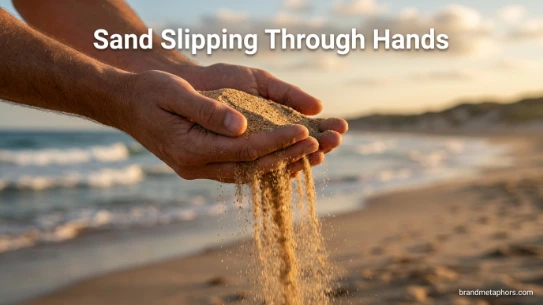
Some frustrations come from things that cannot be held or controlled. The sand slipping through hands metaphor represents this experience.
No matter how tightly you try to hold it, it keeps slipping away.
Example
Trying to control outcomes like timing, other people’s behavior, or uncertain results often creates this feeling.
Meaning
- Loss of control
- Acceptance challenge
- Emotional disappointment
This metaphor teaches that not everything can be controlled. Sometimes frustration comes from resisting natural flow instead of adapting to it.
12. Lessons from Frustration Metaphors
All these metaphors—boiling pots, traffic jams, tangled wires—point to one truth: frustration is a signal, not just an emotion.
It tells you something is blocked, overloaded, or misaligned.
Key lessons
- Frustration builds gradually
- It often signals a need for change
- Repetition without adjustment increases stress
- Emotional awareness reduces intensity
Instead of fighting frustration, understanding its “shape” helps you respond better. You can pause, adjust strategy, or reduce pressure before it grows.
Frustration is not just discomfort—it is information.
Conclusion
Frustration can feel confusing, heavy, and even overwhelming. But when we look at it through metaphors, it becomes easier to understand. A boiling pot shows rising pressure. A traffic jam reveals blocked progress. A tangled wire shows confusion. Each image turns an invisible feeling into something we can recognize and manage.
These metaphors do more than describe emotion—they help you respond to it. They remind you that frustration is often temporary, usually understandable, and always meaningful. It signals that something needs attention, not avoidance.
When you can name the shape of your frustration, you gain control over it. And with that awareness, even the most chaotic emotional moments become easier to navigate with patience and clarity.