

Introduction
A family is often the first world we ever know. Imagine a child sitting at a dinner table, listening to voices rise and fall like waves—some soft with care, others sharp with emotion. In that small moment, the child is learning something powerful: how human connection feels, how love is shown, and how conflict is handled.
Family is not just a group of people related by blood or marriage. It is a living system of emotions, memories, habits, and unspoken bonds.
To understand something as complex as family relationships, we often turn to metaphors. We compare family to things we already understand—trees, houses, rivers, or songs. These metaphors help us see patterns in love, conflict, support, and growth. They also help us explain feelings that are hard to put into simple words.
In real life, family shapes how we think, behave, and connect with others. It influences our identity and emotional health.
That is why exploring metaphors for family relationships is not just a creative exercise—it is a way to better understand ourselves and the people closest to us. Through these images and comparisons, we can find new meaning in everyday family life and discover deeper emotional truths.
1. Family as a Tree with Roots and Branches
One of the most powerful metaphors for family relationships is a tree. The roots represent ancestors and traditions. They are hidden but strong, feeding stability and identity. The trunk represents the present generation, holding everything together. The branches represent children and future generations, spreading in different directions but still connected.
Roots: The Hidden Strength
Roots are unseen, yet they anchor everything. In families, roots symbolize values, culture, and inherited beliefs. Even if we do not always notice them, they shape our choices and reactions.
Branches: Growth and Independence
Branches grow outward, just like family members who develop their own lives. Even when they move away or take different paths, they remain part of the same tree.
This metaphor teaches us that distance does not break connection. A strong family allows growth while still staying rooted in shared history.
2. Family as a House with Rooms
A family can also be seen as a house. Each person is a room, unique in design, size, and purpose, but all part of one structure.
Inside this house, some rooms are quiet, some are loud, and some are rarely visited. Yet they all belong under the same roof.
Different Rooms, Different Roles
Some family members are like the living room—open and social. Others are like bedrooms—private and calm. This shows that differences in personality are natural and necessary.
Walls That Protect and Divide
Walls in a house provide safety but also separation. In families, healthy boundaries work the same way. They protect individuality while maintaining connection.
This metaphor helps us understand that a strong family does not mean everyone is the same. It means everyone belongs in the same safe space.
3. Family as a River Flowing Through Time
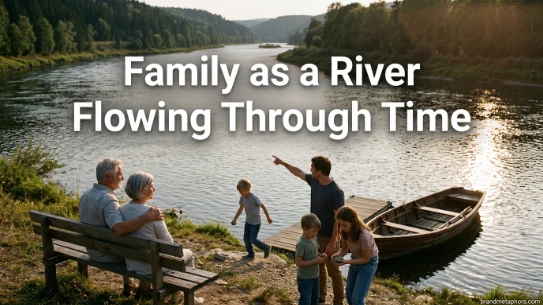
A river is always moving, just like a family. It flows from the past into the present and toward the future.
Changing Yet Continuous
Water in a river is never the same, but the river itself remains. Similarly, family members grow, change, and evolve, but the family identity continues.
Branches and Currents
Sometimes rivers split into streams, like families that spread across cities or countries. Even then, they remain connected to the same source.
This metaphor shows that change is natural in families. What matters is not staying the same, but staying connected.
4. Family as a Team Working Toward Goals
A family can be compared to a team, where each member plays a role in achieving shared goals like happiness, stability, and support.
Different Strengths, One Purpose
In a team, everyone has a position. Some lead, some support, and some guide quietly. In families, these roles shift over time but remain important.
Winning and Losing Together
Families experience success and failure together. Whether facing financial struggles or celebrating achievements, they move as one unit.
This metaphor teaches cooperation. A strong family depends on teamwork, not competition among members.
5. Family as a Garden That Needs Care
A family is like a garden that requires constant attention. Without care, even the strongest plants can weaken.
Watering with Love and Time
Love, communication, and time are like water and sunlight. They help relationships grow strong and healthy.
Weeds of Conflict
Every garden has weeds. In families, these are misunderstandings, arguments, and resentment. If not addressed, they can harm growth.
This metaphor reminds us that relationships need effort. Love is not automatic—it must be nurtured.
6. Family as a Quilt of Different Fabrics
A quilt is made from many pieces of fabric stitched together. Each piece is different in color, texture, and shape, yet together they form something warm and useful.
Individual Pieces Matter
Each family member is like a unique piece of fabric. Their personality, experiences, and emotions add value to the whole.
The Thread of Connection
The thread that holds the quilt together represents love, respect, and shared memories.
This metaphor shows that differences do not weaken a family. They make it richer and more meaningful.
7. Family as a Bridge Between Generations

A bridge connects two places that are separate but need to stay linked. Family works the same way between generations.
Connecting Past and Future
Older generations pass knowledge, traditions, and values to younger ones. This creates a continuous flow of wisdom.
Strength Under Pressure
A strong bridge can hold weight and withstand storms. Similarly, strong families survive challenges through unity and trust.
This metaphor highlights the importance of connection across time.
8. Family as a School of Life
Family is often our first classroom. It teaches us how to speak, behave, and understand emotions.
Lessons Beyond Books
We learn empathy, patience, and respect not from textbooks but from daily interactions at home.
Teachers and Students
Every family member teaches and learns at the same time. Parents guide children, but children also teach adults new perspectives.
This metaphor shows that family is a lifelong learning experience.
9. Family as a Clock with Moving Parts
A clock is made of many gears working together. If one part stops, the whole system is affected.
Timing and Coordination
Each family member has a role and timing. When everyone works in harmony, life feels balanced.
When Parts Fall Out of Sync
Conflicts in families can be seen as gears not aligning. With patience and care, balance can be restored.
This metaphor emphasizes cooperation and timing in relationships.
10. Family as a Song or Orchestra
A family can be compared to music, where each voice or instrument contributes to harmony.
Different Sounds, One Melody
Some voices are loud, others soft, but together they create a full composition.
When Harmony Breaks
If one instrument is off, the music feels disrupted. Similarly, family conflict creates emotional imbalance.
This metaphor highlights emotional connection and the beauty of harmony.
11. Family as a Safety Net
A safety net catches us when we fall. Family often serves this role in emotional and practical life.
Support in Hard Times
During failure, illness, or sadness, family provides comfort and stability.
Trust in Falling
Knowing there is a safety net allows people to take risks and grow.
This metaphor shows that emotional security is a key function of family.
12. Family as a Mirror Reflecting Ourselves

Family often reflects who we are. In their reactions, we see our habits, strengths, and flaws.
Learning About Ourselves
Through family interactions, we understand how we behave under stress or joy.
Growth Through Reflection
Sometimes what we see in the mirror is not comfortable, but it helps us grow.
This metaphor shows that family is not just external—it also shapes our inner world.
Conclusion
Family relationships are complex, emotional, and deeply personal. By using metaphors like trees, houses, rivers, and songs, we can better understand their structure and meaning. These comparisons help us see that families are not perfect systems but living, changing connections that grow over time.
Each metaphor reveals something important: the need for care, the value of difference, the strength of connection, and the importance of shared growth. Whether it is the roots of a tree or the harmony of music, every image points to the same truth—family is both fragile and strong at the same time.
Understanding these metaphors helps us appreciate our own families more deeply. It reminds us that relationships require effort, patience, and love. And in return, they give us identity, support, and belonging.