

Introduction
Imagine a home where two people once shared morning tea, laughter in the kitchen, and quiet plans for the future. Now the same space feels different—echoes instead of conversations, silence instead of shared dreams. Divorce often begins long before papers are signed; it begins in moments like these, where connection slowly fades and two lives start moving in different emotional directions.
To understand divorce deeply, we often turn to metaphors. Metaphors help us describe what is hard to explain. They turn emotional pain, confusion, and change into images we can see and understand. When we say divorce feels like “a broken bridge” or “a storm passing through,” we are trying to give shape to something deeply personal.
This article explores powerful metaphors for divorce to help make sense of emotional separation. These images are not just poetic—they are tools for understanding grief, healing, and growth. Whether someone is going through divorce or trying to support someone who is, these metaphors offer clarity in a difficult emotional journey.
1. Divorce as a Shift in Meaning, Not Just an Ending
Divorce is often seen as an ending, but metaphorically, it can also be understood as a shift in meaning. What once represented “we” becomes “I” again. This change is not always sudden. It is like watching a painting slowly change colors over time until the original image is no longer visible.
In this metaphor, divorce is not a destroyed story but a rewritten one. The meaning of shared memories changes. A vacation once seen as joyful may later feel bittersweet. A home becomes not just a place of love, but also of learning and transformation.
This perspective helps reduce emotional sharpness. Instead of seeing divorce as pure loss, it becomes a transition where identity, purpose, and emotional direction are redefined. It allows space for acceptance without denying pain.
Understanding divorce this way helps people realize that endings can also carry quiet beginnings inside them.
2. Divorce as an Emotional Landscape
Divorce can feel like walking through an unfamiliar landscape where the ground keeps shifting. One day there are hills of sadness, the next there are valleys of relief or confusion. Nothing feels stable.
This emotional landscape is not flat—it is layered. Some areas are filled with memories, others with silence. People often move through this landscape slowly, sometimes going in circles, revisiting the same emotional places again and again.
H3: Navigating Without a Map
There is no clear map for this journey. Each person must learn to recognize their own emotional landmarks—moments of anger, grief, acceptance, or hope.
H3: Learning the Terrain
Over time, the landscape becomes more familiar. The sharp edges soften. What once felt overwhelming begins to feel manageable.
This metaphor helps explain why healing from divorce is not linear. It is a process of slowly learning how to move through emotional space with more awareness and less fear.
3. Divorce as a Broken Bridge
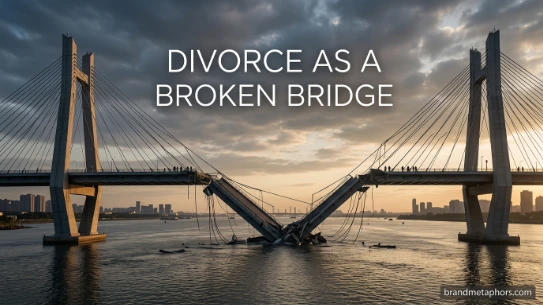
A broken bridge is one of the most powerful metaphors for divorce. It represents a connection that once allowed two people to move freely between each other’s worlds.
When the bridge breaks, communication becomes harder. Distance grows. Even if both sides are still visible, the path between them is gone.
This does not always mean destruction. Sometimes, the bridge simply becomes unsafe or unstable, making continued crossing impossible. The break may even prevent further harm.
In this metaphor, both sides of the bridge still exist. Each person remains whole, but the connection changes shape. Some bridges are rebuilt differently; others remain as reminders of what once connected two lives.
The broken bridge metaphor helps people understand that separation is not always about failure—it can also be about safety, change, and emotional survival.
4. Divorce as Changing Seasons
Divorce can also be understood as a shift in seasons. Relationships often begin in spring—full of growth, warmth, and hope. Over time, they may move into summer stability, autumn reflection, and sometimes winter emotional distance.
When divorce happens, it can feel like entering a long winter. Everything seems quiet, cold, and still. But winter is not the end of the natural cycle. It is a period of rest and transformation.
Spring eventually returns in new forms—new routines, new identities, new emotional strength.
This metaphor helps people understand that emotional seasons are natural. No season lasts forever. Even the coldest emotional winter carries the possibility of future renewal.
5. Divorce as Renovating a Shared House
A shared life can be imagined as a house built together over time. Rooms are added, memories placed on shelves, habits embedded into walls. Divorce becomes a renovation process.
Sometimes renovation means removing certain walls. Sometimes it means dividing space differently. The structure still exists, but its function changes.
This metaphor highlights emotional restructuring. It is not about destroying the house but redefining how it is used. Each person begins redesigning their own space for comfort and stability.
Though painful, renovation creates room for growth. It allows individuals to rebuild their emotional environment in healthier ways.
6. Divorce as a Torn Map of Life Journey
Life with a partner often feels like traveling with a shared map. Decisions are made together, directions are agreed upon, and destinations are planned jointly.
Divorce can feel like that map being torn into two separate paths. Suddenly, each person must navigate without the full picture.
H3: Finding New Directions
At first, this feels disorienting. But slowly, individuals learn to create new routes based on personal goals and needs.
H3: Redrawing the Journey
Over time, new maps are drawn. They may look different, but they are still meaningful.
This metaphor emphasizes independence after separation. Even if the shared map is gone, new journeys can still be meaningful and fulfilling.
7. Divorce as a Passing Storm
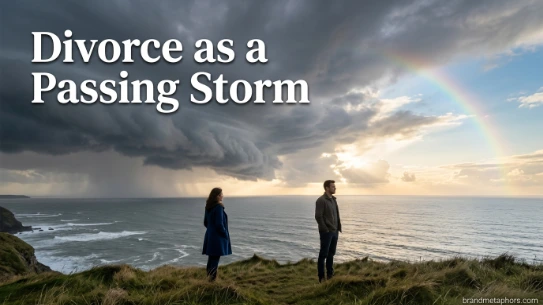
A storm metaphor captures the emotional intensity of divorce. There is wind (conflict), rain (tears), and thunder (arguments or emotional outbursts). During the storm, visibility is low and everything feels unstable.
However, storms do pass. They leave behind changed landscapes, but also clearer skies.
This metaphor helps normalize emotional turbulence. It shows that intense feelings are temporary, even when they feel endless in the moment.
After the storm, people often notice small signs of calm returning—quieter thoughts, steadier emotions, and clearer perspective.
8. Divorce as Closing a Chapter in a Book
Life can be seen as a long book, and relationships are important chapters within it. Divorce represents the end of one chapter—not the end of the book itself.
This metaphor highlights continuity. The story continues even after separation. The ending of one chapter often sets the stage for a very different next one.
It also acknowledges emotional closure. Some chapters end with understanding, others with unanswered questions. Both are valid.
What matters is turning the page, even when it feels difficult.
9. Divorce as an Overgrown Garden
A relationship can be compared to a garden that requires care, attention, and effort. When a marriage ends, it can feel like the garden has become overgrown—plants tangled, paths unclear, growth uncontrolled.
In this metaphor, divorce is the process of stepping back and deciding what to keep, what to prune, and what to let go.
H3: Clearing Space for New Growth
Removing overgrowth does not destroy the garden. It prepares the soil for new planting.
H3: Learning What to Nurture Next
People begin to understand what emotional “plants” they want to grow in the future—peace, respect, independence.
This metaphor emphasizes renewal and emotional clarity.
10. Divorce as a Broken Mirror of Identity
A mirror reflects identity, but during divorce, that reflection can feel fragmented. People may no longer recognize themselves as part of a couple.
This broken mirror metaphor represents identity confusion. Who am I without this relationship? What parts of me were shaped by it?
Over time, the broken pieces are not discarded—they are reassembled into a new reflection. It may not look the same, but it still shows a complete person.
This metaphor supports emotional rebuilding and self-discovery after separation.
11. Divorce as Train Tracks Splitting
A relationship can be imagined as two train tracks running side by side. For a time, they move in the same direction. Divorce is the moment the tracks begin to split.
Both trains continue moving, but toward different destinations. The separation is gradual, not always sudden.
This metaphor helps explain that growth sometimes requires different paths. Staying aligned is not always possible or healthy.
It also shows that distance does not erase the shared journey already traveled.
12. Divorce as Rebuilding Light After Darkness

Finally, divorce can be seen as moving from darkness to light. The early stage often feels dark—uncertainty, sadness, confusion. But over time, light begins to return.
This light is not instant. It appears slowly through small moments: laughter returning, confidence rebuilding, peace increasing.
The metaphor emphasizes hope. Even after emotional darkness, clarity and warmth can return in new and unexpected ways.
Conclusion
Divorce is not just a legal process—it is a deeply emotional transition that reshapes identity, relationships, and daily life. Through metaphors like broken bridges, changing seasons, torn maps, and overgrown gardens, we can better understand the emotional complexity behind separation.
These images help translate pain into meaning. They remind us that divorce is not only about ending, but also about restructuring, healing, and rediscovering selfhood. While the experience can feel overwhelming, metaphors show that change is a natural part of emotional life.
In the end, divorce is not a single story but many layered experiences. And within those layers, there is always the possibility of growth, clarity, and a new beginning shaped in a different, but meaningful, direction.