
Introduction
Disappointment often arrives quietly, like a door that closes just before you reach it. You may have felt it when plans collapse at the last moment, when effort doesn’t match outcome, or when expectations float higher than reality can hold. In those moments, the mind struggles to explain what the heart already feels.
This is where language steps in—not just to describe, but to translate emotion into meaning. Metaphors for disappointment help us shape something unclear into something we can see, touch, and understand.
When someone says disappointment feels like “a balloon losing air” or “a candle flickering out in wind,” they are not just being poetic. They are giving structure to pain that is otherwise hard to explain. These comparisons make emotional experiences easier to process, share, and even heal from.
In real life, we all carry small and large disappointments—missed goals, broken trust, or delayed dreams. Understanding them through metaphors does not erase the feeling, but it softens its weight and helps us reflect more clearly on what went wrong and what can be learned. This article explores powerful metaphors for disappointment, revealing how language shapes emotional understanding in everyday life.
Understanding Metaphors for Disappointment
Metaphors for disappointment are comparisons that help describe emotional letdowns in vivid, relatable ways. Instead of directly saying “I am disappointed,” people often say it feels like “a bridge collapsing before you cross it” or “rain on a planned picnic.” These expressions turn abstract feelings into something visible and understandable.
At their core, metaphors act like emotional translators. Disappointment is often complex—it mixes expectation, hope, effort, and loss. A simple sentence cannot always carry all that weight. But a metaphor can compress it into an image the mind immediately recognizes. For example, “a dry well after a long journey” captures not just sadness but exhaustion and unmet need.
In daily life, these metaphors help us communicate experiences that might otherwise remain locked inside. A student failing an exam might describe it as “building a house that never stands.” A worker passed over for promotion might feel “a ship left behind at the dock.” These images allow others to understand not just what happened, but how deeply it was felt.
By using metaphors, disappointment becomes less invisible. It becomes something we can talk about, reflect on, and eventually reframe. This is the first step toward emotional clarity.
Why We Use Metaphors for Emotional Pain
Human emotions are often too layered for plain language. Disappointment, in particular, blends expectation and reality in a way that can feel confusing. Metaphors help bridge this gap by turning internal chaos into structured imagery.
One reason we use metaphors is because the brain processes images faster than abstract ideas. Saying “I feel like a deflated balloon” immediately communicates a sense of loss, energy drop, and emptiness. There is no need for long explanations. The image does the work.
Another reason is emotional safety. Talking directly about disappointment can sometimes feel too sharp or vulnerable. Metaphors soften the expression. Instead of saying “I failed,” someone might say “the ladder broke halfway up.” This creates emotional distance while still expressing truth.
Emotional Relief Through Indirect Expression
Metaphors also provide relief by making pain less personal. When disappointment is framed as “a storm passing over a field,” it becomes something temporary and natural rather than permanent or defining.
Shared Understanding
They also help others relate. If someone says “it felt like waiting for a train that never arrives,” most people understand the quiet frustration without needing more detail.
In this way, metaphors become emotional shortcuts that connect inner experience with shared human understanding.
Disappointment as a Broken Glass Window
One of the most powerful metaphors for disappointment is a broken glass window. It represents shattered expectations—something that once seemed clear and whole but is now fractured.
Imagine working for months toward a goal. You visualize success like a clean window showing a bright future. Then something goes wrong. The result arrives differently than expected, and suddenly that clear view is cracked. The pieces are still there, but they no longer form the picture you hoped for.
This metaphor captures both loss and fragility. A broken window cannot easily return to its original state. Similarly, disappointment often changes how we see a situation permanently. Even if we move forward, the memory of the break remains.
It also reflects emotional sharpness. Broken glass can hurt if handled carelessly, just as disappointment can cause lingering emotional pain if revisited without care.
However, there is also meaning in the metaphor. Broken windows can be repaired or replaced. This suggests that while disappointment leaves marks, it does not end the possibility of rebuilding. It simply changes the structure of what comes next.
Disappointment as a Fading Sunset
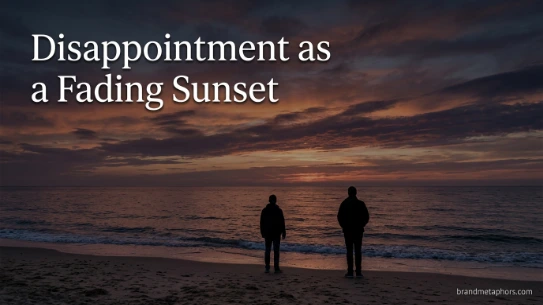
Disappointment can also feel like watching a beautiful sunset slowly disappear before darkness arrives. There is beauty, expectation, and then gradual loss.
The Slow Dissolve of Hope
Unlike sudden failure, this metaphor reflects slow disappointment—situations where things seem promising but gradually lose their brightness. For example, a friendship drifting apart or a long-awaited opportunity fading away.
You stand watching the sky, expecting the colors to stay longer, but they soften, dim, and vanish. That slow fading mirrors how hope sometimes slips away without dramatic collapse.
Emotional Contrast
The sunset metaphor also highlights contrast. The beginning is warm and full of promise. The end feels empty and quiet. This contrast is what makes disappointment more intense.
Even after the sun is gone, the memory of its beauty remains. This reflects how disappointed moments often include both gratitude and sadness at the same time.
In everyday life, this metaphor helps people accept that not all losses are sudden. Some are gentle but still deeply felt.
Disappointment as an Empty Chair at the Table
An empty chair at a table represents absence where presence was expected. It is a powerful metaphor for disappointment in relationships, events, or opportunities.
Imagine preparing a dinner, setting everything perfectly, expecting someone important to arrive. But the chair remains empty. The food cools. The silence grows louder. This image captures emotional letdown in its simplest form—something expected did not arrive.
The empty chair symbolizes more than absence; it represents anticipation turned into silence. It reflects moments when effort meets no response, such as a missed meeting, a canceled promise, or an unfulfilled expectation.
This metaphor is especially strong because it is visual and social. Humans are deeply aware of presence and absence in shared spaces. An empty chair is not just physical—it is emotional space left unfilled.
It also reflects lingering hope. Even after disappointment settles, the chair still “waits” in memory. This shows how emotional experiences often continue beyond the moment they happen.
Disappointment as a Stalled Train at the Wrong Station
Disappointment can feel like arriving at a station only to realize the train you needed has already left—or worse, it never comes.
Waiting Without Control
This metaphor captures helpless waiting. You have done your part: prepared, arrived on time, and followed the schedule. Yet something outside your control disrupts the plan.
For example, a job opportunity that suddenly closes or a plan that gets canceled last minute can feel exactly like this.
The Motion That Stops Suddenly
A train represents progress and movement. When it stalls, everything pauses. This reflects how disappointment interrupts momentum in life.
Even the sound of a distant train fading away can feel like missed opportunity. It suggests something moving forward without you.
This metaphor is powerful because it reflects both time and expectation. You cannot rewind the train. You can only wait for another one, which captures the reality of moving on after disappointment.
Disappointment as a Wilted Garden
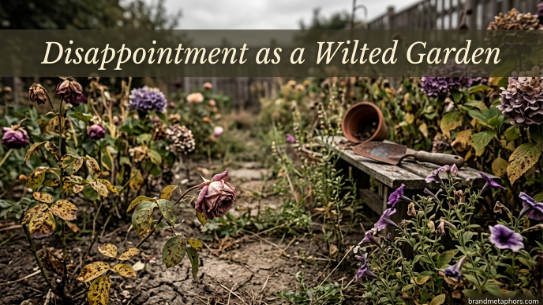
A garden in full bloom represents hope, care, and growth. When disappointment occurs, it can feel like watching that garden slowly wilt despite all effort.
Plants that once stood tall begin to droop. Colors fade. What once felt alive now feels still. This metaphor reflects situations where effort does not produce the expected outcome.
It is often used for long-term disappointments—careers, relationships, or personal goals that do not grow as expected despite attention and work.
The wilted garden also reflects emotional exhaustion. It suggests that disappointment is not just about loss but about energy spent without return.
Yet even in this image, there is potential. Gardens can be revived with care, water, and time. This adds a quiet layer of hope, showing that disappointment is not always final—it can be a pause in growth, not the end of it.
Disappointment as a Cracked Mirror
A cracked mirror reflects a distorted version of reality, making it a strong metaphor for self-directed disappointment.
When expectations about oneself are not met, the image in the mirror no longer feels complete. It may reflect doubt, regret, or self-criticism.
This metaphor shows how disappointment can affect identity. It does not just change how we see outcomes—it changes how we see ourselves.
However, even a cracked mirror still reflects truth. This suggests that despite disappointment, self-worth is not entirely lost. It may be fractured, but it still exists.
Disappointment in Relationships as an Unexpected Storm
Relationships often carry emotional expectations. When those expectations are not met, disappointment can feel like a sudden storm after calm weather.
Everything may seem fine at first—clear skies, steady connection. Then misunderstandings, unmet promises, or emotional distance appear like dark clouds.
The storm metaphor reflects intensity. It is not always about destruction but about disruption. It changes the emotional atmosphere quickly.
After the storm, things may feel different, even if they continue. This mirrors how disappointment in relationships often changes emotional trust and comfort.
Disappointment in Career as Closed Doors in a Long Hallway
Career disappointment can feel like walking through a long hallway filled with doors that do not open.
Each door represents opportunity. You try one after another, hoping for entry. But some remain locked, others close before you reach them.
The Feeling of Rejection Paths
This metaphor reflects persistence mixed with rejection. It shows effort that continues despite repeated setbacks.
Searching for the Right Opening
Even though many doors are closed, the hallway continues. This suggests that opportunities still exist, even if not immediately visible.
How Metaphors Help in Healing Disappointment

Metaphors do more than describe disappointment—they help process it. By turning emotions into images, they make feelings easier to understand and discuss.
When someone says disappointment feels like “a heavy backpack,” they are not just describing pain—they are also identifying weight that can eventually be set down.
Metaphors also create distance. They allow people to observe their feelings rather than be overwhelmed by them.
This reflection is often the first step toward emotional recovery.
Turning Disappointment into Growth
Disappointment, when understood clearly, can become a source of learning. Metaphors like “broken soil before planting” show that disruption can prepare ground for new growth.
Each disappointment carries information: what did not work, what needs change, and what can be improved.
Instead of seeing it as failure, it can be seen as adjustment. Just like weather reshapes landscapes, disappointment reshapes understanding.
Conclusion
Disappointment is a universal experience, but it becomes easier to understand when expressed through metaphors. Images like broken windows, fading sunsets, empty chairs, and stalled trains help translate complex emotions into something visible and relatable. These comparisons do not remove the pain, but they give it shape, making it easier to reflect on and share.
Through metaphors, disappointment shifts from something silent and heavy to something we can interpret and learn from. It becomes less about failure and more about perspective. Whether it appears as a wilted garden or a cracked mirror, each image carries meaning about expectation, loss, and resilience. In the end, metaphors remind us that disappointment is not just an end point—it is part of a larger emotional journey where understanding leads to growth and clarity.