
Introduction (The Quiet Spark That Starts Everything)
Imagine a child standing in a quiet room, staring at a locked drawer. There is no noise, no movement, just stillness—yet inside that child’s mind, a storm is growing. What is inside? Why is it locked? What happens if I open it? That small moment is where curiosity begins. It is not loud or dramatic. It is a soft pull, like something gently tugging at the mind, asking it to look closer.
We all experience this feeling in different ways. Sometimes it appears when we meet a new person. Sometimes it comes when we read a strange word or see something we do not understand. Curiosity is what pushes us to learn, explore, and grow. Without it, life would feel flat and unchanged.
That is why metaphors for curiosity matter. They help us understand this invisible force using simple images from everyday life. When we describe curiosity as a flame, a door, or a river, we can finally see how it moves through our thoughts and shapes our choices. In this article, we will explore powerful metaphors that explain curiosity in clear and meaningful ways, helping us understand how it works in learning, life, and human growth.
Curiosity as a Door Waiting to Be Opened
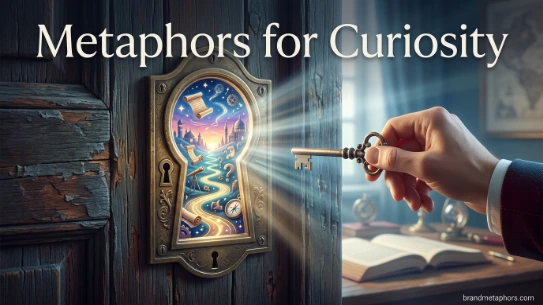
One of the most common metaphors for curiosity is a door. A closed door represents something unknown. Behind it may be answers, stories, or even surprises. Curiosity is the hand that reaches for the handle.
When a student hears a strange fact in class, it feels like standing in front of a locked door. They want to know what is inside, so they start asking questions. That is curiosity pushing them forward.
What the Door Represents
- The unknown
- New knowledge
- Hidden experiences
Every time we ask “what if?” we are turning the handle of that door. Sometimes the door opens easily, and sometimes it takes effort. But curiosity always pushes us to try.
In real life, this metaphor appears in many places. A new job, a new city, or even a new friendship can feel like a door waiting to be opened. Curiosity gives us courage to step inside instead of walking away.
Curiosity as a Flame That Keeps Burning

Curiosity can also be seen as a small flame inside the mind. At first, it is weak, almost invisible. But when something interesting appears, it grows brighter.
Think of a student reading a science book late at night. One question leads to another, and soon they are fully awake, eager to learn more. That is the flame of curiosity spreading.
Why the Flame Metaphor Works
- It starts small
- It grows with attention
- It can fade if ignored
Curiosity needs fuel, just like fire. Questions, experiences, and new ideas keep it alive. Without them, the flame slowly dies out.
This metaphor also shows why curiosity is powerful. A single spark can lead to discovery, invention, or deep understanding. Many great thinkers started with just one small question that refused to leave their mind.
Curiosity as a Compass That Guides Us
Another strong metaphor for curiosity is a compass. A compass does not show everything, but it gives direction. Curiosity works the same way—it points us toward learning.
When someone feels lost in life or confused about a topic, curiosity helps them choose a direction. Instead of staying still, they start exploring.
How Curiosity Guides Us
- It leads us to questions
- It helps us choose what to learn
- It keeps us moving forward
For example, a young artist may not know what style they like. But curiosity pushes them to try different techniques. Over time, they find their direction.
Curiosity does not give full answers. Instead, it gives direction, like a gentle push toward something meaningful.
Curiosity as a Garden That Grows Ideas
Curiosity can also be compared to a garden. In a garden, seeds grow into plants when they are cared for. In the same way, curiosity grows ideas when we nurture it.
Each question is like a seed. When we think about it, explore it, or research it, it begins to grow.
What Makes a Curiosity Garden Grow
- Asking questions regularly
- Exploring new topics
- Staying open-minded
If ignored, the garden becomes dry and empty. But when cared for, it becomes full of life.
For example, a curious child who loves animals may read books, watch documentaries, and visit zoos. Over time, that curiosity grows into deep knowledge or even a career in science.
Curiosity as a River That Never Stops Flowing

Curiosity can also be seen as a river. A river is always moving, always changing. It never stays in one place for long.
In the same way, curiosity moves from one idea to another. One question leads to another, and learning never stops.
Features of the River Metaphor
- Continuous flow of ideas
- Always moving forward
- Connected to different places of knowledge
For example, someone curious about space may first learn about planets. Then they move to stars, then galaxies, and then black holes. The river keeps flowing.
Curiosity as a river shows that learning is not a fixed point. It is a journey without a final stop.
Curiosity as a Key That Unlocks Understanding
Curiosity is often seen as a key. A locked mind cannot understand new things until curiosity turns the key.
When a person hears a confusing idea, curiosity helps them “unlock” meaning by asking questions and seeking answers.
Why the Key Metaphor Matters
- It opens hidden knowledge
- It removes confusion
- It gives access to deeper understanding
For example, a difficult math problem feels like a locked box. Curiosity is what makes a student try different methods until the solution appears.
Without curiosity, the lock stays closed. With curiosity, everything becomes accessible.
Curiosity as a Child That Never Stops Asking
Curiosity is often compared to a child. A child asks many questions without fear or hesitation. “Why is the sky blue?” “How do birds fly?” “What happens at night?”
This endless questioning is the heart of curiosity.
What We Learn From This Metaphor
- Asking questions is natural
- There is no such thing as a “stupid question”
- Learning begins with wonder
Adults often lose this child-like curiosity. They stop asking because they think they should already know. But the truth is, curiosity keeps the mind alive.
When we bring back this child-like thinking, learning becomes easier and more joyful.
Curiosity as a Magnet That Pulls Us In
Curiosity can feel like a magnet. It pulls our attention toward something interesting, even when we do not plan it.
For example, you might see a strange book cover or hear an unusual word. Suddenly, your attention shifts. You want to know more.
How the Magnet Works
- It grabs attention quickly
- It creates strong interest
- It pulls us toward discovery
This metaphor shows that curiosity is not always controlled. Sometimes it simply happens. Our minds are naturally drawn to mystery and newness.
Curiosity as a Staircase of Learning

Curiosity can also be seen as a staircase. Each step takes us higher in understanding. We do not reach the top in one jump—we climb step by step.
How Curiosity Builds Steps
- First question leads to basic knowledge
- Next question builds deeper understanding
- Each answer creates new questions
For example, learning about computers starts with simple ideas like “what is a computer?” Then it moves to “how does it work?” and later to programming and systems.
Curiosity helps us climb slowly but steadily toward mastery.
Real-Life Applications of Curiosity
Curiosity is not just a feeling. It is a tool used in daily life.
In Learning
Students who stay curious understand subjects more deeply. They do not just memorize—they explore.
In Work
Curious workers find better solutions. They ask how things can improve instead of accepting things as they are.
In Life Decisions
Curiosity helps people explore new paths, careers, and experiences without fear.
In all these areas, curiosity leads to growth and improvement. It turns ordinary experiences into learning opportunities.
Common Misunderstandings About Curiosity
Many people misunderstand curiosity. Some think it is dangerous or unnecessary. Others believe it only belongs to children.
But curiosity is not harmful when guided properly. It becomes powerful when balanced with wisdom.
Common Myths
- Curiosity is distraction (truth: it improves focus when directed)
- Only students need curiosity (truth: everyone benefits from it)
- Curiosity wastes time (truth: it builds understanding)
The key is balance. Too little curiosity leads to ignorance. Too much without direction leads to confusion.
Curiosity as a Bridge Between Ignorance and Knowledge
Curiosity is like a bridge. On one side is what we do not know. On the other side is understanding. Curiosity helps us cross that gap.
Without curiosity, we stay on the same side forever. With it, we move forward.
This bridge is built with questions, experiences, and exploration. Every step across it brings us closer to clarity and growth.
Conclusion
Curiosity is not just a feeling—it is a force that shapes how we see the world. Through metaphors like doors, flames, rivers, keys, and gardens, we begin to understand how deeply it influences our thoughts and actions. It pushes us to explore the unknown, ask questions, and grow beyond our limits.
In everyday life, curiosity turns simple moments into opportunities for learning. It helps students understand difficult ideas, guides professionals toward better solutions, and keeps the mind active and alive.
When we protect and nurture curiosity, we protect our ability to grow. It is the quiet voice that says, “look closer,” and the gentle force that leads us forward. In a world full of answers, curiosity is what keeps us asking the right questions.