
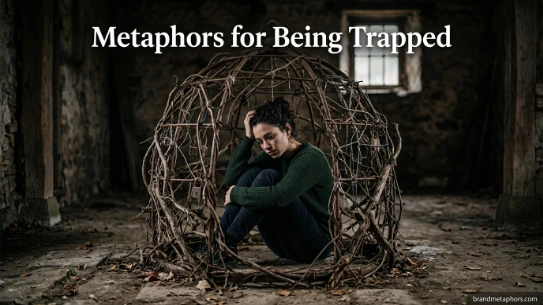
Introduction (Hook: The feeling before the words exist)
There are moments when everything looks normal from the outside, yet something inside feels tightly sealed—like air thinning in a closed room. You sit in a space that is physically open, but your thoughts keep circling the same corners, bumping into invisible walls. A job that no longer breathes life into you. A relationship that feels more like a loop than a connection. A routine that repeats so predictably it begins to feel like a script you didn’t write.
We often reach for metaphors when literal language fails us, especially when describing emotional confinement. “I feel stuck,” we say—but that barely scratches the surface. Being trapped is not always about bars or locks. Sometimes it is a quiet mental room with no door handle, or a road that keeps folding back into itself. Metaphors give shape to that formless pressure. They turn emotional noise into something we can see, examine, and sometimes even escape.
This article explores powerful metaphors for being trapped—how they work, what they mean, and how they can be used in writing, storytelling, and even personal reflection. These images are not just literary tools; they are mirrors. And in those mirrors, we often recognize our own hidden boundaries more clearly than we expect.
The Language of Emotional Confinement: Why “Trapped” Metaphors Matter
When people say they feel trapped, they rarely mean a literal cage. Instead, they are pointing to emotional, psychological, or situational restriction. Metaphors become essential because they translate inner experience into something tangible.
A metaphor like “being buried under concrete thoughts” instantly communicates pressure, weight, and immobility. It is more vivid than saying “I feel stressed.” Similarly, “walking through a corridor that never ends” expresses exhaustion and repetition in a way that plain language cannot.
These metaphors matter because they:
- Help us name complex emotions
- Allow writers to create immersive storytelling
- Give readers recognition and validation
- Open pathways for reflection and healing
When language becomes imagery, emotion becomes something we can navigate instead of something that simply overwhelms us.
The Glass Cage Metaphor: Visible Freedom, Invisible Walls
One of the most powerful metaphors for being trapped is the glass cage. It suggests visibility without access, openness without freedom.
Meaning and Interpretation
A glass cage represents a situation where everything looks fine from the outside. Others may assume you are free because they can see you clearly. Yet you feel enclosed, observed, and unable to break through invisible boundaries.
It often reflects:
- Social pressure
- Emotional isolation
- High-functioning anxiety
- Roles that restrict identity
Example Scenario
You might be in a job where everything appears successful—good salary, stable position, respected title. Yet every morning feels like stepping into a transparent box where your real desires echo unheard.
Example sentence: “Her life looked perfect from the outside, but she was living inside a glass cage, touching freedom only through reflection.”
Alternative Expressions
- Transparent prison
- Invisible enclosure
- Silent confinement
- Clear walls of expectation
Sensory & Emotional Detail
The glass cage is cold but clean. It reflects light beautifully, yet offers no warmth. You can see escape—but every direction ends in resistance you cannot touch.
Mini Story
A man sits at a café window, watching people move freely outside. No one notices that he feels just as separated from them as if he were behind bars. The glass between him and the world is not physical—it is expectation, routine, and fear of change.
The Endless Maze Metaphor: Repetition Without Resolution
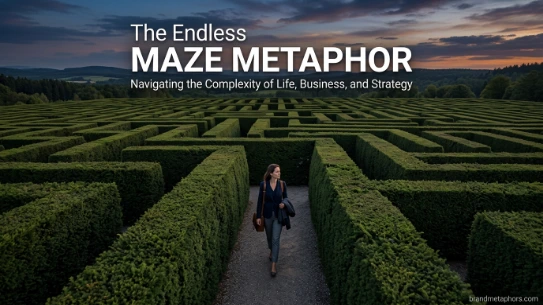
Another powerful image is the maze with no exit. Unlike a cage, a maze suggests movement—but movement without progress.
Meaning and Interpretation
This metaphor represents confusion, overthinking, and cycles that repeat endlessly. It captures the feeling of trying different paths only to return to the same emotional point.
It often reflects:
- Overthinking patterns
- Toxic cycles in relationships
- Repeated mistakes
- Unresolved emotional trauma
Example Scenario
You keep trying to fix a relationship, changing your words, adjusting your behavior, but every attempt leads you back to the same emotional argument.
Example sentence: “He felt like he was running through a maze that rearranged itself every time he turned a corner.”
Alternative Expressions
- Labyrinth of thoughts
- Circular prison
- Never-ending corridor
- Emotional loop
Sensory & Emotional Detail
The maze feels humid and echoing. Footsteps don’t disappear—they return distorted. Every decision sounds correct until it collapses into confusion again.
Mini Story
A student revises the same problem over and over. Each attempt feels promising, but the solution never appears. Slowly, the problem stops being academic—it becomes existential.
The Heavy Chains Metaphor: Weight That Limits Movement
The heavy chains metaphor is one of the oldest and most universally understood symbols of being trapped.
Meaning and Interpretation
Chains represent burden—something attached to you that restricts motion. Unlike invisible cages or mental mazes, chains are felt directly: heavy, dragging, unavoidable.
It often reflects:
- Trauma or past experiences
- Financial burden
- Family responsibility pressure
- Addiction or habit loops
Example Scenario
A person wants to change their life but feels anchored by responsibilities they cannot abandon.
Example sentence: “She dreamed of leaving, but invisible chains of obligation pulled her back every time she tried to move forward.”
Alternative Expressions
- Emotional shackles
- Weight of obligation
- Anchored existence
- Dragging burdens
Sensory & Emotional Detail
Chains are cold and metallic. They clink softly with every attempt to move, reminding you of resistance. Even rest feels heavy because the weight never leaves.
Mini Story
A woman receives an opportunity to study abroad. She feels joy—but also the sudden weight of caring for family members who depend on her. The chains are not made of iron alone, but of love, expectation, and guilt.
Psychological Traps: When the Mind Builds Its Own Walls
Not all traps are external. Many are constructed internally through fear, belief, or habit.
Meaning and Interpretation
Psychological traps are self-sustaining mental patterns that limit possibility. Unlike physical metaphors, these are invisible even to the person experiencing them.
Common forms include:
- Fear of failure
- Fear of success
- Low self-worth beliefs
- Catastrophic thinking
Example Scenario
Someone avoids opportunities because they assume failure is inevitable, even without evidence.
Example sentence: “He wasn’t locked in a room—he was locked inside the version of himself he believed he couldn’t escape.”
Alternative Expressions
- Mental enclosure
- Cognitive prison
- Thought loop confinement
- Inner barricade
Sensory & Emotional Detail
This trap feels quiet. No sound of chains or walls—only repetition of thoughts, like a whisper repeating the same warning again and again.
Literary Echoes: Trapped Spaces in Storytelling
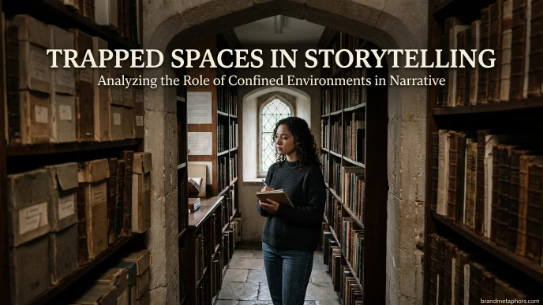
Throughout literature, the idea of being trapped appears in symbolic and narrative forms. Writers often use confinement to explore identity, power, and freedom.
Characters may find themselves:
- In bureaucratic systems they cannot escape
- In surreal environments that shift without logic
- In social roles that define their existence
These literary traps are not just plot devices—they reflect human psychology. The reader recognizes something familiar in them: the sense of being caught in structures larger than oneself.
Even in folklore and modern storytelling, the trapped character often becomes a mirror for society’s invisible rules. The cage is rarely just physical—it is symbolic of expectation, fear, or control.
Real-Life Traps: Work, Relationships, and Routine
Metaphors of being trapped often emerge from everyday life rather than dramatic situations.
Work Life
A repetitive job can feel like walking a treadmill—constant motion, no distance covered.
Relationships
Some relationships feel like emotional mazes where conversations loop without resolution.
Routine
Daily repetition can turn time into a closed circuit, where days feel identical even when they are not.
Example reflection: You wake up, follow the same steps, hear the same sounds, and slowly the sense of progression fades. Life feels less like a journey and more like a replay.
Creative Practice: Exercises for Using Trapped Metaphors
To better understand and use these metaphors, try these creative prompts:
- Describe your current mood as a physical space Is it a room, a tunnel, a cage, or a field with invisible walls?
- Rewrite “I feel stuck” in three metaphorical ways Example: “I am circling a room with no windows.”
- Turn a personal challenge into a maze story What represents the exit? What changes the path?
- Write a paragraph using only sensory metaphors for restriction Focus on weight, texture, sound, and space.
These exercises help translate emotional states into expressive language, making them easier to understand and communicate.
Using Trapped Metaphors in Writing and Social Media
Metaphors of confinement are powerful tools in creative expression.
In Writing
They deepen emotional impact and create vivid imagery that readers remember.
In Social Media
Short metaphorical lines often resonate strongly because they compress complex feelings into shareable language.
Bonus Tips
- Keep metaphors consistent within a piece for stronger imagery
- Combine contrast (freedom vs. confinement) for emotional tension
- Avoid overloading—one strong metaphor is more effective than many weak ones
Example post-style line: “Some days feel like living inside a thought that forgot how to end.”
Breaking the Trap: Metaphors of Escape and Transformation
Every trap metaphor carries an implied opposite: escape.
- Glass cages can crack
- Mazes can reveal patterns
- Chains can loosen
- Mental walls can be questioned
Transformation often begins when the metaphor itself changes—from confinement to movement, from repetition to direction.
Even imagining escape is a shift in perspective. It suggests that the structure is not absolute, even if it feels that way.
FAQs: Metaphors for Being Trapped
1. Why are metaphors important for describing feeling trapped?
They translate emotional experiences into visual language, making complex feelings easier to understand and express.
2. What is the most common metaphor for being trapped?
Common ones include cages, chains, mazes, and walls, each representing different types of restriction.
3. Can trapped metaphors help in writing?
Yes, they create vivid imagery and emotional depth, helping readers connect more strongly with the narrative.
4. Are these metaphors only used in literature?
No, they are widely used in everyday speech, therapy, social media, and personal reflection.
5. How can I create my own trapped metaphor?
Think of your feeling as a physical space or object, then describe its texture, shape, and movement.
Conclusion
Metaphors for being trapped are more than literary expressions—they are emotional maps. They help us understand the invisible architecture of limitation, whether it appears as routine, fear, responsibility, or thought itself. A glass cage, a never-ending maze, or a weight of chains are not just images; they are ways of seeing experience more clearly.
And perhaps the most important realization is this: once something can be described, it can also be questioned. Once it can be imagined differently, it can begin to shift. Metaphors do not just describe confinement—they quietly suggest the possibility of release.