
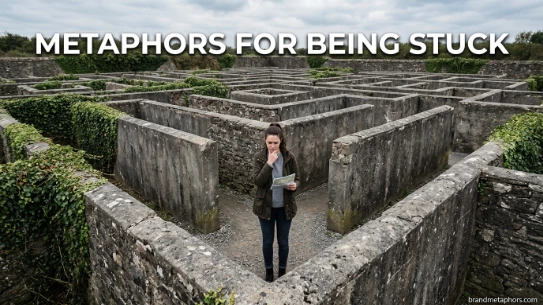
When Everything Feels Frozen: A Moment We All Recognize
There are days when life feels like it has quietly pressed the “pause” button without asking for permission. You sit at your desk, staring at a blinking cursor that refuses to turn into words. Or you stand in the middle of your room, unsure why even small decisions feel heavy—what to do next, where to begin, how to move at all. Outside, life continues its rhythm, but inside, something feels jammed, like a wheel that spins but doesn’t grip the road.
This is what it means to feel stuck—not just physically still, but emotionally paused, mentally tangled, or creatively blocked. It can happen in careers, relationships, studies, or even in personal growth. And yet, strangely enough, most people struggle to describe it directly. That’s where metaphors come in.
Metaphors give shape to invisible feelings. They turn confusion into something we can picture, hold, and sometimes even escape from. When we say “I’m stuck in mud,” or “my mind is a traffic jam,” we are not just being poetic—we are translating emotion into imagery that helps us understand ourselves.
This article explores powerful metaphors for being stuck, how they reflect our inner world, and how they can help us move forward again.
What Does “Being Stuck” Really Mean in Life and Mind?
Being stuck is not always about doing nothing. Often, it feels like trying very hard but going nowhere. It can show up as procrastination, indecision, burnout, or emotional numbness.
Psychologically, it is often a mix of fear, uncertainty, and overload. When the brain cannot decide between options or feels overwhelmed by pressure, it can temporarily “freeze.” This is why even simple tasks start to feel complicated.
In everyday life, being stuck might look like:
- Knowing you need to start something but delaying it endlessly
- Feeling trapped in a routine that no longer inspires you
- Replaying the same thoughts without resolution
- Wanting change but not knowing the first step
Metaphors help because they take this abstract experience and give it structure. Instead of saying “I feel confused and blocked,” you might say “I feel like I’m walking through deep water.” Suddenly, the feeling becomes easier to understand—and sometimes easier to change.
Metaphor 1: Stuck in Mud or Quicksand – When Every Step Sinks You Back
One of the most common metaphors for being stuck is the image of mud or quicksand. You try to move forward, but the ground pulls you down with every effort.
Meaning and Explanation
This metaphor represents situations where effort feels counterproductive. The more you struggle, the more drained you become. It often reflects emotional exhaustion, overthinking, or external obstacles that slow progress.
Example Sentence or Scenario
“I tried to fix everything at once, but it felt like I was stuck in mud—every decision only pulled me deeper into confusion.”
Sensory and Emotional Detail
Imagine cold, thick earth clinging to your shoes. Each step requires effort, and progress is painfully slow. There’s frustration, but also helplessness, as if motion itself is the problem.
Alternative Expressions
- “Walking through heavy ground”
- “Moving in slow motion through resistance”
- “Caught in emotional sludge”
Mini Story
A university student preparing for exams studies late into the night but cannot focus. The more notes they make, the more overwhelmed they feel. They describe it later as “running in place inside deep mud—exhausting but not moving.”
Reflection
This metaphor reminds us that sometimes forcing effort without direction increases struggle. The solution is not always to push harder—but to pause, simplify, or change strategy.
Metaphor 2: Mental Traffic Jam – When Thoughts Block Each Other

Another powerful image is the traffic jam: cars honking, engines idling, no clear movement forward.
Meaning and Explanation
This metaphor describes mental overload—too many thoughts, decisions, or worries competing for attention. Nothing moves because everything is trying to move at once.
Example Sentence or Scenario
“My mind felt like a traffic jam—ideas, worries, and memories all stuck in one noisy intersection.”
Sensory and Emotional Detail
Picture a crowded city road at rush hour. Horns echo, brake lights glow red, and frustration builds as no one can pass through. Inside the mind, this feels like racing thoughts that cancel each other out.
Alternative Expressions
- “Mental gridlock”
- “Thought congestion”
- “Cognitive overload”
Mini Cultural Reference
In many busy cities, traffic jams are a daily reality. Writers often use them to symbolize modern life—fast-paced, crowded, and mentally exhausting. Just like in city traffic, progress requires timing, patience, and sometimes taking a different route.
Reflection
This metaphor shows that stuckness is not always lack of ability—it can be excess input. Clearing mental space often comes before real movement.
Metaphor 3: Locked Room with the Key Inside – When Freedom Feels Close but Unreachable
Sometimes being stuck feels like standing inside a locked room, only to realize the key is already in your hand.
Meaning and Explanation
This metaphor represents internal barriers—fear, self-doubt, or hesitation—that prevent action even when solutions exist.
Example Sentence or Scenario
“I knew what I needed to do, but I stayed frozen, like I was in a locked room holding the key and still unable to turn it.”
Sensory and Emotional Detail
There is silence in the room, except for the faint sound of doubt. The key is cold in your palm. Freedom is possible—but something invisible holds you back.
Alternative Expressions
- “Self-imposed cage”
- “Invisible walls”
- “Trapped in hesitation”
Mini Story
An artist wants to share their work online but fears judgment. Every time they prepare to post, they hesitate and close the app. Later, they realize nothing was stopping them except fear of visibility.
Reflection
This metaphor is powerful because it shows that not all barriers are external. Sometimes, the way out already exists—we just have to use it.
Why Metaphors Help Us Understand Feeling Stuck
Metaphors are not just literary tools; they are cognitive bridges. They help the brain translate emotional confusion into visual meaning.
When you say:
- “I’m stuck in mud,” you understand effort and resistance.
- “My mind is a traffic jam,” you recognize overload.
- “I’m in a locked room,” you see fear and hesitation.
This transformation matters because naming a feeling often reduces its power. Once something becomes visible in language, it becomes easier to work with.
Metaphors also allow emotional distance. Instead of being overwhelmed inside the feeling, you observe it from the outside.
Creative Exercises: Turn Your Stuckness into Language
Try these simple practices to transform your emotional blocks into metaphors:
Exercise 1: Name Your Stuckness
Complete the sentence:
- “Right now, I feel like I am ___”
Examples:
- a car with no fuel
- a book with missing pages
- a phone with too many tabs open
Exercise 2: Sensory Mapping
Describe your stuck feeling using senses:
- What does it look like?
- What sound does it have?
- What texture or temperature would it be?
Exercise 3: Rewrite Your Block
Take a current problem and turn it into a metaphor, then rewrite the ending:
- “I am stuck in fog…” → “but fog always clears when I keep walking.”
These exercises are especially useful for writers, students, and anyone trying to understand emotional blocks.
Real-Life Moments and Cultural Echoes of Being Stuck
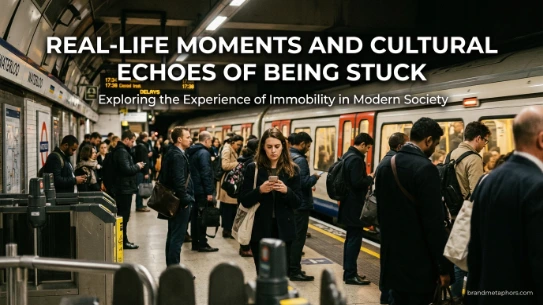
Stories across cultures often reflect the feeling of being stuck.
In ancient myths, heroes frequently enter forests or labyrinths where they lose direction before finding wisdom. These stories symbolize psychological stuckness—confusion before clarity.
In everyday life, a worker trapped in a repetitive job may feel like they are “walking on a treadmill”—constant motion without progress. A writer facing a blank page may describe it as “staring into an empty sky waiting for rain.”
Even in films and novels, characters are often shown in literal or emotional traps before transformation. These moments remind us that stuckness is often part of a larger journey, not the end of it.
Practical Ways to Move Beyond Feeling Stuck
While metaphors help us understand, small actions help us move.
1. Reduce the size of the task
Instead of solving everything, focus on one tiny step.
2. Change the environment
A new space can break mental patterns.
3. Write before thinking
Freewriting helps bypass internal pressure.
4. Talk it out
Speaking often turns emotional fog into clarity.
5. Accept temporary stillness
Sometimes stuckness is the mind’s way of asking for rest, not punishment.
Think of it like loosening mud from shoes—you don’t always run faster; sometimes you simply clean and reset.
FAQs: Metaphors for Being Stuck
1. Why do people use metaphors for feeling stuck?
Because emotions like confusion or overwhelm are abstract, metaphors make them easier to understand and express.
2. What is the most common metaphor for being stuck?
Common ones include being stuck in mud, traffic jams, or locked rooms.
3. Can metaphors help reduce stress?
Yes. They help externalize emotions, making them less overwhelming and more manageable.
4. Are metaphors useful in writing?
Absolutely. They make writing more vivid, relatable, and emotionally engaging.
5. How do I create my own metaphor for being stuck?
Think of your feeling, then compare it to a physical experience—something slow, blocked, or repetitive.
Conclusion
Being stuck is not a failure of movement—it is a moment of pause in a larger journey. Sometimes life slows us down so we can see more clearly, rethink direction, or gather strength for the next step.
Metaphors give us a language for these pauses. Whether it is mud, traffic, or locked rooms, each image helps us recognize what we are feeling without being trapped inside it.
And once we can describe the stuckness, we are already halfway toward moving beyond it.