
Introduction: Why Language Precision (and Figurative Thinking) Improves Writing
Strong writing is not only about grammar—it is about clarity, precision, and expressive control. When students and writers understand subtle differences between similar-looking words, their communication becomes sharper and more professional.
At the same time, figurative language plays a powerful role in shaping meaning. Literary devices such as metaphor, simile, idiom, and descriptive language help writers express complex ideas in creative ways. For example, saying “a foolproof plan” is not just literal—it suggests something so strong and reliable that failure seems impossible.
However, confusion often arises when words sound correct but are actually incorrect. One of the most common spelling mistakes in English is the confusion between “foolproof” and “fullproof.” This article explains everything in detail so learners can avoid this error and improve their vocabulary, writing skills, and creative expression.
Meaning of Foolproof (Correct Usage)
The correct word is foolproof.
Definition:
Foolproof means something that is so well designed, simple, or effective that it cannot fail or be used incorrectly, even by someone inexperienced.
Key idea:
It describes something safe, reliable, and mistake-resistant.
Examples of meaning in context:
- A foolproof method ensures success even for beginners.
- A foolproof system prevents errors completely.
- A foolproof recipe is easy enough for anyone to follow.
In semantic SEO terms, related phrases include:
- error-free system
- fail-safe method
- reliable process
- mistake-proof design
- simple instructions
Is “Fullproof” a Real Word?
The term fullproof is incorrect in standard English.
Why it appears:
Many learners mistakenly assume:
- “full” (meaning complete)
- “proof” (meaning resistant)
So they combine them into “fullproof,” thinking it means “completely safe.”
Reality:
- “Fullproof” is NOT recognized in dictionaries.
- It is a spelling error or misspelling of “foolproof.”
Important note:
Even though it looks logical, English vocabulary does not support this formation.
Etymology and Word Origin of Foolproof
Understanding word origins improves vocabulary retention and writing confidence.
Breakdown:
- Fool = a person who makes mistakes or lacks experience
- Proof = resistant to or protected against something
Historical meaning:
Originally, “foolproof” described mechanisms or instructions so simple that even a “fool” could not mess them up.
Evolution in usage:
Today, it is used broadly in:
- technology
- education
- cooking
- business systems
- safety instructions
This evolution shows how language adapts to modern communication needs.
Why Learners Confuse Foolproof and Fullproof
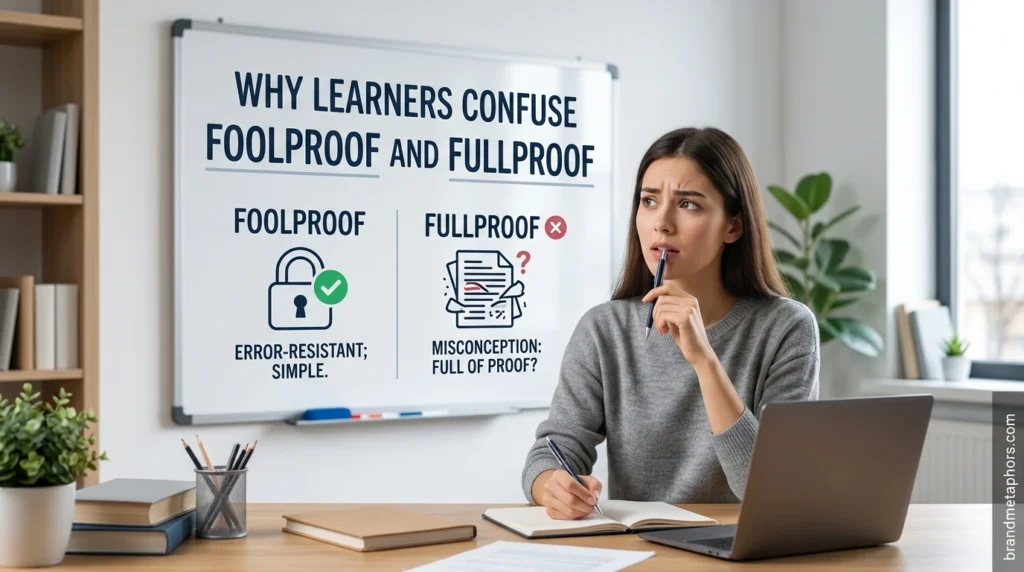
This is a common linguistic issue influenced by phonetics and cognitive processing.
1. Sound similarity
“Fool” and “full” sound very similar in fast speech.
2. Overgeneralization
Learners try to apply logic:
- full + proof = completely protected (incorrect reasoning)
3. Lack of exposure
Many students rarely see the word written correctly in context.
4. Typing habits
Autocorrect sometimes fails to correct uncommon spelling errors.
NLP insight:
This is an example of orthographic confusion, where spelling is influenced by pronunciation.
Foolproof vs Fullproof: Quick Comparison Table
FeatureFoolproofFullproofCorrectness✅ Correct❌ IncorrectDictionary statusListedNot listedMeaningCannot fail or go wrongNo meaningUsage in writingAcademic, professional, everydayAvoid completelyExampleA foolproof planIncorrect spelling
This table is useful for quick revision and exam preparation.
Sentence Examples Using Foolproof (Context-Based Learning)
Understanding usage through sentence examples improves writing fluency.
1. Academic writing
- The scientist developed a foolproof method to reduce experimental errors.
2. Daily life
- This mobile app has a foolproof setup process for beginners.
3. Business context
- The company implemented a foolproof security system to protect data.
4. Instructional tone
- Follow this foolproof guide to assemble the furniture correctly.
5. Creative writing
- She believed she had a foolproof plan, but life had other ideas.
6. Informal tone
- Don’t worry, this trick is foolproof—you can’t mess it up.
These examples show how tone changes meaning and emotional impact.
Tone and Writing Style Usage in English Communication
Different tones require different vocabulary choices.
1. Formal tone
Used in academic and professional writing:
- foolproof system
- foolproof solution
2. Informal tone
Used in conversation:
- foolproof trick
- foolproof hack
3. Instructional tone
Used in guides and manuals:
- foolproof steps
- foolproof method
Writing skill insight:
Choosing the right tone improves readability, clarity, and audience engagement.
Common Mistakes and Misconceptions
Many learners repeatedly make predictable errors with this word.
1: Writing “fullproof”
- Incorrect due to assumption-based spelling
2: Overusing in formal academic writing
- Can sound too simplistic if overused
3: Misunderstanding meaning
- Some think it means “fully protected from everything,” which is exaggerated
4: Confusing with “bulletproof”
- “Bulletproof” is physical protection
- “Foolproof” is logical or procedural safety
Language learning tip:
Always verify uncertain words using trusted dictionaries.
Figurative Language and Creative Writing Connections
Even though “foolproof” is literal in meaning, it often appears in figurative expressions.
1. Idiomatic usage
- “There is no foolproof plan in life.” This suggests unpredictability of life.
2. Metaphorical extension
- “Her foolproof confidence shattered under pressure.” Here, the word enhances emotional imagery.
3. Simile-style expression (creative adaptation)
- “His strategy was as foolproof as a locked vault.”
4. Descriptive language in storytelling
Writers use it to:
- build irony
- create tension
- show contrast between expectation and reality
Literary device insight:
It can contribute to dramatic irony, where something believed to be perfect fails unexpectedly.
Vocabulary Enhancement and Writing Skills Development

Learning correct usage strengthens overall communication ability.
Benefits:
- improves academic writing accuracy
- enhances professional communication
- reduces spelling errors
- builds lexical confidence
Related vocabulary (LSI keywords):
- fail-safe
- reliable system
- secure method
- error-resistant process
- simplified instruction
Creative writing improvement:
Writers can use “foolproof” to:
- establish trust in narration
- highlight irony
- emphasize reliability before a twist
Exercises for Practice (Active Learning Section)
Exercise 1: Choose the correct word
Fill in the blank:
- This software has a ______ system for backups.
- The recipe is ______ and easy to follow.
- Many people mistakenly write ______ instead of foolproof.
Exercise 2: Sentence correction
Correct the mistakes:
- This is a fullproof method.
- The plan is fullproof and secure.
- I created a fullproof strategy for exams.
Exercise 3: Creative writing task
Write 5 sentences using “foolproof” in:
- academic context
- daily life
- storytelling
- instruction manual
- humorous tone
Exercise 4: Figurative usage challenge
Rewrite these literally:
- “a foolproof dream”
- “foolproof confidence”
- “foolproof destiny”
Exercise 5: Vocabulary expansion
Replace “foolproof” with synonyms:
- fail-safe
- reliable
- error-proof
- secure
Frequently Asked Questions (FAQs)
1. What is the correct spelling: foolproof or fullproof?
The correct spelling is foolproof. “Fullproof” is incorrect.
2. What does foolproof mean in simple English?
It means something that cannot fail or go wrong.
3. Why do people write fullproof?
Because “full” and “fool” sound similar, causing spelling confusion.
4. Is foolproof used in formal writing?
Yes, it is commonly used in academic, technical, and professional writing.
5. What are synonyms of foolproof?
Synonyms include fail-safe, reliable, error-proof, and secure.
Conclusion
Understanding the difference between similar-looking words like “foolproof” and “fullproof” is essential for improving writing accuracy and confidence. While the incorrect form may appear logical, only “foolproof” is accepted in standard English.
Beyond spelling, this word also demonstrates how language blends literal meaning with expressive usage in figurative language, creative writing, and descriptive communication. Whether you are writing essays, stories, or professional documents, using precise vocabulary strengthens your message and builds credibility.
By practicing examples, exploring literary devices, and expanding your vocabulary, you can significantly improve your writing skills and avoid common linguistic mistakes in English.