
Introduction: Why Language Precision and Expression Matter in Writing
Strong writing is not only about correct grammar—it is also about clarity, tone, and expression. Whether you are writing essays, creative stories, professional emails, or academic assignments, your choice of words shapes how your message is received. This is where figurative language, descriptive language, and precise vocabulary play an important role.
Figurative language—such as metaphors, similes, idioms, and poetic expressions—adds depth and emotion to writing. It helps writers communicate ideas in more engaging and memorable ways. For example, instead of saying “very easy,” a writer might say “as easy as pie,” which creates a stronger mental image. These techniques improve writing skills, vocabulary enhancement, and overall communication effectiveness.
However, even the most creative writing must begin with correct word usage. Small spelling mistakes can weaken meaning and reduce credibility. One such commonly confused spelling issue is the difference between “of course” and its incorrect form. Understanding this distinction is essential for students, writers, and English learners who want to improve both accuracy and fluency in English communication.
What Does “Of Course” Mean in English?
The phrase “of course” is a common English expression used to show certainty, agreement, or obvious truth. It is often used in both spoken and written communication.
Meaning:
- Certainly
- Definitely
- Naturally
- Without doubt
- Obviously
Example Sentences:
- Of course, I will help you with your homework.
- You are of course invited to the meeting.
- Of course, she passed the exam; she studied very hard.
This phrase is widely used in formal and informal contexts, making it an essential part of everyday English vocabulary.
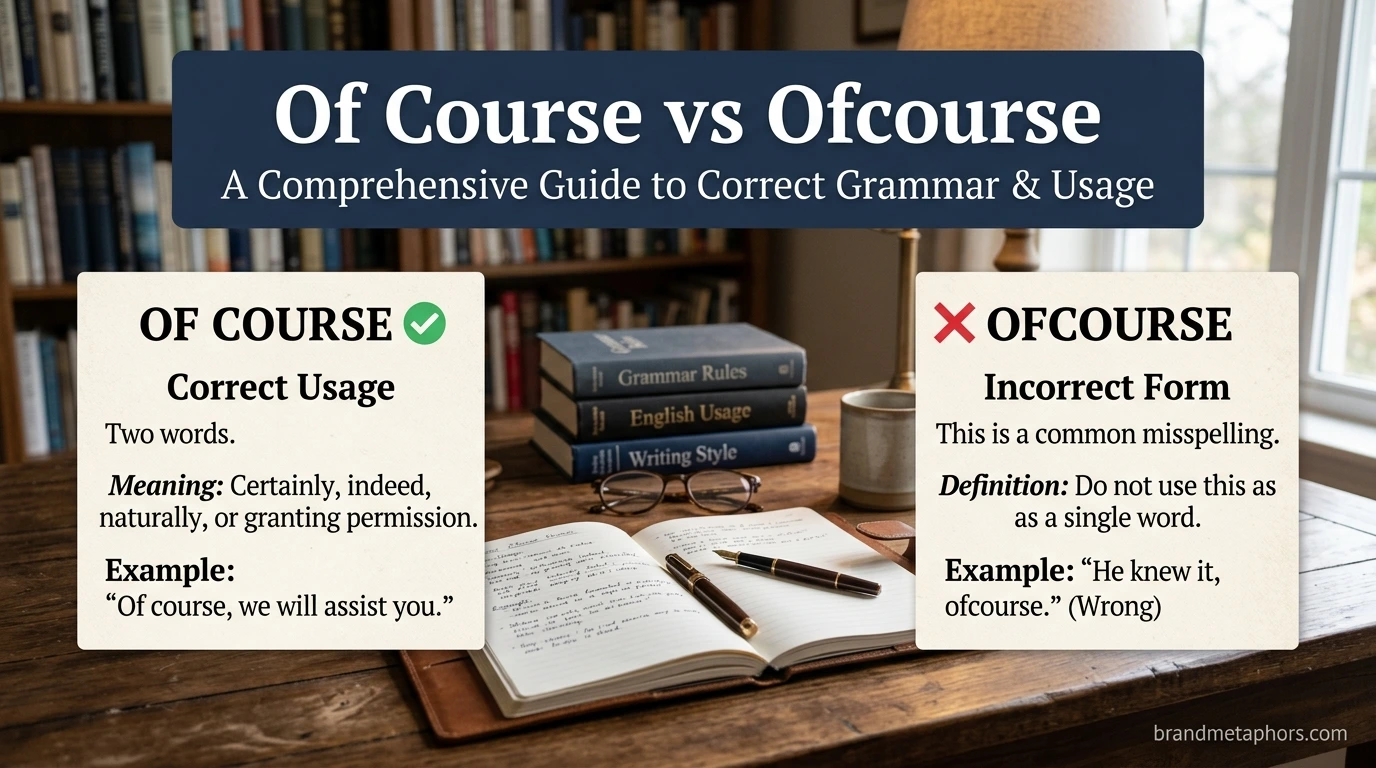
Is “Ofcourse” Correct or Incorrect?
One of the most frequent spelling mistakes among English learners is writing “ofcourse” as a single word. In standard English, this form is incorrect.
The correct form is always:
of course (two separate words)
The mistake happens because learners often pronounce it quickly in speech, making it sound like a single unit. However, in written English, grammar rules clearly separate the two words.
Key Point:
- ❌ Ofcourse (incorrect)
- ✅ Of course (correct)
Understanding this difference improves writing accuracy and helps avoid common spelling errors in academic and professional contexts.
Why Do Learners Confuse “Ofcourse” and “Of course”?
Language confusion often comes from pronunciation, typing habits, and digital communication styles.
Common Reasons:
- Fast typing in chats and social media
- Mishearing spoken English
- Lack of formal grammar practice
- Influence of informal writing styles
In creative writing and digital communication, such errors may seem minor, but in academic writing they can affect credibility and clarity.
Usage in Different Contexts and Tone
The phrase “of course” can change tone depending on context. It may express politeness, confidence, sarcasm, or emphasis.
1. Polite Agreement
- Of course, I would be happy to assist you.
2. Strong Confirmation
- Of course, this solution will work.
3. Emotional Reassurance
- Of course, everything will be fine.
4. Informal Conversation
- Can you come today? — Of course!
5. Sarcastic Tone (figurative usage)
- Oh, of course, that always happens when I’m late.
This shows how tone and figurative language can influence meaning even in simple expressions.
Sentence Examples for Better Understanding
Here are categorized examples to help learners understand usage clearly.
Formal Writing Examples:
- Of course, the data supports the research hypothesis.
- The committee will, of course, review the proposal carefully.
Informal Writing Examples:
- Of course I remember you!
- Of course we can go to the park.
Creative Writing Examples:
- Of course, the night whispered secrets through the trees.
- Of course, her heart knew what her mind refused to accept.
These examples show how even a simple phrase can be used in descriptive language and poetic expression.
Common Mistakes Learners Make
English learners often make small but important errors when using this phrase.
Mistakes Include:
- Writing “ofcourse” as one word
- Overusing it in formal writing
- Using it sarcastically in inappropriate contexts
- Incorrect punctuation placement
- Mixing tone in academic writing
Correct Usage Tip:
Always separate the words and adjust tone based on context.
Comparison Table: “Of Course” vs Common Confusions
ExpressionCorrectnessMeaningUsage Contextof courseCorrectCertainly / definitelyFormal & informalofcourseIncorrectNot valid in EnglishAvoid completelycertainlyCorrectStrong agreementFormal writingnaturallyCorrectObviously / expectedNeutral toneobviouslyCorrectClearly / evidentlyInformal to formal
This table helps learners quickly distinguish proper usage and improve vocabulary enhancement.
When to Use “Of course” in Writing and Speech
Knowing when to use this phrase improves both communication and writing skills.
Best Situations:
- Agreeing with someone
- Confirming instructions
- Responding politely
- Emphasizing obvious facts
- Supporting statements in essays
Example in Academic Writing:
- Of course, further research is needed to confirm these findings.
Example in Daily Conversation:
- Will you join us? — Of course!
When to Avoid Using “Of course”

Even though it is common, overuse or incorrect use can weaken writing.
Avoid When:
- Writing highly formal academic essays (use alternatives like “certainly” or “indeed”)
- Repeating it too frequently in one paragraph
- Using it in overly emotional or sensitive contexts
- Writing professional reports that require neutral tone
Better Alternatives:
- Certainly
- Indeed
- Absolutely
- Without doubt
Writing Skills and Vocabulary Enhancement
Improving vocabulary is not just about learning new words—it is about understanding how words function in context. Expressions like “of course” show how simple phrases can carry tone, confidence, and meaning.
How It Helps Writing:
- Improves sentence fluency
- Enhances descriptive language
- Supports creative writing style
- Builds natural conversational tone
- Strengthens clarity in communication
Writers often combine such phrases with figurative language techniques like metaphors and similes to make writing more expressive. For example:
- Of course, his words were a lighthouse in the storm of confusion.
This blend of literal and figurative expression creates stronger emotional impact.
Exercises for Learners
Try these activities to improve understanding.
Exercise 1: Correct the Sentence
- Ofcourse I will attend the class.
- Of course she is right.
- He said ofcourse he would come.
Exercise 2: Fill in the Blanks
- ______, I will help you with your project.
- She was, ______, the best student in the class.
- ______ we can try again tomorrow.
Exercise 3: Rewrite with Better Tone
Rewrite using formal alternatives:
- Of course, we agree with your proposal.
- Of course, the results are accurate.
Exercise 4: Creative Writing Task
Write 3 sentences using “of course” in a poetic or imaginative style.
Frequently Asked Questions (FAQs)
1. Is “ofcourse” a correct English word?
No, “ofcourse” is incorrect. The correct form is “of course.”
2. Why do people write “ofcourse”?
It happens due to fast typing, informal writing, and pronunciation habits.
3. Can I use “of course” in formal writing?
Yes, but in very formal contexts, alternatives like “certainly” may be better.
4. What is the meaning of “of course”?
It means certainly, definitely, or obviously.
5. Is “of course” an idiom?
Yes, it functions like an idiomatic expression showing agreement or certainty.
Conclusion
Understanding the difference between “of course” and its incorrect spelling is a small but important step toward mastering English writing. While creative writing allows flexibility with figurative language, poetic expression, and descriptive style, correct grammar remains the foundation of clear communication.
By improving vocabulary, practicing sentence examples, and avoiding common mistakes, learners can enhance both academic and creative writing skills. Whether you are writing essays, stories, or professional emails, precision in language builds credibility and confidence.
In the end, mastering such simple expressions strengthens overall communication—and that is, of course, essential for every English learner.