
Have you ever received an email ending with the phrase “for your records” and wondered whether it is grammatically correct? Or perhaps you have used it yourself when sending an invoice, receipt, contract, or important document.
This expression is one of the most common phrases in business communication, legal correspondence, customer service, healthcare, education, and personal recordkeeping. Although it appears simple, many English learners and professionals still ask whether it is correct, when it should be used, and whether there are more natural alternatives.
The good news is that the expression is completely acceptable in standard English when used appropriately. However, understanding its meaning, tone, and context helps you communicate more professionally and avoid sounding repetitive.
In this guide, you’ll learn everything you need to know about this common expression, including its grammatical correctness, meaning, examples, professional uses, alternatives, common mistakes, and best practices.
What Does This Expression Mean?
The phrase simply means that the information or document is being shared so the recipient can keep it for future reference.
It does not require any action from the recipient. Instead, it tells them that the attached document or information may be useful later.
Examples include:
- A receipt after a purchase
- A signed agreement
- A medical report
- An invoice
- A warranty certificate
- A payment confirmation
- Meeting notes
- Tax documents
In each case, the sender is providing information that should be saved rather than immediately acted upon.
Is It Grammatically Correct?
Yes.
The phrase is completely grammatically correct in English.
It functions as a prepositional phrase.
Structure:
WordFunctionForPrepositionYourPossessive determinerRecordsPlural noun
Together they mean:
“To keep in your personal or professional files.”
Because “records” usually refers to multiple documents or pieces of information, the plural form sounds natural.
Examples:
Attached is your receipt for your records.
Please retain this copy for your records.
I’m sending this confirmation for your records.
This document is provided for your records only.
All of these are perfectly acceptable.
Why People Use This Phrase
People use it because it politely explains why they’re sending information.
Instead of requiring action, it tells the recipient:
- Save this.
- Keep it for future use.
- File it safely.
- Refer back to it if needed.
This removes confusion.
Without the phrase:
Attached is the agreement.
The reader might wonder whether they need to review, sign, or respond.
With the phrase:
Attached is the signed agreement for your records.
Now the purpose is immediately clear.
Common Situations Where It Is Used
This expression appears in many professional settings.
Business Emails
Examples:
- invoices
- receipts
- quotations
- contracts
- payment confirmations
Example:
Attached is your paid invoice for your records.
Banking
Banks often send:
- statements
- transaction confirmations
- loan documents
- payment receipts
Example:
Please keep this confirmation for your records.
Healthcare
Hospitals and clinics frequently send:
- prescriptions
- laboratory reports
- insurance forms
- vaccination records
Example:
A copy of your medical report is enclosed for your records.
Education
Schools send:
- transcripts
- enrollment confirmations
- fee receipts
- certificates
Example:
Please retain this receipt for your records.
Human Resources
HR departments commonly send:
- employment contracts
- salary slips
- tax forms
- policy acknowledgments
Example:
This document is being shared for your records.
Different Types of Records People Keep
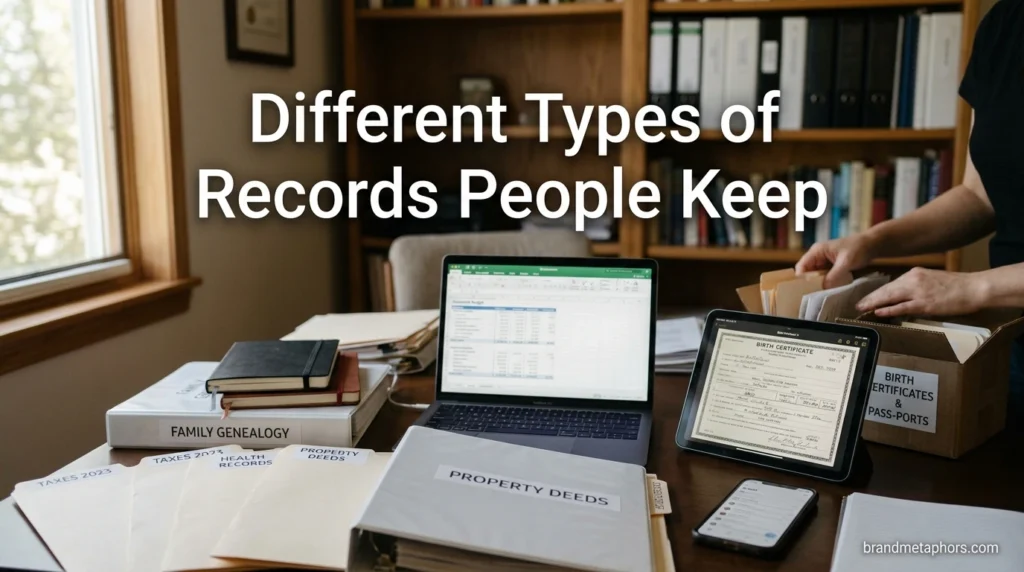
Although the phrase remains the same, the type of information varies.
Some common categories include:
Financial Records
- Bank statements
- Bills
- Tax returns
- Receipts
- Investment reports
Legal Records
- Contracts
- Court documents
- Wills
- Licenses
- Agreements
Medical Records
- Prescriptions
- Health reports
- Vaccination certificates
- Insurance claims
Educational Records
- Diplomas
- Certificates
- Academic transcripts
- Enrollment letters
Personal Records
- Birth certificates
- Marriage certificates
- Utility bills
- Property documents
Professional Email Examples
Here are natural examples that sound polished.
Example 1
Attached is the signed agreement for your records.
Example 2
Thank you for your payment. Please find the receipt attached for your records.
Example 3
We have processed your request successfully. A confirmation copy is attached for future reference.
Example 4
This email serves as confirmation of today’s meeting for your records.
Example 5
Please keep this document in case you need it later.
Better Alternatives Depending on the Situation
Repeating the same phrase in every email can become monotonous.
Here are several excellent alternatives.
AlternativeBest Used WhenFor future referenceGeneral communicationFor your filesOffice settingsPlease retain this copyFormal correspondenceKeep this for referenceFriendly communicationFor documentation purposesLegal or technical writingFor your informationWhen no action is requiredFor referenceInternal communicationPlease save this copyCustomer support
Examples:
- Please retain this receipt.
- Keep this confirmation for future reference.
- Attached is a copy for your files.
- Please save this document.
Each alternative changes the tone slightly while keeping the meaning.
Common Mistakes to Avoid
Although the phrase is simple, writers sometimes misuse it.
Using It When Action Is Required
Incorrect:
Please sign this contract for your records.
If a signature is required, the purpose is not merely recordkeeping.
Better:
Please review and sign the attached contract.
Adding Unnecessary Words
Less natural:
For your own personal records.
The possessive already makes the meaning clear.
Simply write:
For your records.
Overusing the Phrase
Using it in every email can make your writing repetitive.
Instead, alternate with:
- Please keep this copy.
- Save this for future reference.
- Attached for reference.
Using It Without an Attachment
If no supporting document exists, the phrase may confuse readers.
For example:
Thank you for your purchase for your records.
Instead:
Thank you for your purchase.
Benefits of Using This Expression

There are several reasons professionals continue to use it.
Improves clarity
Readers instantly understand why the document is being shared.
Reduces confusion
Recipients know they do not need to respond.
Sounds professional
The phrase is standard across many industries.
Encourages organization
People are reminded to keep important documents.
Creates better communication
Everyone understands the intended purpose of the attachment.
Tips for Using It Naturally
Follow these simple guidelines.
- Use it when sharing documents worth saving.
- Place it near the end of the sentence.
- Avoid repeating it multiple times in one email.
- Choose alternatives for variety.
- Match the tone to your audience.
- Keep surrounding sentences concise.
Good example:
Attached is the updated invoice for your records.
Less effective:
Attached is the invoice for your records because it is for your records and should remain in your records.
Real-Life Examples
Customer Service
Thank you for your purchase. Your receipt is attached for your records.
Insurance
Please keep this policy confirmation for future reference.
Real Estate
Attached is the signed purchase agreement for your files.
Freelancing
I’ve attached the final invoice for your records.
University
Please retain this enrollment confirmation for future reference.
Healthcare
Here is a copy of today’s examination report for your records.
When You Should Not Use This Phrase
There are situations where another expression works better.
Avoid it when:
- requesting immediate action
- asking someone to review a document
- requiring approval
- requesting signatures
- assigning tasks
- requesting feedback
Instead use:
- Please review.
- Please respond.
- Action required.
- Kindly approve.
- Please sign.
- Let me know your thoughts.
The phrase is intended only for informational purposes.
Frequently Asked Questions
1. Is the phrase grammatically correct?
Yes. It is a standard and widely accepted expression in both American and British English.
2. Is it formal or informal?
It is considered neutral to formal, making it appropriate for business, legal, educational, and professional communication.
3. Can it be used in emails?
Absolutely. It is one of the most common closing phrases when sending receipts, invoices, contracts, and confirmations.
4. What does it actually tell the reader?
It tells the recipient to keep the document because it may be useful in the future. It does not request any immediate action.
5. Can I replace it with “for future reference”?
Yes. That is one of the best alternatives and often sounds slightly more conversational while conveying the same idea.
6. Is “for your record” correct?
Generally, no. The plural records is the standard form because it refers to documents, files, or stored information collectively.
7. Should I use it in every professional email?
No. Use it only when sharing information intended for safekeeping. If you need someone to review, approve, or respond, choose wording that clearly requests that action.
8. Where is this phrase most commonly used?
It frequently appears in business correspondence, banking, healthcare, education, government communication, customer service, legal documents, and human resources.
Conclusion
The expression is a grammatically correct, professional, and widely accepted way to tell someone that a document is being provided for safekeeping or future reference. Whether you’re sending a receipt, contract, invoice, report, certificate, or confirmation email, it clearly communicates that the information should be retained rather than acted upon immediately.
To write more naturally, vary your wording with alternatives such as “for future reference,” “for your files,” or “please retain this copy” when appropriate. Most importantly, reserve the phrase for situations where the recipient simply needs to keep the document, not review or respond to it.
Mastering small expressions like this can make your emails sound clearer, more polished, and more professional—an important skill for students, employees, business owners, and anyone who communicates regularly in English.