
Introduction
Strong writing is more than using correct grammar. It is about choosing the right words to express ideas clearly and creatively. Figurative language, descriptive language, literary devices, and rich vocabulary help writers create vivid images, communicate emotions, and engage readers. Whether you are writing an essay, poem, story, business email, or academic paper, selecting the correct word makes a significant difference.
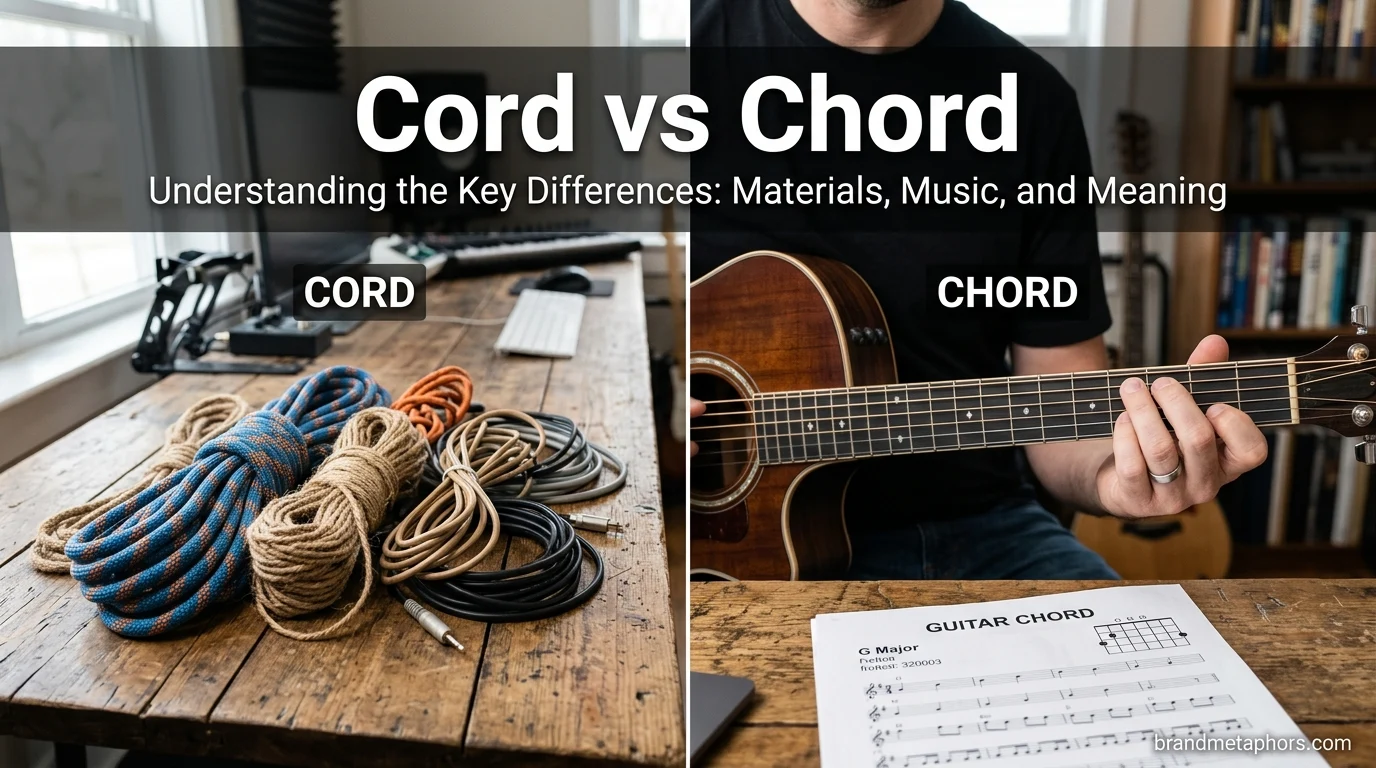
Many English learners become confused by words that sound alike but have different meanings. These words are known as homophones. One of the most common examples is cord vs chord. Although they share nearly identical pronunciation, they belong to entirely different contexts and meanings.
Understanding their differences helps improve writing skills, vocabulary enhancement, and communication accuracy. This guide explains each word in detail with definitions, comparison examples, sentence examples, common mistakes, creative writing tips, figurative language applications, and practical exercises so you can confidently use the correct word every time.
What Is the Difference Between the Two Words?
The easiest way to remember these terms is by understanding what each represents.
FeatureCordChordPrimary MeaningA rope, cable, string, or anatomical structureA group of musical notes played togetherPart of SpeechNounNounCommon ContextPhysical objects, anatomy, electronicsMusic, harmony, emotions, figurative writingPronunciation/kɔːrd//kɔːrd/Are They Homophones?YesYes
Although they sound identical, they are never interchangeable.
Think of it this way:
- One belongs to the physical world.
- The other belongs primarily to music and figurative expression.
Understanding “Cord”
A cord refers to a long, thin object that resembles rope, string, cable, or flexible material. It can also describe certain body tissues or structures.
Common meanings include:
- Electrical cable
- Rope
- String
- Shoelace
- Extension cable
- Fabric tie
- Anatomical structure
Examples
- Please unplug the power cord.
- She tied the package with a red cord.
- The curtain cord became tangled.
- The extension cord was too short.
- The climbing cord held everyone’s weight safely.
Anatomical Examples
Medical professionals also use this word in anatomy.
Examples include:
- spinal cord
- vocal cords
- umbilical cord
Sentence examples:
- The spinal cord carries signals between the brain and body.
- Singing requires healthy vocal cords.
- The doctor examined the umbilical cord after birth.
Understanding “Chord”
A chord is a musical term referring to multiple notes played simultaneously to create harmony.
It is one of the foundations of music theory.
Examples include:
- major chord
- minor chord
- guitar chord
- piano chord
- suspended chord
- seventh chord
Sentence Examples
- She learned a new guitar chord.
- The pianist played a beautiful chord.
- That final chord ended the concert perfectly.
- Beginners often practice simple chords first.
- Every song uses different chord progressions.
Outside music, the word also appears in figurative language.
For example:
- His speech struck a chord with the audience.
- The movie struck a chord among young viewers.
Here, it means creating an emotional connection.
Quick Memory Tricks
Remembering which word to use becomes easier with simple associations.
WordMemory TrickCordThink of cable, rope, string, wireChordThink of choir, guitar, piano, harmony
Another useful trick:
- Cord = Connected physically
- Chord = Connected musically
Usage in Everyday English
Both words appear regularly but in different situations.
Everyday Uses of Cord
- charging cord
- extension cord
- phone cord
- drawstring cord
- curtain cord
- climbing cord
Example sentences:
- My charging cord stopped working.
- The extension cord reached the backyard.
- He wrapped the cord neatly.
Everyday Uses of Chord
- piano chord
- guitar chord
- vocal chord progression
- emotional chord
Example sentences:
- The guitarist practiced every chord carefully.
- That melody begins with a simple chord.
- Her story struck a chord with readers.
Figurative Language and Creative Writing

Writers often use these words differently.
Figurative Language
The musical term appears far more often in figurative language.
Examples include:
- struck a chord
- touched a chord
- emotional chord
These expressions describe emotional resonance rather than music itself.
Example:
The teacher’s words struck a chord with every student.
Meaning:
The message deeply affected everyone.
Metaphor Examples
- His kindness played a peaceful chord in my heart.
- Her speech created a chord of hope.
Simile Examples
- The melody spread like a gentle chord across the room.
- Their friendship blended like a perfect chord.
Poetic Expression
Poets frequently use musical imagery because harmony symbolizes balance, love, peace, and unity.
Example:
Every memory became another chord in the song of life.
Comparison Examples
Understanding both words side by side reduces confusion.
IncorrectCorrectPlug the power chord.Plug the power cord.Learn a guitar cord.Learn a guitar chord.The extension chord is broken.The extension cord is broken.The piano played a beautiful cord.The piano played a beautiful chord.
Notice how one belongs to electricity while the other belongs to music.
Sentence Examples by Category
Home
- The vacuum cord needs replacing.
- Wrap the extension cord safely.
School
- Students learned a piano chord.
- Music class introduced new chord progressions.
Technology
- My laptop charging cord broke.
- Never pull a device by its cord.
Literature
- The novel struck a chord with readers.
- Her poem created a chord of nostalgia.
Health
- The spinal cord controls many body functions.
- Healthy vocal cords are essential for singers.
Tone, Style, and Context
Choosing the correct word depends entirely on context.
SituationCorrect ChoiceElectronicsCordMedicineCordRopeCordMusicChordEmotional expressionChordSongwritingChord
Formal Writing
Both words are appropriate when used accurately.
Examples:
- Researchers studied spinal cord injuries.
- The composer introduced a dramatic chord.
Informal Writing
- I forgot my charging cord.
- That song really struck a chord.
Academic Writing
Use precise terminology.
Examples:
- The spinal cord connects the brain to the nervous system.
- Harmony depends on proper chord structure.
Common Mistakes and How to Avoid Them
Because these words sound identical, writers often substitute one for the other.
Mistake 1
❌ Guitar cord
✔ Guitar chord
Reason:
Music uses chords.
Mistake 2
❌ Extension chord
✔ Extension cord
Reason:
Electrical cables are cords.
Mistake 3
❌ Piano cord
✔ Piano chord
Reason:
Musical notes create chords.
Mistake 4
❌ Phone chord
✔ Phone cord
Reason:
Charging cables are cords.
Mistake 5
❌ The article struck a cord.
✔ The article struck a chord.
Reason:
The idiom relates to musical harmony representing emotional connection.
When to Use Each Word
Use “Cord” When Referring To
- ropes
- strings
- cables
- electrical wires
- anatomy
- fabric ties
Examples:
- charging cord
- spinal cord
- curtain cord
- extension cord
Use “Chord” When Referring To
- music
- harmony
- instruments
- songwriting
- emotional idioms
Examples:
- guitar chord
- piano chord
- major chord
- struck a chord
When to Avoid Each Word

Avoid using cord when discussing:
- music theory
- harmony
- musical notes
- emotional idioms
Avoid using chord when discussing:
- electrical equipment
- anatomy
- ropes
- strings
- cables
Checking the surrounding context usually reveals the correct choice immediately.
Writing Skills and Vocabulary Enhancement
Learning homophones improves communication and writing quality.
Professional writers pay close attention to word choice because small spelling differences can completely change meaning.
To strengthen vocabulary:
- Read regularly.
- Notice words used in different contexts.
- Practice writing original sentences.
- Learn common homophones together.
- Review dictionaries when uncertain.
- Edit carefully before publishing.
Creative writers also benefit from understanding figurative language, descriptive language, literary devices, metaphor examples, simile examples, and idiom meaning because precise vocabulary creates stronger imagery and clearer communication.
Practice Exercises
Exercise 1
Choose the correct word.
- Please hand me the extension ______.
- She played a beautiful piano ______.
- The speech struck a ______ with the audience.
- My phone ______ stopped working.
- Doctors examined the spinal ______.
Answers
- cord
- chord
- chord
- cord
- cord
Exercise 2
Correct the mistakes.
- The guitar cord sounded beautiful.
- I lost my charging chord.
- His speech struck a cord.
- Wrap the extension chord neatly.
- The pianist learned every major cord.
Correct Answers
- The guitar chord sounded beautiful.
- I lost my charging cord.
- His speech struck a chord.
- Wrap the extension cord neatly.
- The pianist learned every major chord.
Quick Reference Summary
QuestionAnswerWhich word means cable or rope?CordWhich word belongs to music?ChordWhich appears in anatomy?CordWhich appears in the idiom “struck a ___”?ChordWhich word refers to harmony?ChordWhich word refers to electrical wires?Cord
Frequently Asked Questions
1. Why are these words confusing?
They are homophones, meaning they sound exactly alike but have different spellings and meanings.
2. Which one is used with guitars?
Musicians play a chord, which is a combination of notes. A guitar may also have a cord if it is connected to an amplifier, but these are entirely different concepts.
3. What does “strike a chord” mean?
It is an idiom meaning something creates a strong emotional response or feels personally meaningful.
4. Is “spinal chord” correct?
No. The correct medical term is spinal cord.
5. How can I remember the difference?
Associate cord with cables, ropes, and anatomy, and associate chord with harmony, music, and emotional expression.
Conclusion
Mastering the difference between these two commonly confused homophones strengthens both written and spoken English. One refers to physical objects such as cables, ropes, and important anatomical structures, while the other belongs to the world of music and harmony and appears in familiar expressions that describe emotional impact.
Whether you are a student improving grammar, a writer polishing creative work, or an English learner expanding vocabulary, understanding the distinction helps eliminate common mistakes and increases confidence.
By practicing sentence examples, recognizing context clues, and remembering simple memory tricks, you can consistently choose the correct word. Accurate vocabulary not only improves clarity but also enhances descriptive language, figurative expression, and overall communication, making your writing more precise, engaging, and effective.