

Learning English conjunctions can feel confusing, especially when two similar words seem to serve the same purpose. Many learners easily understand words like and, or, and but, yet struggle when they encounter a negative connector in books, exams, or conversations.
This guide explains how this important coordinating conjunction works, when to use it, and how to avoid the mistakes that even advanced English learners sometimes make. Whether you’re writing essays, preparing for English exams, improving business communication, or simply trying to sound more natural, mastering this connector will make your sentences clearer and more grammatically correct.
By the end of this article, you’ll understand the grammar rules, sentence patterns, common errors, and practical examples that help you use this conjunction with confidence.
What Does This Negative Conjunction Mean?
This coordinating conjunction joins two or more negative ideas. It introduces another statement that is also negative.
Think of it as meaning:
- And not
- Neither
- Not either
Instead of repeating a negative word multiple times, English often uses this conjunction to connect ideas smoothly.
Simple Examples
- She doesn’t like coffee, nor does she enjoy tea.
- He never apologized, nor did he explain his actions.
- They weren’t invited, nor were they expecting an invitation.
Notice that both parts express negative information.
Why Is It Important in English Grammar?
Although it appears more often in formal English than casual conversation, understanding it offers several advantages.
Benefits of learning it
- Improves writing quality
- Creates smoother sentence flow
- Helps in academic essays
- Makes formal communication more polished
- Strengthens grammar skills
- Appears frequently in standardized English tests
Writers often use it because it avoids unnecessary repetition while connecting related negative ideas elegantly.
Basic Grammar Rule
The biggest rule to remember is that it usually follows a negative statement.
Pattern
Negative clause + conjunction + helping verb + subject + main verb
Example:
She didn’t call, nor did she send a message.
Notice the inversion.
Instead of writing:
❌ She didn’t call, nor she sent a message.
Correct form:
✅ She didn’t call, nor did she send a message.
This inversion is similar to many other formal English sentence structures.
Sentence Structures You Should Know
Different situations require different patterns.
StructureExampleNegative statement + conjunctionI wasn’t tired, nor was I hungry.Neither…norNeither Alex nor Emma attended the meeting.After “not”He is not honest, nor is he reliable.Multiple negative ideasShe couldn’t swim, nor could she drive.Formal writingThe report contained no errors, nor did it require revisions.
Understanding these patterns makes it much easier to write naturally.
Everyday Examples
Below are examples from daily conversations and writing.
School
- The student didn’t finish the homework, nor did he study for the quiz.
- She wasn’t late, nor was she absent.
Workplace
- The manager didn’t approve the proposal, nor did she offer feedback.
- Our team wasn’t informed, nor were we consulted.
Family
- Dad didn’t complain, nor did Mom.
- My sister doesn’t eat meat, nor does my brother.
Travel
- The flight wasn’t delayed, nor was the luggage lost.
- We didn’t visit the museum, nor did we explore the old town.
Sports
- The team didn’t score early, nor did they create many chances.
- The coach wasn’t satisfied, nor were the fans.
Difference Between “Neither…Nor” and This Conjunction
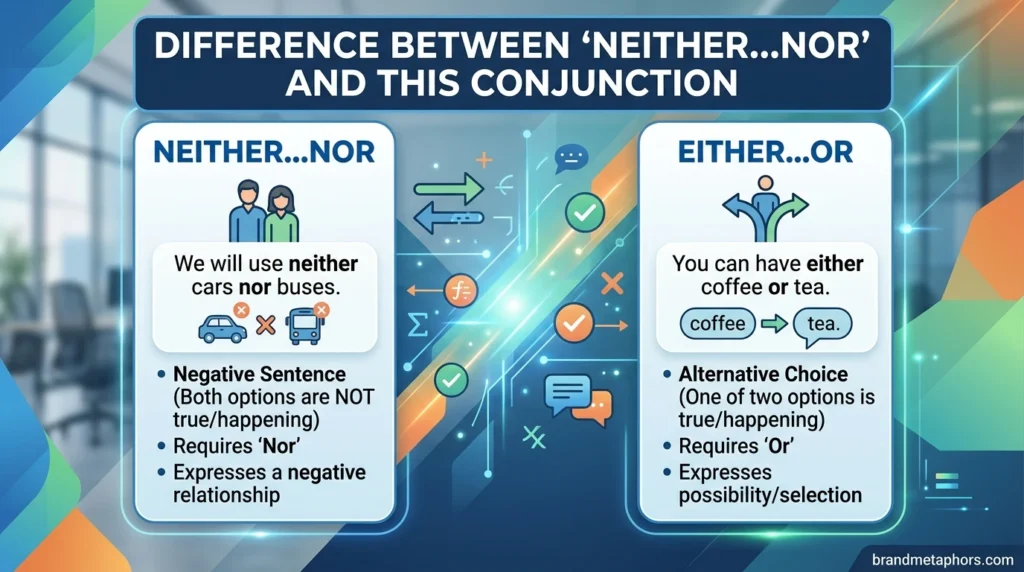
Many learners confuse these two structures.
Although related, they are used differently.
FeatureThis ConjunctionNeither…NorFunctionConnects a second negative statementConnects two nouns, verbs, adjectives, or phrasesPositionUsually after a negative clauseStarts the sentence or phraseVerb inversionUsually yesNo inversion after the pair itselfExampleShe didn’t sing, nor did she dance.Neither Sarah nor Lisa sang.
Compare
Correct:
- She wasn’t hungry, nor was she thirsty.
- Neither Sarah nor Lisa was hungry.
Both are correct, but their structures differ.
Common Mistakes Learners Make
Understanding common errors helps avoid them.
1. Forgetting inversion
Incorrect
He didn’t laugh, nor he smiled.
Correct
He didn’t laugh, nor did he smile.
2. Using it after a positive sentence
Incorrect
She likes pizza, nor she likes pasta.
Correct
She likes pizza, but she doesn’t like pasta.
3. Double negatives
Incorrect
He didn’t never arrive, nor didn’t he call.
Correct
He never arrived, nor did he call.
4. Mixing formal and informal styles
Very formal:
The witness offered no explanation, nor did he provide evidence.
Casual conversation usually sounds better as:
He didn’t explain anything, and he didn’t provide any evidence either.
5. Wrong subject-verb agreement
Incorrect
Neither the teacher nor the students was ready.
Correct
Neither the teacher nor the students were ready.
Agreement depends on the subject closest to the verb.
Formal vs Informal Usage
One reason learners rarely hear this conjunction is that spoken English often prefers simpler alternatives.
Formal writing
- The proposal received no support, nor was additional funding approved.
- The investigation revealed no fraud, nor did auditors discover irregularities.
Informal speech
Instead of saying:
I don’t like coffee, nor do I like tea.
Most native speakers say:
- I don’t like coffee, and I don’t like tea either.
- I don’t like coffee or tea.
Both sound more conversational.
Tips for Using It Naturally
Follow these practical tips.
Always check the first clause
Ask yourself:
Is the first clause already negative?
If yes, this conjunction may fit.
Remember inversion
Think of these common helping verbs:
- did
- do
- does
- was
- were
- have
- has
- had
- can
- could
- should
- will
- would
Example:
She wasn’t surprised, nor was I.
Don’t overuse it
Academic writing benefits from variety.
Instead of repeating the same connector many times, alternate with:
- and
- but
- however
- yet
- neither…nor
- also
- furthermore
This improves readability.
Read quality writing
Books, newspapers, academic journals, and professional articles frequently use this conjunction correctly.
The more examples you read, the more natural the pattern becomes.
Practice Sentences
Try completing these examples.
Exercise 1
She didn’t answer the phone, ______ did she reply to my email.
Answer:
nor
Exercise 2
The store wasn’t open, ______ was the pharmacy.
Answer:
nor
Exercise 3
Neither Tom ______ Jerry attended the meeting.
Answer:
nor
Exercise 4
The weather wasn’t warm, ______ was it sunny.
Answer:
nor
Exercise 5
He never apologized, ______ did he admit his mistake.
Answer:
nor
Practicing sentence completion is one of the fastest ways to master the structure.
Writing Better Sentences with Negative Coordination
Professional writers use this conjunction because it creates elegance and avoids repetition.
Instead of writing:
- She didn’t smile.
- She didn’t wave.
- She didn’t speak.
You can write:
- She didn’t smile, nor did she wave or speak.
The second version is smoother, more concise, and easier to read.
Academic Example
Instead of
The experiment did not support the theory. The experiment did not produce reliable data.
Write
The experiment did not support the theory, nor did it produce reliable data.
Business Example
Instead of
The client didn’t approve the budget. The client didn’t request revisions.
Write
The client didn’t approve the budget, nor did they request revisions.
These improvements make writing more professional.
Best Practices for English Learners

If you’re trying to become fluent, remember these habits.
- Learn complete sentence patterns instead of isolated words.
- Practice transforming two negative sentences into one.
- Read newspapers and novels for authentic examples.
- Listen to formal speeches and documentaries.
- Write your own examples every day.
- Review grammar regularly.
- Pay attention to helping verbs.
- Focus on sentence inversion until it feels natural.
Consistent practice builds confidence much faster than memorizing grammar rules alone.
Frequently Asked Questions
1. Is this conjunction only used in negative sentences?
Yes. It normally connects another negative idea to an already negative statement.
2. Why does the verb come before the subject?
English uses inversion after this conjunction in formal grammar, similar to question word order.
3. Can it begin a sentence?
Yes, although this is uncommon and usually appears in literary or highly formal writing.
Example:
Nor did anyone expect such an outcome.
4. Is it common in everyday conversation?
Not very. Native speakers usually choose simpler alternatives in casual speech.
5. What’s the difference between “or” and this conjunction?
Or presents choices, while this conjunction links additional negative ideas.
6. Can it connect more than two ideas?
Yes.
Example:
She didn’t complain, nor did she argue, nor did she leave early.
7. Is it appropriate for academic writing?
Absolutely. It is widely accepted in essays, reports, research papers, and professional documents.
8. How can I remember the grammar rule?
Remember this formula:
Negative statement + helping verb + subject + main verb
If you remember the inversion pattern, you’ll avoid the most common mistakes.
Conclusion
Mastering this negative coordinating conjunction is an important step toward stronger English grammar and more polished writing. Although it appears more frequently in formal contexts than in everyday conversation, understanding its structure helps you connect negative ideas clearly and concisely.
The key points are simple: use it after a negative statement, remember subject-auxiliary inversion, and avoid pairing it with positive clauses. With regular practice, reading authentic English, and writing your own examples, you’ll soon recognize the pattern naturally and use it with confidence in essays, professional communication, and advanced English conversations.