
Have you ever read a piece of text that made you feel like you were watching a movie inside your head? One moment you are staring at black ink on a white page, and the next, you are walking through a foggy forest or feeling the crisp autumn wind on your face.
This magic happens because of descriptive language and figurative language. When writers use the right words, they do not just state facts. They create living, breathing worlds. Using powerful vocabulary improves writing and communication by turning simple ideas into vivid experiences. It helps us connect with readers on a deeper emotional level.
However, to build these mental worlds, you must master word choice. A single letter can change the entire meaning of a sentence. A common point of confusion for students, writers, and English learners is the mix-up between envision and invision.
In this comprehensive guide, you will learn the exact meanings of these words, how to use them as literary devices, and how to apply them to level up your writing skills.
1. Defining Envision: The Power of Mental Sight
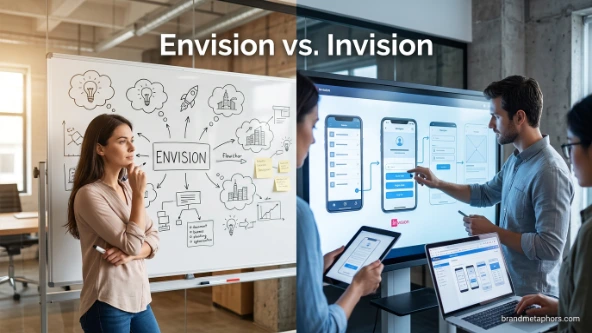
To envision means to picture something in your mind as a future possibility. It is an act of imagination, hope, or planning. When you envision something, you are looking ahead in time and creating a mental image of what could be.
The Origin of the Word
The word comes from the prefix en- (meaning “to cause to be in”) and the root word vision (from the Latin videre, meaning “to see”). Therefore, to envision literally means to bring something into your sight—specifically, your inner sight.
Key Aspects of Envisioning:
- Future Focus: It almost always deals with the future or things that do not exist yet.
- Creativity: It requires a leap of imagination.
- Intentionality: It often involves planning or hoping for a specific outcome.
When a character in a story dreams of a better life, or when an inventor designs a new tool, they are engaging in the act of envisioning.
2. Unpacking Invision: Trademark vs. Common Typos
Now, let us clear up the confusion around invision. If you search for this word in a traditional English dictionary, you might be surprised to find that it does not exist as a standard verb or noun.
Here is what you need to know about this term:
1. The Typo
Most of the time, when people write “invision,” they actually mean “envision.” It is a very common spelling error because the letter i and the letter e can sound similar in spoken English depending on your accent.
2. The Proper Noun (Brand Name)
In the modern digital world, InVision (with a capital V) is a well-known digital product design platform used by professionals to create app and website prototypes.
Summary for Writers:
If you are writing a formal essay, a story, or a poem, you should almost always use envision. Only use InVision if you are talking about the specific software company.
3. How Envision Acts as a Tool for Creative Writing
In creative writing, your primary goal is to make the reader see what you see. The word envision is deeply tied to the concept of imagery. Imagery is a literary device where a writer uses vivid descriptions to appeal to the reader’s physical senses.
When you write, you must envision the scene first. If the image in your mind is blurry, the words on the page will be blurry too.
Enhancing Your Narrative Arc
You can use the concept of envisioning to develop your characters. What does your main character envision for their future?
- A hero might envision a peaceful kingdom.
- A villain might envision total control.
- A student might envision passing a difficult exam.
By clearly stating what a character envisions, you instantly show the reader their deepest desires and motivations without needing long explanations.
4. Comparing Envision with Similar Vocabulary Words
To achieve true vocabulary enhancement, it helps to see how envision compares to similar verbs. While they all relate to the mind, they have different shades of meaning.
WordMeaningBest Used ForEnvisionTo picture a future possibility or concept.Hopeful dreams, future plans, big ideas.ImagineTo form a mental image of anything (real or unreal).Fantasy, fiction, wild thoughts.VisualizeTo form a mental image of a specific, concrete thing.Sports training, remembering a map, processing data.ForeseeTo know or predict something before it happens.Warnings, logic-based predictions, prophecy.
Quick Rule of Thumb:
- Use visualize when you are picturing something that already exists or has a strict shape (like a math problem or a layout).
- Use envision when you are dreaming big about what the future might hold.
5. Sentence Examples Across Different Contexts
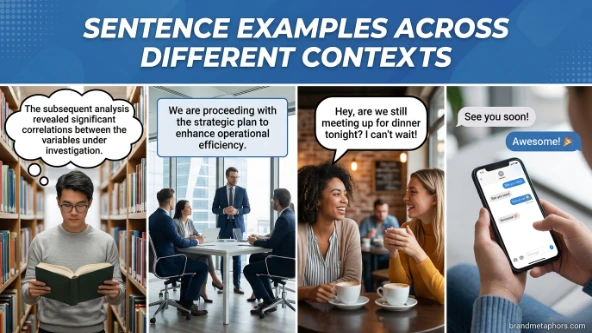
The best way to learn new words is to see them in action. Here are several sentence examples showing how to use envision correctly in different writing styles.
Everyday and Casual Contexts
- “I can easily envision us living by the beach in a few years.”
- “Do you envision any problems with our travel plans for this weekend?”
- “She could not envision a life without her favorite pet.”
Professional and Business Contexts
- “The CEO asked the team to envision a new marketing strategy for the upcoming year.”
- “We envision a steady 10% growth in sales over the next two quarters.”
- “Managers must envision potential risks before launching a new project.”
Academic and Essay Writing Contexts
- “Historians believe that ancient builders did not envision their monuments lasting for thousands of years.”
- “The author forces the reader to envision a dystopian world where technology rules human life.”
- “Scientists envision a clean energy future powered entirely by solar and wind power.”
6. Figurative Language: Simile and Metaphor Examples
Figurative language goes beyond the literal meaning of words to create a fresh, exciting image. Let us look at how we can use simile examples and metaphor examples to express the idea of envisioning.
Simile Examples (Using “like” or “as”)
A simile compares two different things using words such as “like” or “as” to create a vivid mental picture.
- Example 1: “He could envision his success as clearly as a bright neon sign in the dark.”
- Example 2: “Thinking about the future, she could envision her dreams unfolding like the petals of a morning rose.”
- Example 3: “The planner could envision the new city grid like a giant chess board ready for play.”
Metaphor Examples (Direct Comparison)
A metaphor states that one thing is another thing, making the description even stronger.
- Example 1: “To envision a better world is the spark that lights the fire of progress.”
- Example 2: “Her mind was a cinema, constantly envisioning adventures in distant lands.”
- Example 3: “He did not just guess the future; he envisioned a roadmap written in the stars.”
7. Deep Dive into Poetic Expression and Literary Devices
Poets and novelists use poetic expression to give deep emotional weight to their words. The act of envisioning is a favorite theme in literature because it touches on hope, time, and the human spirit.
When writing poetry or lyrical prose, you can use envision to connect the internal world of the mind with the external world of nature.
Examples of Poetic Usage:
“I envision the winter snow while standing in the heat of June, remembering that every season must dance to its own quiet tune.”
In this short poetic line, envisioning allows the speaker to travel through time, bringing the cool peace of winter into a hot summer day.
Literary Devices to Pair with Envision:
- Personification: Give human traits to the things you envision. (e.g., “She envisioned a future where peace walked hand-in-hand with justice.”)
- Juxtaposition: Place two opposite ideas side by side. (e.g., “While standing in the ruins of war, he could only envision a landscape of beautiful gardens.”)
8. Tone Usage: Adjusting for Your Audience
Depending on your audience, the way you use envision will change. It is a highly flexible word that can sound warm and inspiring, or cold and analytical.
1. The Inspirational Tone
This tone is perfect for speeches, creative stories, and personal essays. It focuses on hope and big dreams.
- Example: “We must envision a world where every child has access to books and clean water.”
2. The Analytical Tone
This tone fits scientific papers, business reports, and academic essays. It focuses on logic and forward planning.
- Example: “Based on current data, urban planners envision a complete shift toward public transit by 2040.”
3. The Melancholic Tone
You can also use envision to show sadness, especially when a character pictures something they can never have.
- Example: “In the quiet dark of his room, he would envision the smiling face of the friend he lost long ago.”
9. Idiom Meaning: Expressions Related to Vision and Imagination
While “envision” itself isn’t a part of many old idioms, there are several idiomatic expressions that carry the exact same idiom meaning. Learning these will give you more variety in your writing.
1. In my mind’s eye
- Meaning: In my imagination or memory.
- Example: “In my mind’s eye, I can still envision my grandmother’s old wooden house perfectly.”
2. Cast your mind forward
- Meaning: To think about or plan for the future.
- Example: “If you cast your mind forward, you can envision how technology will change schools.”
3. Pipe dream
- Meaning: An impossible hope or plan for the future (the opposite of a realistic envisioning).
- Example: “He envisioned starting a business on Mars, but his friends thought it was just a pipe dream.”
4. Paint a picture
- Meaning: To describe something so clearly that others can envision it.
- Example: “The author paints a vivid picture of the jungle, allowing readers to envision the exotic wildlife.”
10. When to Use Envision vs. When to Avoid It
Using big words can make your writing look smart, but using them in the wrong place can confuse your reader. Here is a simple guide on when to use envision and when to pick a simpler word.
When to Use Envision:
- When you are describing a creative process or a long-term goal.
- When a character is thinking deeply about what lies ahead.
- When you want to add a formal, elegant touch to your sentences.
When to Avoid It:
- Avoid it for simple sight: Do not use it if you are looking at something with your physical eyes right now.
- Incorrect: “I envision the book sitting on the table in front of me.”
- Correct: “I see the book sitting on the table in front of me.”
- Avoid it for fast actions: If a thought flashes quickly in someone’s head, use “thought” or “pictured.”
- Incorrect: “He suddenly envisioned a red apple.”
- Correct: “He suddenly thought of a red apple.”
11. Common Mistakes and Misconceptions
To ensure your writing skills remain top-notch, watch out for these three frequent errors made by students and English learners.
Error 1: Spelling it with an “I” (Invision)
As discussed earlier, this is the number one error. Always check your spelling. Remember: Envision starts with an E, just like Explore and Expect.
Error 2: Confusing Envision with “Revise”
Some learners mix up these words because they both have “vise” in them.
- To revise means to change or correct something you already did.
- To envision means to look forward to something new.
- Incorrect: “I need to envision my essay before I hand it in.”
- Correct: “I need to revise my essay before I hand it in.”
Error 3: Double Futures
Since envision already implies looking into the future, you do not need to overload the sentence with extra future-tense words.
- Clunky: “In the future yet to come, I envision a tomorrow where…”
- Better: “I envision a future where…”
12. Practical Exercises for Students and English Learners
The best way to lock this new knowledge into your brain is to practice. Grab a piece of paper or open a blank document and complete these three quick exercises.
Exercise 1: Fill in the Blanks
Choose the correct word (envision or invision) for each sentence.
- The architect drew a sketch to help the clients __________ the final house.
- I opened my laptop to design a website prototype using the __________ software.
- It is difficult to __________ how the world will change in the next century.
Exercise 2: Sentence Transformation
Rewrite the following simple sentences to make them more advanced by using the word envision and adding some descriptive language.
- Simple: “I think about my next vacation.”
- Advanced: __________________________________________________
- Simple: “The teacher wants the students to do well.”
- Advanced: __________________________________________________
Exercise 3: Creative Writing Prompt
Write a short paragraph (3 to 5 sentences) about a character who discovers a secret door in their house. Use the word envision at least once, and include one simile or metaphor.
Answer Key for Exercise 1:
- envision (meaning to picture the future house)
- InVision (referring to the specific design tool)
- envision (meaning to imagine the future century)
13. Frequently Asked Questions (FAQs)
1. Is “invision” ever a real word in English?
No, “invision” is not a standard English word found in trusted dictionaries. It is either a spelling mistake for “envision” or it refers to the private brand name of the design tool software, InVision.
2. Can I use “envision” when talking about the past?
Generally, no. Envision is focused on the future or on unseen possibilities. If you are talking about remembering something that already happened, use words like recollect, remember, or recall. However, you can say: “In the past, people envisioned that we would have flying cars by now.”
3. What is the difference between “envision” and “envisage”?
These two words are very close siblings! Both mean to picture something in the mind. The main difference is regional: envision is much more common in American English, while envisage is preferred in British English.
4. Is “envision” a formal word?
Yes, it is considered slightly formal. It is excellent for essays, speeches, and creative literature. In casual conversation, people often swap it for simpler phrases like “picture this” or “imagine.”
5. What is the noun form of envision?
The noun form is envisioning (the act of doing it) or simply vision (the concept or plan itself). For example: “The successful project was a result of the team’s shared vision.”
Conclusion
Mastering the difference between envision and its common misspelling is a fantastic step toward building excellent writing skills. By choosing to envision your ideas clearly before you put them on paper, you open the door to beautiful poetic expression and powerful figurative language.
Remember, clear writing comes from clear thinking. Keep practicing your vocabulary enhancement, use your literary devices with care, and never stop creating bright mental worlds for your readers to explore.
What do you envision creating with your new writing skills today?