
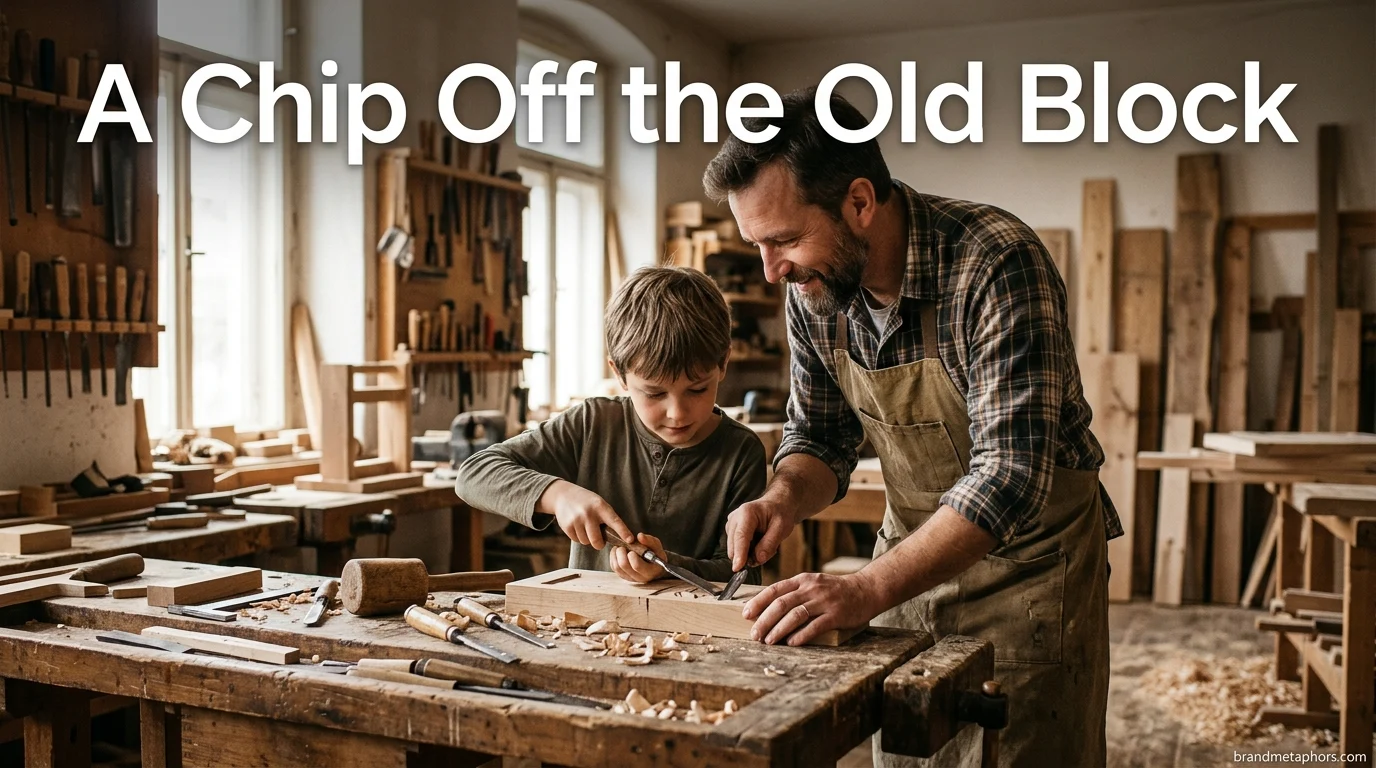
Language is full of colorful phrases that say a lot in just a few words. Some idioms are funny, some are poetic, and some feel deeply personal because they describe family, personality, and shared traits. One such expression is a chip off the old block. It is a well-known English idiom used to describe someone—usually a child—who is very similar to their parent in character, behavior, appearance, habits, or skills.
This phrase appears often in daily conversation, storytelling, family talk, school writing, and even in media and entertainment. It is simple, but it carries a warm and meaningful idea: children often resemble the people who raise them, especially their parents. Sometimes the similarity is physical, like having the same smile. Other times it is about behavior, talent, attitude, or even the way a person speaks.
In this guide, you’ll learn the full meaning of the idiom, where it comes from, how to use it correctly, what makes it so popular, and how it compares to similar expressions. You’ll also find sentence examples, real-life situations, a helpful table, and FAQs that answer common search questions. Whether you are an English learner, student, writer, or teacher, this article will help you understand and use the phrase naturally.
What Does “A Chip Off the Old Block” Mean?
This idiom means that a child is very much like their parent, especially in personality, habits, abilities, or looks. Most often, it is used in a positive or affectionate way.
Simple meaning
If someone says, “He’s a chip off the old block,” they mean:
- He is very similar to his father or mother
- He has inherited certain traits from a parent
- He behaves, speaks, or thinks in a way that strongly resembles a parent
- He may share the same talent, career interest, or attitude
Short definition
A chip off the old block = a person, especially a son or daughter, who is very similar to one of their parents.
Basic idea behind the idiom
Imagine a small piece chipped off a large block of wood or stone. That small piece would look like the larger block because it came from it. In the same way, a child may seem like a smaller version of a parent.
Quick examples
- Ali loves cricket and plays exactly like his father. He’s a chip off the old block.
- Sana is as kind and patient as her mother.
- The boy tells jokes just like his dad—definitely a chip off the old block.
The Origin of the Idiom
The phrase has been used in English for a long time. It comes from the image of a chip, or small piece, that breaks off from a larger block of wood or stone. Since the chip comes from the block, it naturally looks like it.
How the image works
Think of a carpenter cutting wood. A small piece that comes off the main block still has the same material, texture, and appearance. That image became a way to describe a child who seems to come directly from the parent in looks, habits, or nature.
Historical background
The modern phrase “a chip off the old block” became common in English over time, but older versions of the saying existed before it. The idea has always been the same: children often resemble their parents.
Why the phrase survived
This idiom stayed popular because:
- It is visual and easy to understand
- It describes family resemblance in a memorable way
- It works in both casual and literary language
- It can be used for appearance, talent, or personality
Idioms survive when they express something universal. Family resemblance is one of those universal human experiences.
When Do People Use This Expression?
People use this phrase when they notice a strong similarity between a child and a parent. It can be used in many everyday situations.
Common situations where it fits
You may hear it when someone notices that a child:
- Looks like a parent
- Speaks in the same style
- Has the same laugh or facial expressions
- Shares the same talent or hobby
- Acts with the same confidence or kindness
- Has the same stubbornness or sense of humor
- Follows the same career path
- Handles problems the same way
Everyday examples
- A teacher notices that a student writes beautifully like her mother.
- A family friend sees a son fixing machines just like his father.
- A coach watches a girl play football with the same passion as her mom.
- A grandmother hears a child speaking and says, “That’s exactly how your father talks!”
Tone of the expression
Most of the time, the phrase is:
- Warm
- Friendly
- Proud
- Playful
- Admirative
Sometimes it can also be slightly critical if the shared trait is negative, but even then it is often said with humor.
Traits That Can Make Someone “A Chip Off the Old Block”
The idiom does not only refer to physical appearance. It can describe many kinds of resemblance. This is one reason the phrase is so useful.
1) Physical resemblance
A child may have:
- The same eyes
- The same smile
- The same height or build
- Similar facial expressions
- Similar body language
Example: “Every time I see Hamza smile, I see his father in him. He’s a chip off the old block.”
2) Personality traits
A child may be:
- Calm like a parent
- Funny like a parent
- Hardworking like a parent
- Brave like a parent
- Quiet like a parent
Example: “Her mother is gentle and thoughtful, and so is she.”
3) Talents and skills
A child may share:
- Musical talent
- Sports ability
- Business sense
- Writing skill
- Artistic creativity
Example: “His father was a great singer, and now he sings beautifully too.”
4) Habits and behavior
A child may:
- Wake up early like a parent
- Keep things neat like a parent
- Talk with the same expressions
- React the same way under stress
- Enjoy the same hobbies
5) Values and mindset
A child may learn:
- Honesty
- Discipline
- Generosity
- Respect for others
- Love of learning
This is one of the deepest ways children become similar to their parents.
Positive and Negative Uses of the Idiom
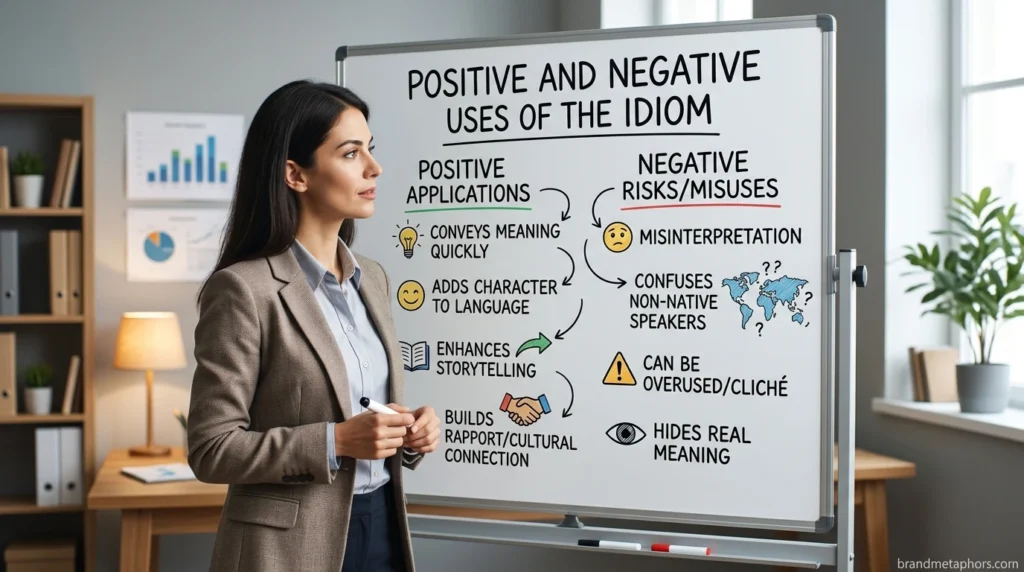
Most idioms have shades of meaning depending on context. This one is usually positive, but not always.
Positive use
People often say it to praise or admire someone.
Positive examples
- “She works as hard as her mother. She’s a chip off the old block.”
- “He’s as honest and reliable as his dad.”
- “Like her mother, she’s a natural leader.”
In these examples, the phrase celebrates:
- Good character
- Strong family values
- Talent and discipline
- Shared success
Slightly negative or humorous use
Sometimes the idiom is used when a child copies a less desirable trait.
Examples
- “His father never admits he’s wrong, and neither does he.”
- “She argues just like her mother.”
- “He spends money too fast, just like his dad.”
In such cases, the phrase may carry:
- Gentle teasing
- Family humor
- Mild criticism
- A playful tone
The context and voice matter a lot. A smile can change the whole meaning.
Real-Life Examples of Family Resemblance
This idiom becomes easier to understand when we look at real-life situations. Here are some simple examples from daily life.
Example 1: The athlete’s child
A father played local football for years. His son grows up, joins the school team, runs with the same energy, and loves the game just as much. People watching the match say, “He’s a chip off the old block.”
Example 2: The teacher’s daughter
A mother is known for her calm nature, clear speech, and love of books. Her daughter also enjoys reading, explains things well, and helps classmates learn. Teachers say she is very much like her mother.
Example 3: The family business
A shopkeeper has spent years serving customers with honesty and friendliness. His daughter begins helping in the shop and speaks to customers in the same warm way. Regular customers notice the similarity.
Example 4: The artist’s son
A mother paints landscapes in her free time. Her son starts sketching from a young age and develops a strong eye for color and detail. The family proudly uses the idiom to describe him.
Example 5: The same sense of humor
A father tells jokes, makes everyone laugh, and always has a funny comeback. His son does the same at family dinners. Everyone smiles and says he takes after his dad.
These examples show that the idiom can be used for:
- Sports
- Teaching
- Business
- Art
- Humor
- Character and values
Why This Idiom Is Important in English
This phrase is more than just a casual saying. It teaches learners how English expresses relationships, identity, and shared traits in a natural way.
1) It helps you understand native speech
Idioms appear in:
- Movies
- TV shows
- Interviews
- Novels
- Conversations
- Social media captions
Knowing this phrase helps you understand what people mean without confusion.
2) It improves speaking and writing
Using idioms correctly makes your English sound:
- More natural
- More expressive
- More fluent
- More engaging
3) It teaches cultural ideas
The idiom reflects a common belief: children often resemble the adults who raise them. This idea appears in many cultures and languages.
4) It adds color to description
Instead of saying, “He is similar to his father,” the idiom gives the sentence personality and rhythm.
Compare the two:
- He is very similar to his father.
- He’s a chip off the old block.
The second one sounds more vivid and memorable.
Common Sentence Patterns and How to Use It Correctly
If you want to use this idiom naturally, it helps to learn the sentence patterns.
Most common structure
Subject + is/was + a chip off the old block
Examples
- He is a chip off the old block.
- She’s a chip off the old block.
- Their son is a chip off the old block.
- You can tell he’s a chip off the old block.
Useful sentence starters
- Everyone says he’s…
- She really is…
- In many ways, he’s…
- Watching her work, you can see she’s…
- From his smile to his attitude, he’s…
More example sentences
- My brother is a chip off the old block; he even laughs like our father.
- Her daughter is a chip off the old block and has the same artistic talent.
- He may be young, but he’s a chip off the old block when it comes to business.
- Their son is polite, thoughtful, and hardworking—a chip off the old block.
Tips for correct use
Use it when:
- The resemblance is clear
- The person you mention is younger or a child of the older person
- The comparison feels natural and easy to understand
Avoid using it when:
- The relationship is not clear
- The similarity is very weak
- The context is formal and highly technical
Similar Idioms and Related Expressions
English has many expressions about resemblance, family traits, and inherited behavior. Knowing related phrases helps expand vocabulary and improve writing.
Similar expressions
1) Like father, like son
This means a son behaves like his father.
Example: “He loves repairing cars—like father, like son.”
2) Like mother, like daughter
This means a daughter resembles her mother in some way.
Example: “They both have the same confidence and style—like mother, like daughter.”
3) Take after
This phrasal verb means to resemble a parent or family member.
Example: “She takes after her mother in both looks and personality.”
4) The apple doesn’t fall far from the tree
This means children are often similar to their parents.
Example: “His father is a musician, and now he’s one too. The apple doesn’t fall far from the tree.”
5) Spitting image
This means someone looks extremely similar to another person.
Example: “She’s the spitting image of her grandmother.”
Comparison Table: Similar Expressions and Their Uses

ExpressionMeaningBest Used ForExampleA chip off the old blockA child is very similar to a parent in traits, habits, or abilityGeneral resemblance in character, behavior, talent, or looks“He’s a chip off the old block and runs the family shop just like his father.”Like father, like sonA son behaves like his fatherFather-son similarities“He loves cricket too—like father, like son.”Like mother, like daughterA daughter resembles her motherMother-daughter similarities“They both love fashion—like mother, like daughter.”Take afterTo resemble a family memberLooks, habits, or personality“She takes after her aunt.”The apple doesn’t fall far from the treeChildren are often like their parentsFamily similarity in general“He’s stubborn like his dad; the apple doesn’t fall far from the tree.”Spitting imageLooks exactly like someoneStrong physical resemblance“He’s the spitting image of his grandfather.”
This table helps show that while these phrases are related, each one has a slightly different use.
Benefits of Learning and Using Idioms Like This
For English learners, idioms can feel difficult at first. But once you understand them, they become one of the best tools for speaking and writing naturally.
1) Better vocabulary
Idioms add variety to your language. Instead of repeating simple words like “same” or “similar,” you can express ideas in a richer way.
2) Stronger writing style
If you write stories, essays, blogs, or captions, idioms make your language more colorful and memorable.
3) More natural conversation
Native speakers use idioms often. Knowing them helps you:
- Understand others
- Reply more naturally
- Sound more confident in speech
4) Cultural understanding
Idioms show how a language thinks. This one reflects family identity, inherited traits, and shared behavior.
5) Better reading comprehension
Books, films, and articles often use figurative language. Learning idioms helps you understand the real meaning behind the words.
How to Teach or Learn This Idiom Easily
Whether you are a student, teacher, parent, or self-learner, there are simple ways to remember and use this expression.
Easy learning strategies
Use family examples
Think of someone you know who is very much like a parent. Real people make idioms easier to remember.
Create your own sentences
Write 5–10 sentences using the idiom in different ways:
- for looks
- for talent
- for personality
- for habits
Compare with your own language
Many languages have expressions about children resembling parents. If your language has a similar phrase, connect the meanings.
Watch movies or interviews
When you hear people talk about family resemblance, notice which expression they use.
Use picture memory
Imagine a small piece of wood coming from a large block. That image can help you remember the meaning for a long time.
Mistakes to Avoid When Using the Phrase
Learners often understand the meaning but still use idioms in unnatural ways. Here are some common mistakes.
Mistake 1: Using it for unrelated people
This idiom usually refers to a child and parent relationship, not random people.
Incorrect: “My friend is a chip off the old block of his teacher.”
Better: “My friend takes after his teacher in the way he speaks.” or “My friend is a chip off the old block of his father.”
Mistake 2: Using it in very formal writing
In academic or technical writing, it may be better to use direct language like:
- resembles
- inherited traits from
- shares characteristics with
Mistake 3: Forcing it when the similarity is weak
If someone only shares one tiny habit with a parent, the idiom may sound exaggerated.
Mistake 4: Misunderstanding the tone
It is usually warm and conversational. In a serious or scientific discussion, plain wording may fit better.
How This Idiom Connects to Family, Identity, and Human Nature
This expression stays popular because it speaks to something deeply human. Families pass on more than eye color and facial features. They also pass on values, traditions, attitudes, interests, and ways of living.
What the idiom reveals
It reminds us that children often learn by watching. They copy:
- speech patterns
- manners
- emotional responses
- work habits
- interests and goals
Nature and nurture
The phrase also connects to the bigger idea of nature and nurture:
- Nature: qualities a child may inherit
- Nurture: qualities shaped by upbringing and environment
In real life, both often work together. A child may be born with certain natural abilities, then grow even more similar to a parent through daily life, practice, and shared experiences.
Why people love saying it
People use this phrase because it:
- feels affectionate
- honors family connection
- notices shared strengths
- turns a simple observation into a memorable line
That is why the idiom remains alive in spoken and written English.
FAQs About “A Chip Off the Old Block”
1) What does “a chip off the old block” mean in simple words?
It means a child is very similar to their parent in personality, behavior, appearance, or skills.
2) Is the idiom positive or negative?
Usually it is positive or affectionate. But it can also be used humorously to point out a bad habit shared by a parent and child.
3) Is it only used for sons and fathers?
No. It can be used for sons, daughters, mothers, or fathers. It simply refers to a child strongly resembling a parent.
4) Can I use it in formal writing?
It is better for conversation, storytelling, blogs, and creative writing. In formal writing, words like resembles, inherits, or takes after may sound more suitable.
5) What is the difference between “a chip off the old block” and “like father, like son”?
“Like father, like son” specifically compares a father and son. “A chip off the old block” is broader and can be used for many kinds of parent-child resemblance.
6) Can the idiom refer to looks only?
Yes, but not only looks. It can also describe behavior, talent, values, habits, and personality.
7) What is a similar phrase to this idiom?
Similar phrases include:
- like father, like son
- like mother, like daughter
- take after
- the apple doesn’t fall far from the tree
- spitting image
8) Why is this idiom useful for English learners?
It helps learners understand natural spoken English, improve vocabulary, use figurative language, and make writing more expressive.
Conclusion
The idiom a chip off the old block is a warm and memorable way to describe a child who strongly resembles a parent. That resemblance may show in looks, personality, talent, behavior, values, or everyday habits. The phrase is simple, visual, and rich in meaning, which is why it has stayed popular for generations.
For English learners, this idiom is worth knowing because it appears in conversation, storytelling, and daily life. It also opens the door to a wider understanding of figurative language, family-related expressions, and natural English speech. More importantly, it shows how language captures human experience in a vivid way. A single phrase can describe love, similarity, identity, and family connection all at once.
If you want to sound more natural in English, this idiom is a great one to learn, remember, and use. It is short, expressive, and easy to apply in real life—especially when you meet someone who reminds you so much of a parent that there is no better way to describe them.