
Introduction
Good writing is not only about grammar. It is also about choosing the right words to express the right meaning. A single word can change the message of a sentence, and that is why understanding similar-sounding words is so important. This is especially true for students, writers, and English learners who want to improve clarity, confidence, and writing skills.
Figurative language also plays an important role in communication. It makes writing more vivid, memorable, and emotional. It helps writers paint pictures with words, build strong descriptions, and create powerful poetic expression. But even the most creative sentence can lose its meaning if the wrong word is used. For example, confusing worn and warn may make a sentence sound strange or completely change its meaning.
These two words look and sound somewhat similar, but they are very different in grammar, meaning, and usage. One relates to use, damage, or clothing, while the other relates to giving a warning or alert. If you mix them up, your sentence may become unclear.
In this article, you will learn the difference between worn and warn, their meanings, grammar roles, pronunciation tips, sentence examples, common mistakes, tone usage, figurative language examples, writing exercises, and memory tricks. By the end, you will know exactly when to use each word and when to avoid them.
What Is the Difference Between Worn and Warn?
The main difference is simple:
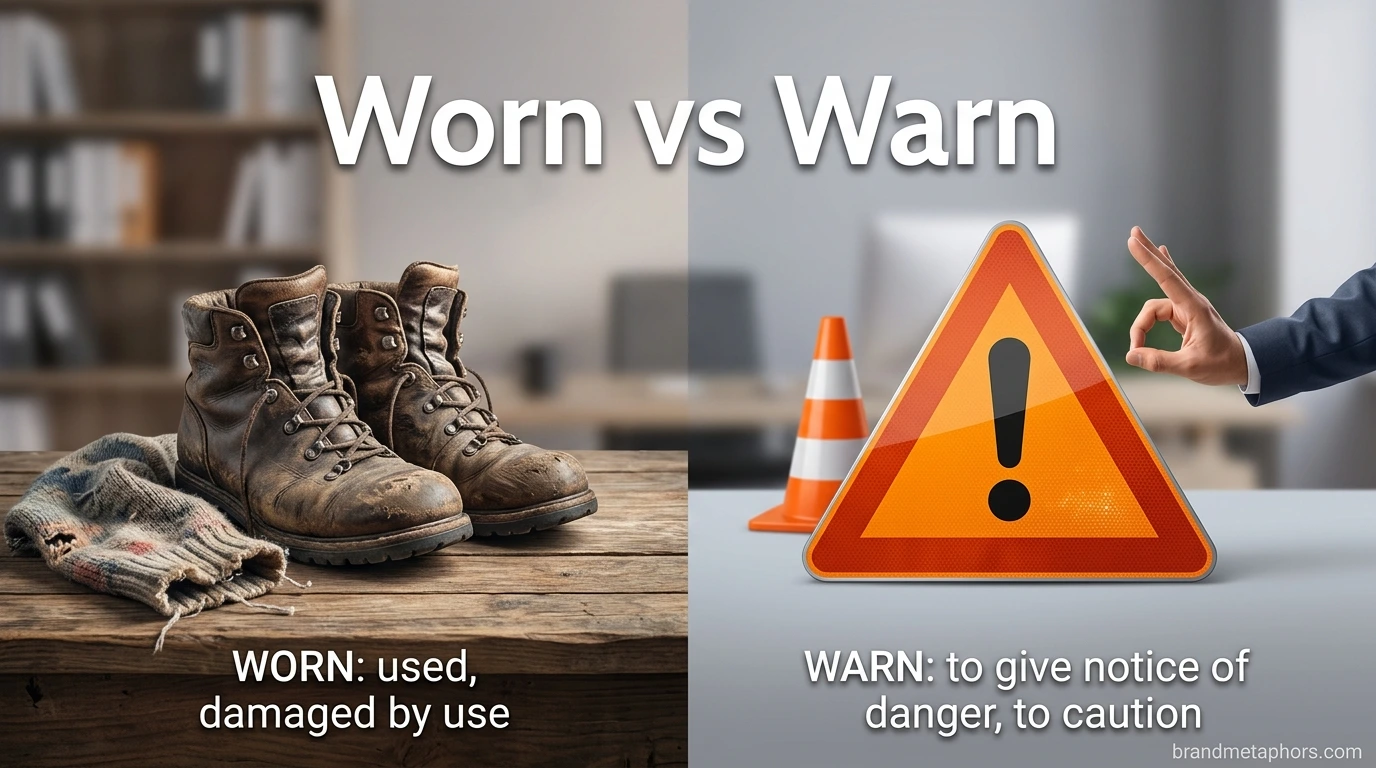
- Worn is the past participle of wear. It usually means something was used, damaged, weakened, or put on the body as clothing.
- Warn is a verb that means to alert, advise, or tell someone about danger, risk, or a possible problem.
Quick comparison
WordPart of SpeechMain MeaningExampleWornVerb form / adjectiveUsed a lot, damaged, tired, or dressed in somethingMy shoes are worn.WarnVerbTo alert someone about danger or troubleI want to warn you about the storm.
Simple way to remember
- Worn = connected to wear
- Warn = connected to warning
These two words are not interchangeable. Even though they may look close in spelling, they do very different jobs in English.
Meaning of Worn
Worn is the past participle of the verb wear. It has a few common meanings in English, depending on context.
1) Worn = used for a long time and no longer in good condition
This meaning is common for clothes, shoes, furniture, roads, books, and other objects.
Examples:
- His jacket looked old and worn.
- The carpet was worn near the door.
- These shoes are too worn to use again.
- The pages of the book were worn at the edges.
2) Worn = physically or mentally tired
It can describe a person who feels exhausted.
Examples:
- After the long trip, she looked worn.
- He felt worn after working all day.
- The nurse was worn from the night shift.
3) Worn = put on the body
It can also mean “dressed in” or “carried on the body.”
Examples:
- The medal was worn proudly on his coat.
- Traditional clothes were worn during the festival.
- Her ring was worn on the left hand.
Grammar note
Worn is often used:
- with has/have/had as part of a verb phrase
- She has worn that dress before.
- as an adjective
- He sat in a worn chair.
Meaning of Warn
Warn is a verb. It means to tell someone about danger, trouble, risk, or a bad result before it happens. It is used when someone gives a caution, advice, or alert.
Common meanings of warn
1) To tell someone about danger
- The teacher warned us about the wet floor.
- They warned the villagers about the flood.
2) To advise someone not to do something
- I warn you not to touch that wire.
- My mother warned me not to stay out late.
3) To give notice about a possible bad result
- The doctor warned him that smoking could harm his lungs.
- Experts warn that the heat may get worse this week.
Grammar note
Warn is a base verb. It changes like this:
Verb FormWordBase verbwarnPast tensewarnedPast participlewarned-ing formwarning
Common sentence patterns with warn
- warn someone about something
- She warned me about the scam.
- warn someone of something
- They warned us of possible delays.
- warn someone not to do something
- He warned me not to drive so fast.
- warn that + clause
- Scientists warn that water levels are rising.
Pronunciation and Spelling Difference

Many learners confuse these words because they are close in spelling and may sound similar in fast speech. But they are not the same.
Spelling difference
- worn = w-o-r-n
- warn = w-a-r-n
Sound difference
In many accents:
- worn sounds closer to worn / wornn
- warn sounds closer to warn / warnn
The vowel sound changes. That small spelling change creates a different word and a different meaning.
Why spelling matters
Look at these two sentences:
- The sign warned drivers about the bridge. This means the sign gave a warning.
- The sign was worn by rain and wind. This means the sign became damaged over time.
Both sentences are correct, but the meaning is completely different.
Worn as a Verb and as an Adjective
One reason worn confuses learners is that it can work in more than one way.
1) Worn as part of a verb tense
Here it is used with have, has, or had.
Examples:
- I have worn these boots for years.
- She had worn the same scarf every winter.
- They have worn uniforms since school started.
In these examples, worn is part of the verb wear.
2) Worn as an adjective
Here it describes the condition of something or someone.
Examples:
- He gave me a worn notebook.
- Her face looked worn after the exam week.
- The old sofa was torn and worn.
Common adjective meanings of worn
- old from use
- weak from effort
- tired in appearance
- faded or damaged
Writing tip
If worn is describing a noun, it is likely acting as an adjective:
- worn shoes
- worn hands
- worn face
- worn fabric
Warn as an Action Verb in Everyday English
Warn is used when someone actively gives caution or advice. It is common in speaking, writing, news reports, school rules, health advice, weather updates, and safety instructions.
Everyday situations where warn is used
At home
- My father warned me not to leave the gate open.
- She warned her brother about the hot pan.
At school
- The teacher warned the class about cheating.
- The principal warned students not to run in the hall.
In public safety
- Police warned drivers to avoid the road.
- Officials warned people about heavy rain.
In health and medicine
- Doctors warn that too much sugar can affect health.
- The label warns users to keep the medicine away from children.
Tone of warn
The tone of warn can be:
- serious
- protective
- official
- caring
- urgent
For example:
- Friendly tone: I’m warning you because I care.
- Formal tone: The notice warns customers of delays.
- Strong tone: I warned you not to go there.
Side-by-Side Comparison Examples
The best way to understand confusing words is to compare them directly. Below are clear comparison examples.
Sentence with WornSentence with WarnMy shoes are worn out.I want to warn you about the slippery floor.He looked worn after the match.They warned us of a coming storm.The old flag was worn by years of wind.The guard warned visitors not to cross the line.She had worn that necklace before.The doctor warned him about stress.The chair is too worn to repair.I must warn you that this path is dangerous.
Notice the pattern
- Worn describes condition, use, or clothing.
- Warn describes giving advice, caution, or danger information.
Sentence Examples for Students and English Learners
Here are many sentence examples to make the difference easy to remember.
Sentences with worn
About clothing and objects
- My school bag is worn at the corners.
- He threw away his worn socks.
- The old jeans were worn but comfortable.
- The handle of the mug was worn smooth.
- The road looked worn after years of traffic.
On tiredness
- She looked worn after taking care of the baby all night.
- I felt worn after finishing the project.
- His voice sounded worn and weak.
- The team was worn by the long journey.
- Her eyes looked worn from lack of sleep.
About wearing something
- She had worn her blue dress to the wedding.
- He has worn glasses since childhood.
- The crown was worn during the ceremony.
- Soldiers had worn heavy boots in the field.
- The actor had worn a black coat in the film.
Sentences with warn
About danger
- I must warn you about the deep water.
- The sign warns drivers of falling rocks.
- They warned us about the storm.
- Please warn the children to stay away from the fire.
- The guide warned tourists about wild animals.
About advice
- My friend warned me not to trust the fake website.
- She warned him not to waste his money.
- The teacher warned us to revise before the exam.
- I warned my brother not to touch the wet paint.
- The doctor warned her to rest more.
In formal or official contexts
- Scientists warn that pollution is rising.
- The company warned customers of a delay.
- Officers warned residents to stay indoors.
- The report warns of economic trouble ahead.
- The app warns users before deleting data.
Worn and Warn in Figurative Language and Creative Writing
Figurative language makes writing richer, stronger, and more expressive. If you are a student or writer, learning how to use words like worn and warn in descriptive language can improve your storytelling and vocabulary enhancement.
Using worn in figurative language
Because worn often suggests age, pain, repetition, or exhaustion, it works well in emotional and descriptive writing.
Metaphor examples with worn
- Her heart was a worn map of old disappointments.
- His smile was a worn curtain hiding deep sadness.
- The city stood like a worn giant under the summer sun.
Simile examples with worn
- He looked as worn as a traveler lost in the desert.
- The book felt like a worn blanket full of memories.
- Her voice was as worn as an old record.
Poetic expression with worn
- The worn road remembered every footstep.
- Time left its fingerprints on the worn walls.
- A worn moon hung over the quiet village.
In these examples, worn adds emotional depth. It helps describe age, tiredness, memory, struggle, and time.
Using warn in figurative language
Warn is more action-based, so it appears in writing that creates tension, danger, or suspense.
Metaphor examples with warn
- The dark clouds warned the town of trouble.
- The silence warned him more than words ever could.
- Her trembling voice warned of a hidden fear.
Simile examples with warn
- The wind warned us like a whisper before a storm.
- His eyes warned me like a flashing red light.
Personification with warn
- The river warned the villagers with its rising roar.
- The old house warned visitors through its broken creaks.
Why this matters for creative writing
Using the right word helps the reader feel the scene correctly:
- worn creates images of age, use, tiredness, or memory.
- warn creates images of caution, danger, fear, or advice.
That is why word choice matters in literary devices, storytelling, and descriptive language.
When to Use Worn

Use worn when you want to talk about one of these ideas:
1) Something is old or damaged from use
- worn shoes
- worn furniture
- worn pages
- worn steps
2) Someone looks tired or exhausted
- worn face
- worn expression
- worn body after work
3) Something was put on the body
- worn as a ring
- worn as a uniform
- worn during a ceremony
4) You need the past participle of wear
- has worn
- had worn
- have worn
Good examples
- The carpet is badly worn.
- He looked worn after the exam.
- She had worn the same coat for years.
Tone of worn
Worn often gives a tone of:
- sadness
- age
- realism
- exhaustion
- memory
- simplicity
It can be useful in essays, fiction, poetry, personal writing, and descriptive paragraphs.
When to Use Warn
Use warn when you want to tell, advise, alert, or caution someone.
1) To alert someone about danger
- warn about fire
- warn about a scam
- warn of heavy rain
2) To advise against an action
- warn someone not to go
- warn someone not to touch
- warn someone not to believe a lie
3) To state a future risk
- experts warn that prices may rise
- doctors warn that stress can harm sleep
Good examples
- I warned him about the broken stairs.
- The teacher warned us not to be late again.
- Weather experts warn of strong winds tonight.
Tone of warn
Warn often sounds:
- serious
- protective
- formal
- urgent
- responsible
It is common in safety writing, school rules, news, reports, and advice.
When to Avoid Worn and Warn
Sometimes learners use one of these words where another word would be better. Here is when to avoid them.
Avoid worn when:
You mean “warn”
Incorrect:
- I worn you about the dog.
Correct:
- I warn you about the dog.
You mean “wearing now”
Incorrect:
- I worn a red shirt today.
Correct:
- I am wearing a red shirt today. or
- I wore a red shirt today. depending on the time.
You mean “broken” in a stronger way
Sometimes damaged, torn, cracked, or destroyed may be more exact than worn.
Example:
- The phone screen is cracked. Not:
- The phone screen is worn.
Avoid warn when:
You mean “tell” in a neutral way
Warn is not neutral. It suggests danger, caution, or a negative result.
Incorrect:
- She warned me her name.
Correct:
- She told me her name.
You mean “remind”
Incorrect:
- Please warn me to bring my notebook.
Better:
- Please remind me to bring my notebook.
You mean “advise” in a soft or general sense
Sometimes advise fits better in formal writing:
- The teacher advised students to revise early.
Use warn only if there is caution or risk:
- The teacher warned students that failure to revise could lower grades.
Common Mistakes with Worn and Warn
These mistakes are very common among English learners.
Mistake 1: Using worn instead of warn
❌ I worn you not to go there. ✅ I warned you not to go there.
Why? Because the sentence is about giving a warning, so the correct verb is warn, and in past tense it becomes warned.
Mistake 2: Using warn instead of worn
❌ My shoes are warn out. ✅ My shoes are worn out.
Why? Because the sentence describes the condition of the shoes.
Mistake 3: Confusing worn, wore, and wear
- wear = base form
- wore = past tense
- worn = past participle
Examples:
- I wear glasses.
- I wore glasses yesterday.
- I have worn glasses for years.
Mistake 4: Using warn without an object or clear message
Sometimes learners write: ❌ He warned. This can be grammatical in a limited context, but it often feels incomplete.
Better:
- He warned us about the fire.
- He warned that the bridge was unsafe.
Mistake 5: Using warn for every kind of advice

Not all advice is a warning.
Compare:
- My mother advised me to save money.
- My mother warned me not to trust the scammer.
The second sentence includes danger or risk, so warned is the better word.
Memory Tricks to Remember the Difference
Easy memory tricks can help you avoid confusion.
Trick 1: Worn belongs to wear
Both words are about clothing or use:
- wear
- wore
- worn
Think: Worn = something has been used or worn on the body.
Trick 2: Warn belongs to warning
Both words are about danger or advice:
- warn
- warning
Think: Warn = tell someone to be careful.
Trick 3: Use a picture in your mind
- Worn → old shoes, faded cloth, tired face
- Warn → red sign, danger signal, careful advice
Trick 4: Test the sentence
Ask:
- Is this sentence about condition/use/clothing? → use worn
- Is this sentence about caution/danger/advice? → use warn
Quick Grammar and Usage Table
FeatureWornWarnWord typePast participle of wear / adjectiveVerbCore ideaUsed, damaged, tired, dressed inAlert, caution, adviseRelated wordswear, wore, wornwarn, warned, warningCommon contextclothes, shoes, objects, tired peopledanger, risk, advice, safetyExampleThe bag is worn out.I warn you to be careful.Tonedescriptive, emotional, observationalserious, protective, urgent
Worn vs Warn in Academic and Daily Writing
Students often ask where these words appear most often. The answer is: both academic and daily English, but in different ways.
In academic writing
Worn may appear in:
- literature analysis
- descriptive essays
- history writing
- visual descriptions
- narrative writing
Example:
- The poet uses the image of worn hands to represent hard work and struggle.
Warn may appear in:
- reports
- formal essays
- health writing
- environmental writing
- safety instructions
Example:
- Researchers warn that climate change may increase drought in dry regions.
In daily speaking
Worn
- My slippers are worn out.
- You look worn today.
- That shirt is too worn to wear outside.
Warn
- I’m warning you, don’t go alone.
- She warned me about that website.
- Let me warn you, the road is very rough.
Practice Exercises for Students
Try these exercises to test your understanding.
Exercise 1: Choose the correct word
Fill in the blank with worn or warn.
- The teacher will ______ us about the test rules.
- My sandals are completely ______ out.
- The doctor tried to ______ him about unhealthy habits.
- Her face looked tired and ______.
- The sign ______ drivers of road work ahead.
- He had ______ the same watch for ten years.
- I must ______ you not to open that door.
- The old sofa is soft but very ______.
Answers
- warn
- worn
- warn
- worn
- warns / warned
- worn
- warn
- worn
Exercise 2: Correct the mistake
Find and fix the wrong word.
- I worn you not to touch the wire.
- These shoes are warn out.
- The police worn people about the flood.
- She looked warn after the long journey.
- He had warn that coat before.
Correct answers
- I warned you not to touch the wire.
- These shoes are worn out.
- The police warned people about the flood.
- She looked worn after the long journey.
- He had worn that coat before.
Exercise 3: Write your own sentences
Write:
- 3 sentences using worn
- 3 sentences using warn
- 1 sentence using worn in a descriptive paragraph
- 1 sentence using warn in a story with suspense
This exercise improves writing skills, sentence building, and vocabulary control.
5 Frequently Asked Questions
1) Is worn the past tense of wear?
Not exactly. Wore is the past tense of wear. Worn is the past participle.
- Present: wear
- Past: wore
- Past participle: worn
Example:
- I wore the jacket yesterday.
- I have worn this jacket many times.
2) Can worn mean tired?
Yes. Worn can describe a person who feels physically or emotionally tired.
Example:
- She looked worn after caring for the patient all night.
3) What does warn mean in simple words?
Warn means to tell someone about danger, risk, or a possible problem before it happens.
Example:
- I warned him about the broken steps.
4) Can warn and advise mean the same thing?
Sometimes they are close, but not always. Warn usually includes danger, caution, or a bad result. Advise is broader and softer.
Compare:
- The doctor advised him to rest.
- The doctor warned him that ignoring the pain could be dangerous.
5) How can I remember the difference easily?
Use this memory trick:
- worn = from wear = clothes, use, damage, tiredness
- warn = from warning = caution, danger, advice
Conclusion
Learning the difference between worn and warn is a small step that can make a big difference in your English. These two words may look similar, but they are used in very different ways.
Final review
- Worn relates to wear. It can describe something used, damaged, faded, tired, or something that has been put on the body.
- Warn means to give a warning, caution, or alert about danger, trouble, or risk.
One last comparison
- The shoes are worn. → condition of the shoes
- I warn you about the road. → giving a warning
Why this matters in writing
Choosing the correct word improves:
- grammar accuracy
- vocabulary enhancement
- writing skills
- clarity in essays and conversations
- creative writing and descriptive language
- confidence in speaking and reading
Whether you are writing a school essay, a story, a report, or a social media caption, the right word makes your meaning clear. It also helps you sound more natural and professional. Keep practicing with sentence examples, comparison examples, and short exercises. Over time, these word choices will become easier and automatic.
If you remember just one thing, remember this: