
Imagine reading a book where the author only describes things exactly as they are. “The sun was hot. The flowers were red. The wind was blowing.” It feels a bit flat, doesn’t it? It reads more like a police report than a captivating story.
Now, imagine transforming those sentences: “The sun was a golden coin in the sky. The flowers danced in the gentle breeze.” Suddenly, the scene comes alive. This is the power of figurative language—the secret sauce that elevates ordinary communication into extraordinary art. Whether you are a student striving for better grades, a copywriter engaging an audience, or an English learner looking for vocabulary enhancement, mastering descriptive language is your key to success.
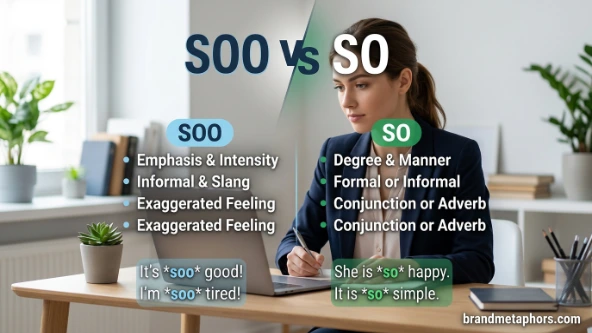
In this comprehensive guide, we will explore a highly debated topic in modern English usage: the nuance of soo vs so. While it might look like a simple typo or a casual text-message quirk, the choice between “so” and its elongated cousin “soo” brings up fascinating questions about modern writing skills, literary devices, poetic expression, and how human language evolves in the digital age.
1. Understanding the Core Difference: “so” vs “soo”
At its heart, the debate over soo vs so comes down to formal grammar versus emotional emphasis.
The Standard: “So”
In traditional English, “so” is a powerhouse word. It wears many hats: it can be an adverb meaning “to such a great extent” (“I am so tired”), a conjunction linking cause and effect (“It rained, so we stayed inside”), or an intensifier. It is grammatically correct, universally accepted, and essential for academic writing.
The Modern Twist: “Soo”
On the other hand, “soo” is a product of modern digital communication, visual text cues, and creative writing. It is not an officially recognized word in standard dictionaries, but it serves a vital purpose in informal communication. By adding an extra “o,” writers can replicate the cadence of spoken speech. It adds a layer of vocal inflection, showing extreme emphasis, excitement, or sarcasm that a single “so” sometimes fails to convey in a text message.
2. The Role of Intensive Words in Descriptive Language
To truly understand why we look for ways to stretch our words, we have to look at how we build descriptive language. Elements like simile examples and metaphor examples rely heavily on modifiers to set the scale of an emotion or image.
When you use an intensive modifier, you are adjusting the “volume” of your sentence. Look at how the volume changes in these examples:
- Low Volume: “The room was quiet.”
- Medium Volume: “The room was so quiet you could hear a pin drop.” (A classic simile example).
- High Volume (Spoken/Informal): “The room was soo quiet it felt eerie.”
In formal writing, we use literary devices and well-crafted vocabulary enhancement to turn up the volume. In informal writing, we often rely on visual spelling tricks like “soo” to achieve the same result.
3. Comparison Examples: Side-by-Side Analysis
To give you a clear picture of how these two words function in the real world, let’s examine some direct comparison examples. Notice how the meaning shifts from factual to highly expressive.
Context / ScenarioUsing Standard “So”Using Informal “Soo”Expressing Hunger“I am so hungry I could eat a horse.” (Idiom meaning: Very hungry)“I am soo hungry right now, please hurry!” (Urgent, whiny, or highly expressive)Reacting to a Movie“The ending was so sad.” (Factual, calm statement)“The ending was soo sad, I cried for an hour!” (Deeply emotional, dramatic)Giving Directions“Walk down the hall and turn left, so you don’t get lost.” (Logical conjunction)Not applicable. (Using “soo” here breaks the grammar entirely).Showing Sarcasm“Oh, that is so interesting.” (Can be polite or neutral)“Oh, that is soo interesting…” (Clearly indicates a sarcastic tone)
4. Sentence Examples: Master Both Forms in Context
The best way to develop strong writing skills is to see words used correctly in multiple sentence examples. Let’s look at how both words operate across different settings.
Correct Sentence Examples for “So” (Grammatical & Formal)
- “The mathematical formula was so complex that even the professor had to double-check the results.”
- “She trained diligently for the marathon, so she managed to finish in the top ten.”
- “Never have I ever seen a sunset so vibrant and breathtaking.”
Contextual Sentence Examples for “Soo” (Casual & Creative Writing)
- “I am soo over this cold weather; I need some sunshine immediately!”
- “That puppy is soo cute I just want to squeeze it!”
- “We waited in line for soo long, but the roller coaster was totally worth it.”
5. Literary Devices and Poetic Expression
Can a casual variation like “soo” ever find a home in poetic expression or creative writing? The answer is yes, but it depends entirely on your piece’s tone and medium.
Authors of contemporary fiction, graphic novels, and modern poetry frequently break traditional grammar rules to capture authentic human voices. If a character is a teenager texting their friend, using “so” might actually sound unnatural and robotic.
Creative Writing Tip: Use “soo” when you want to write exactly how people talk. It serves as an orthographic device—a spelling choice that conveys sound, speed, and emotion.
However, if you are writing a formal sonnet or a classical essay, you must stick to standard literary devices. Instead of stretching a word to “soo,” you can use powerful vocabulary enhancement to show scale:
- Instead of “soo big,” use gargantuan or immense.
- Instead of “soo beautiful,” use radiant or resplendent.
6. Tone Usage: Matching Your Audience

Understanding when to use soo vs so requires a solid grasp of tone. Your target audience should dictate your language choices every single time.
[Audience and Tone Alignment] ├── Formal (Essays, Resumes, Business Emails) ──> Always use “So” └── Informal (Texts, Fiction Dialogue, Social Media) ──> Use “Soo” for emphasis
1. The Professional and Academic Tone
In academic essays, business reports, and cover letters, consistency and precision are vital. You must use “so” solely as a logical connector or a measured adverb. Using “soo” in a university paper will signal to your grader that you lack professional writing skills.
2. The Casual and Relatable Tone
On social media, in text messages, or when writing a casual blog post, your goal is to build a quick connection. Here, “soo” acts as a friendly wink to the reader. It breaks down walls and makes the writer sound like a real person sitting across the room from you.
7. When to Use “So” and When to Use “Soo”
To keep your writing sharp, memorize this simple rule of thumb for when to deploy each word form.
Always Use “So”:
- In Cause-and-Effect Sentences: “The store was closed, so I went home.”
- In Formal Directives: “Please sit down so we can begin the meeting.”
- In Professional Correspondence: “Thank you so much for your time.”
You Can Use “Soo”:
- To Mimic Spoken Inflection: “I am soo ready for the weekend!”
- To Heighten Sarcasm: “Oh, soo brave of you to say that behind a screen.”
- In Dialogue for Creative Writing: “But Mom, everyone else is going, please say yes, soo please!”
8. When to Avoid “Soo”: Red Flags for Writers
While descriptive language encourages experimentation, using “soo” incorrectly can damage your credibility. Avoid using the elongated form in these critical situations:
- In Technical or Scientific Writing: Scientific papers require cold, objective data. Emotions do not belong there, meaning “soo” has no place there either.
- When “So” is Acting as a Conjunction: Never write, “The car broke down, soo we walked.” The word “soo” only works as an intensive adjective/adverb modifier, never as a structural connector.
- Excessively: Even in casual chats, typing “It was soo, soo, soo good” quickly becomes annoying to read. Use it sparingly for genuine moments of peak emphasis.
9. Figurative Language Deep Dive: Idioms, Similes, and Metaphors
Let’s bridge the gap between simple text modifiers and advanced writing skills by examining how intensifiers connect with figurative expressions.
Simile Examples
A simile compares two things using the words “like” or “as.”
- Standard: “He is so sly, he is like a fox.”
- Casual: “He is soo sneaky, literally like a fox.”
Metaphor Examples
A metaphor states that one thing is another thing to make a striking comparison.
- Standard: “The classroom was so chaotic; it was a zoo.”
- Analysis: Here, “so” measures the degree of chaos before the metaphor delivers the mental picture.
Idiom Meaning
An idiom is a phrase where the collective meaning is completely different from the literal words. For example, consider the idiom “to cost an arm and a leg” (meaning something is incredibly expensive).
- Application: “That new smartphone is so expensive, it costs an arm and a leg!”
- Casual Twist: “That concert ticket was soo overpriced, it cost an arm and a leg!”
10. Common Mistakes and How to Fix Them
Let’s look at the most frequent errors English learners and writers make with these words, along with straightforward fixes to polish your vocabulary.
Mistake 1: The Formal Slippage
- Incorrect: “The study concludes that the asset is soo volatile that investors should avoid it.”
- The Fix: Change to “so,” or better yet, upgrade the vocabulary: “The study concludes that the asset is highly volatile…”
Mistake 2: Missing the Mark on Conjunctions
- Incorrect: “I lost my keys, soo I arrived late to class.”
- The Fix: “I lost my keys, so I arrived late to class.”
Mistake 3: Over-reliance on Intensifiers
- Incorrect: “The cake was so good, and the icing was so sweet, and the party was so fun.”
- The Fix: “The cake was delicious, the icing incredibly sweet, and the party absolutely unforgettable.”
11. Interactive Exercises: Test Your Writing Skills

Put your knowledge to the test! Choose the correct word (so or soo) for each sentence based on the context provided. (Answers can be found at the very end of this section).
- (Context: An email to your university professor) “Dear Dr. Smith, thank you _____ much for extending my assignment deadline.”
- (Context: A text message to your best friend about a long day) “I am _____ incredibly tired, I literally cannot move my legs.”
- (Context: A fantasy novel dialogue where a young child is begging) “Please don’t go into the dark forest, it looks _____ scary!”
- (Context: A business presentation slide) “Our Q3 profits rose by 15%, _____ we are expanding our marketing budget.”
Answers: 1. so | 2. soo (or so) | 3. soo | 4. so
12. Quick Comparison Reference Table
For a quick summary you can look back on whenever you are writing, check out this reference tool:
AspectThe Word “So”The Word “Soo”Dictionary StatusOfficial, standard English word.Informal slang / Phonetic spelling.Primary FunctionConjunction, adverb, pronoun.Emphaticintensifier.BestUsed InEssays, emails, books, formal speech.Texts, casual social posts, raw dialogue.Visual EffectClean, neat, professional.Dramatic, loud, expressive.Grammar FlexibilityHighly flexible across multiple rules.Only replaces the intensive adverb “so.”
13. Frequently Asked Questions (FAQs)
1. Is “soo” grammatically correct?
No, “soo” is not recognized as a grammatically correct word in standard English dictionaries. It is an informal variation used entirely for stylistic and emotional emphasis in casual communication.
2. Can I use “soo” in creative writing?
Yes! Creative writing gives you the freedom to use informal language. It works wonderfully in fiction dialogue, poetry, or first-person stories to show a character’s true voice and personality.
3. How does “soo” change the meaning of a sentence compared to “so”?
It doesn’t change the literal meaning, but it heavily changes the tone. “So” states an intensity factually, while “soo” injects strong personal emotion, drama, or sarcasm into the statement.
4. What are some formal alternatives to using “so” or “soo” too much?
To enhance your vocabulary, replace repetitive intensifiers with strong adjectives or adverbs like extremely, immensely, profoundly, exceptionally, remarkably, or exceedingly.
5. Does using “soo” help or hurt search engine optimization (SEO)?
It depends on user search intent! If people are searching for casual terms or looking up the difference between soo vs so, using both naturally helps search engines understand the topic through Natural Language Processing (NLP). However, for professional topics, stick to standard spelling.
Conclusion
At the end of the day, language is a living, breathing tool designed to help us connect with one another. Standard rules give us the structure we need to share complex ideas clearly, while creative adaptations allow us to express our unique feelings and personalities.
When choosing between soo vs so, simply look at your setting. If you are writing a school paper or a professional email, respect the classic rules of grammar and stick to “so.” But if you are chatting with friends or writing a fun story, feel free to stretch your words and let your voice shine through. By understanding these subtle differences, you will build sharper writing skills and a deeper love for the English language!